Saturn’s rings and moon Titan formed through ancient moon collisions
A new model links Saturn’s rings and Titan to ancient moon collisions, revealing a surprisingly violent recent history.

 Edited By: Joshua Shavit

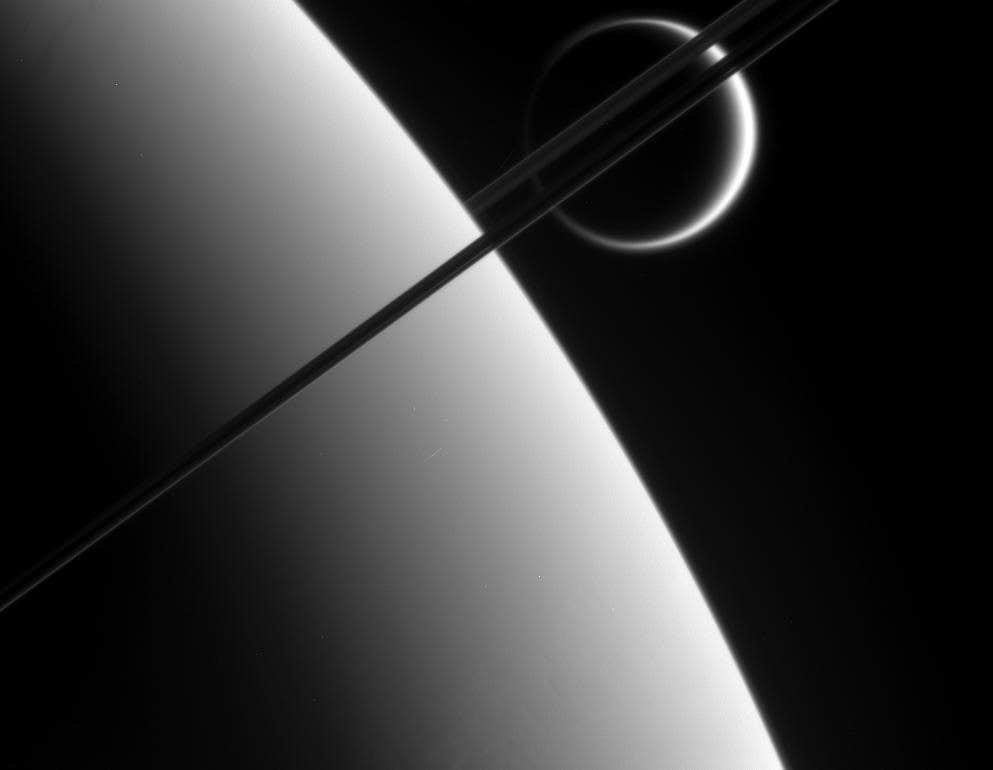
This view was taken from above the ringplane and looks toward the unlit side of the rings. Here, the probe gazes upon Titan in the distance beyond Saturn and its dark and graceful rings. (CREDIT: NASA/JPL/Space Science Institute)
At a glance, Saturn's rings appear calm and pristine when observed from afar. These rings are quite narrow and consist mainly of water ice particles that uniformly circle Saturn in a symmetric configuration. However, a recent study indicates that the current state of Saturn's rings results from repeated cataclysmic events that have occurred over time.
According to Matija Ćuk and his colleagues at the SETI Institute, the origin of Saturn's largest moon, Titan, may also provide insight into Saturn's rings. This connection is made by combining evidence from two different contexts, both of which are due to the collision of moons.
To illustrate, Titan is thought to have formed from coalescing several smaller moons, while the gravitational chaos created from Titan's migration from Saturn may have resulted in the formation of Saturn's rings due to subsequent moon collisions.
For some time, researchers have struggled to provide satisfactory explanations for several unresolved questions involving the bizarre characteristics of Titan (i.e., the unusual orbit), the oddities of Hyperion, and the remarkably recent age of Saturn's rings.
Hyperion as a Clue to Saturn’s History
The "tumbling" moon Hyperion, in all likelihood, provides a clue to the genesis of the Saturnian system. Hyperion's unique form (irregular, porous, and tumbling) differs from the normal shape exhibited by most moons.
At the same time, Hyperion has been found to exhibit a precise 4:3 orbital resonance relationship with Titan, which indicates that Titan and Hyperion share a stable ratio of durations for their respective orbits.
Recent simulations convincingly demonstrate that Hyperion's current orbital pattern developed only approximately 400 to 500 million years ago, well after the inception of the Solar System. Hyperion's eccentric elliptical orbit has grown progressively larger as Titan's orbital distance from Saturn has increased throughout time owing to the continuous influence of tidal forces. Calculations demonstrate that Titan's orbit must have expanded by just a few percent in order for Titan's conditions to be what they are today, which could account for the relative "young" age of Titan.
"Hyperion was, by far, the best indication of the history of Saturn's moons," said Ćuk.
An important question remains as to how Hyperion, the smallest of Saturn's moons, came into being and whether something happened to create Hyperion's features. The research team believes that one potential reason why Hyperion is relatively young is because of the loss of another moon that was orbiting between Titan and Iapetus.
Surviving Evidence of the Proposed Collision with Titan
The researchers believe that the missing moon (which they have named Proto-Hyperion) collided with Titan approximately 400 million years ago. Computer modeling of the Saturnian system suggests that this type of collision was one of the most probable outcomes of the protomoon's dynamic instability.
Of the total number of 60 models simulating the Saturn system, Proto-Hyperion collided with Titan in 42 of them.
Moreover, the collision would have created Titan in a radically different way than it exists today. Titan may have appeared like the cratered moon of Jupiter known as Callisto, with no substantial atmosphere, prior to the impact.
However, the modification of Titan's shape created by a large-scale merger would have obliterated impact craters, altered the moon's structure, and helped to clarify why Titan possesses a highly eccentric present-day orbit that is still migrating toward more circular orbits.
Additionally, the moon Hyperion's low density and high porosity characteristics support this idea of forming through fragments of the impact. This indicates that Hyperion is probably a conglomerate mass rather than a solid mass (i.e., an aggregate of smaller masses that had not been built back into a single solid body).
It is likely that Titan was formed from a merger with an object, but the timing of that merger is less clear. Research indicates that Titan was formed from a merger with a larger body that would have left behind the material necessary to create Saturn's rings.
From Moon Collisions to Ring Formation
The research supports the idea that Titan's formation directly impacted the formation of the rings, although they were created after Titan formed. Titan was initially in a highly eccentric orbit. As Titan moved away from Saturn, its gravitational field could have created resonances with the inner moons, causing them to become unstable.
When two moons have similar orbital periods, over time, their gravitational interactions can produce ever-increasing gravitational "nudges," leading to the stretching of the moons' orbits until eventually a collision occurs.
Through computer simulations, it is possible to see that two moons similar to Dione and Rhea would, over time, collide. These types of collisions create an enormous amount of debris. Some of the debris would be attracted to Saturn and create a ring system, and some of the debris would eventually recombine and form new moons.
The results of the Cassini-Huygens mission during its final operational phase confirm the belief that the ring system is relatively young (less than several hundred million years old). Based on the rates of micrometeorite dust accumulation, it can be concluded that the actual age of the ring system is most likely in the range of 100–200 million years.
The timing of the events is consistent with the idea that Titan was formed from a merger approximately 400 million years ago, and that the collision and formation of the inner moons occurred within the next tens to hundreds of millions of years.
Saturn’s Spin History Continues to Evolve
In addition to providing insight into the evolution of Saturn's moons, the authors offer an update on Saturn's axial tilt. For many years, many scientists believed that Saturn's wobble matched the motion of Neptune's orbit. Cassini data suggests that it did at one time, but that it is no longer in sync, and something has likely happened to cause the loss of this relationship. It is likely that the merger or loss of a moon has created enough symmetry changes to cause a change in the rate of precession of Saturn's tilt.
The continued orbital evolution of Saturn's moons reinforces the idea that the moons are still evolving. Approximately 50 million years ago, Titan and Iapetus likely passed through a 5:1 orbital resonance with each other. Computer simulations indicate that this resonance would likely have resulted in additional modifications to Iapetus's orbit, which may have put it at risk of being released from Saturn's gravitational influence.
Many computer simulations indicate that Iapetus is in significant danger of being ejected from Saturn's gravitational influence.
Testing the Titan Surface Theory
While it may prove difficult to establish the precise timing and conditions that led to the development of Titan's surface several hundred million years ago, NASA's Dragonfly mission could help.
NASA has plans to use its rotorcraft to take detailed measurements of Titan's surface and analyze its surface chemistry. Indications of active resurfacing and/or unusual internal structures may lend support to the idea that Titan has undergone substantial impacts.
The authors of this study do admit there are several uncertainties regarding their model of tidal evolution and models for the expected nature and extent of debris that may form Hyperion or Saturn's ring system. However, a large number of scientists support the current estimates for how old Saturn's rings are, and what they will find will support the idea that Saturn has been a planet in violent flux for several hundred million years, rather than being a planet that has been a stable and static arrangement for many, many years.
Thus, one of the most beautiful features in the Solar System may have been produced through destruction.
Research findings are available online in the journal arXiv.
The original story "Saturn’s rings and moon Titan formed through ancient moon collisions" is published in The Brighter Side of News.
Related Stories
- Titan’s interior is slushy ice, not a hidden ocean, Cassini data finds
- Scientists design orbiting satellite networks for detailed exploration of Titan
- Titan’s icy surface hides a chemical mystery that could explain how life began
Like these kind of feel good stories? Get The Brighter Side of News' newsletter.
Joseph Shavit
Writer, Editor-At-Large and Publisher
Joseph Shavit, based in Los Angeles, is a seasoned science journalist, editor and co-founder of The Brighter Side of News, where he transforms complex discoveries into clear, engaging stories for general readers. With vast experience at major media groups like Times Mirror and Tribune, he writes with both authority and curiosity. His writing focuses on space science, planetary science, quantum mechanics, geology. Known for linking breakthroughs to real-world markets, he highlights how research transitions into products and industries that shape daily life.