Scientists achieve first-ever quantum teleportation between separate semiconductor chips
Scientists in Germany teleport quantum data between light particles, a key step toward building a secure global quantum internet.

 Edited By: Joseph Shavit

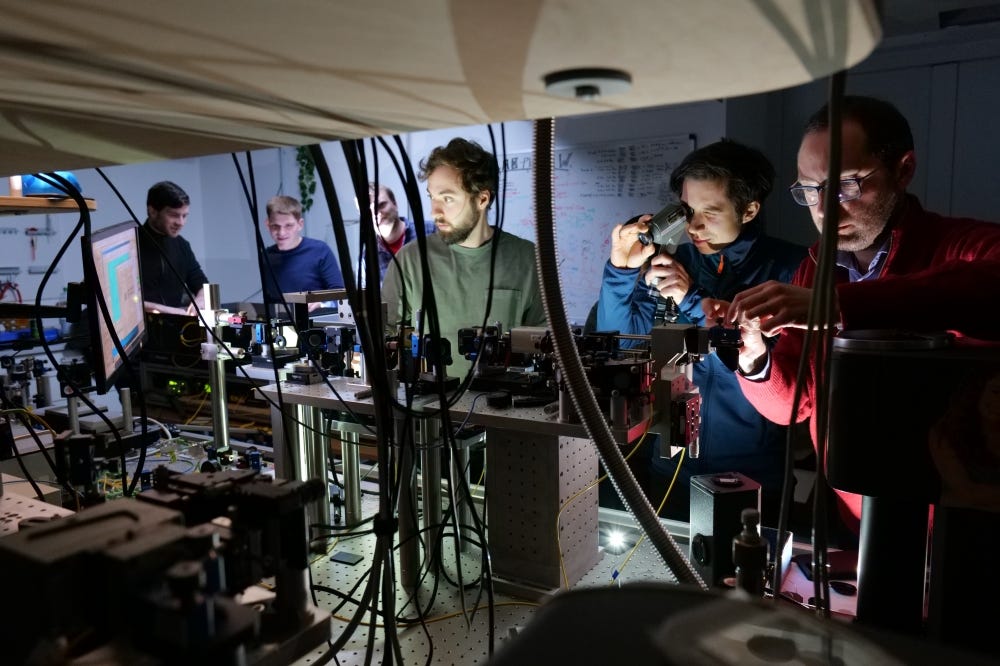
Physicists from research groups at the University of Stuttgart, Saarbrücken, and Dresden conducting an experiment on quantum teleportation (from left to right: Tobias Bauer, Marlon Schäfer, Caspar Hopfmann, Stefan Kazmaier, Tim Strobel, and Simone Luca Portalupi). (CREDIT: Julian Maisch)
A quiet shift is taking place in physics labs that could one day reshape how you send a message, store data, or protect secrets. Researchers at the University of Stuttgart have taken a major step toward building a quantum internet, a network that would link future quantum computers and sensors through light, not wires, and protect data in ways today’s systems cannot match.
The team showed, for the first time, that quantum information can be teleported between photons made by two separate semiconductor quantum dots. In simple terms, this means the state of one particle of light can be transferred to another, even when the two never touch. This is not science fiction. It is one of the building blocks for quantum networks.
“For the first time worldwide, we have succeeded in transferring quantum information among photons originating from two different quantum dots,” said Prof. Peter Michler, head of the Institute for Semiconductor Optics and Functional Interfaces and deputy spokesperson for Quantenrepeater.Net.
Quantum dots are tiny islands of semiconductor material that behave like artificial atoms. They can release single particles of light on demand and store quantum information for short times. That makes them promising tools for a future communication system that relies on the rules of quantum physics rather than standard electronics.
Turning light into a carrier of secrets
Every photo, text, or video today travels as chains of zeros and ones. In a quantum network, information is instead carried by single photons. Data can be stored in their polarization, the direction in which their light waves point. Because of the laws of quantum mechanics, anyone trying to spy on such a signal would leave a trace. In theory, secure communication would become almost foolproof.
There is a practical obstacle. Ordinary internet signals can be boosted every few dozen miles by amplifiers. Quantum data cannot. You cannot copy or strengthen it without changing it. Once a delicate quantum signal fades, it is lost.
Physicists hope to solve that with quantum repeaters. These devices would sit along fiber lines and refresh information by teleporting it from one photon to the next. To work, each repeater must make photons from different sources behave as if they were twins.
“That has never been done before with quantum dots because it is so hard,” said Tim Strobel, first author of the study and a researcher at the Institute for Semiconductor Optics and Functional Interfaces.
Making distant photons speak the same language
The breakthrough came from persuading light made in two different places to act alike. One quantum dot produced a single photon. A second dot created a linked pair of photons, known as entangled. When the single photon met one from the pair, its quantum state jumped to the partner photon, which could be meters away.
To succeed, the photons had to be nearly identical in color, timing, and shape. That took years of work in chip design and materials science. Partners at the Leibniz Institute for Solid State and Materials Research in Dresden built dots that differed so slightly they were almost carbon copies.
Even then, there was another hurdle. Quantum dots naturally emit light that is not ideal for long fiber links. Modern networks work best at much longer wavelengths.
The solution came from quantum frequency converters, devices that shift the color of a photon without damaging its quantum properties. Two converters created by a group led by Prof. Christoph Becher at Saarland University transformed the light from both dots into the range used by today’s telecom cables.
Once converted, the photons behaved as if they were born to travel the internet.
Proving teleportation really worked
A bold claim needs hard proof. In this case, the team measured how closely the teleported photon matched the original. This check is called fidelity.
Classical tricks can mimic teleportation up to a point. The best they can do is a score of two thirds. Real quantum teleportation must do better.
The researchers reached an average fidelity of about 0.72. That may sound modest, but in this field it is the difference between imitation and reality. The result placed the experiment clearly on the quantum side.
They tested several types of light states, from straight and diagonal orientations to circular ones. In each case, the teleported photon carried the right signature more than 70 percent of the time. When the team filtered out stray signals and focused on the cleanest events, the results improved further.
“These results reflect years of scientific dedication and progress,” said Dr. Simone Luca Portalupi, one of the study coordinators. “It’s exciting to see how experiments focused on fundamental research are taking their first steps toward practical applications.”
From lab bench to real networks
During the experiment, the dots were linked by about 10 meters of fiber. That distance is small but the principle scales up. At telecom wavelengths, modern cables lose little light even over many miles.
The same group has already shown that entangled photons from similar sources can survive a 36 kilometer trip across Stuttgart without losing their connection. That hints at what may be possible when these systems move outside the lab.
One challenge remains. Light in long fibers slowly twists its direction of polarization. The researchers say active correction systems could solve this, keeping quantum data steady over greater spans.
Another goal is speed. Right now, successful teleportation events are rare. Improvements in chip making and cleaner light conversion could boost the rate and reliability.
Practical Implications of the Research
A quantum internet could transform how sensitive information is sent. Banking data, medical records, and government communications could become immune to hacking.
Scientists could also link distant quantum computers, allowing machines in different cities to act as one powerful system. That could speed research in materials science, drug discovery, and climate modeling.
Quantum networks may support new types of sensors for navigation, geology, and medicine, with accuracy beyond today’s tools. While practical systems are still years away, this experiment shows the pieces can work together.
The age of quantum communication is no longer just a theory on paper. It is starting to take shape in glass fibers and tiny chips.
Research findings are available online in the journal Nature Communications.
Related Stories
- Ground-based satellite uplink revolutionizes quantum communication
- Oxford physicists achieve teleportation between two quantum supercomputers
- Researcher breakthrough creates extended quantum entanglement between molecules
Like these kind of feel good stories? Get The Brighter Side of News' newsletter.
Shy Cohen
Writer