Scientists are close to proving that primordial black holes exist
A sub-solar LIGO signal may be the strongest hint yet that primordial black holes help make up dark matter.

 Edited By: Joshua Shavit

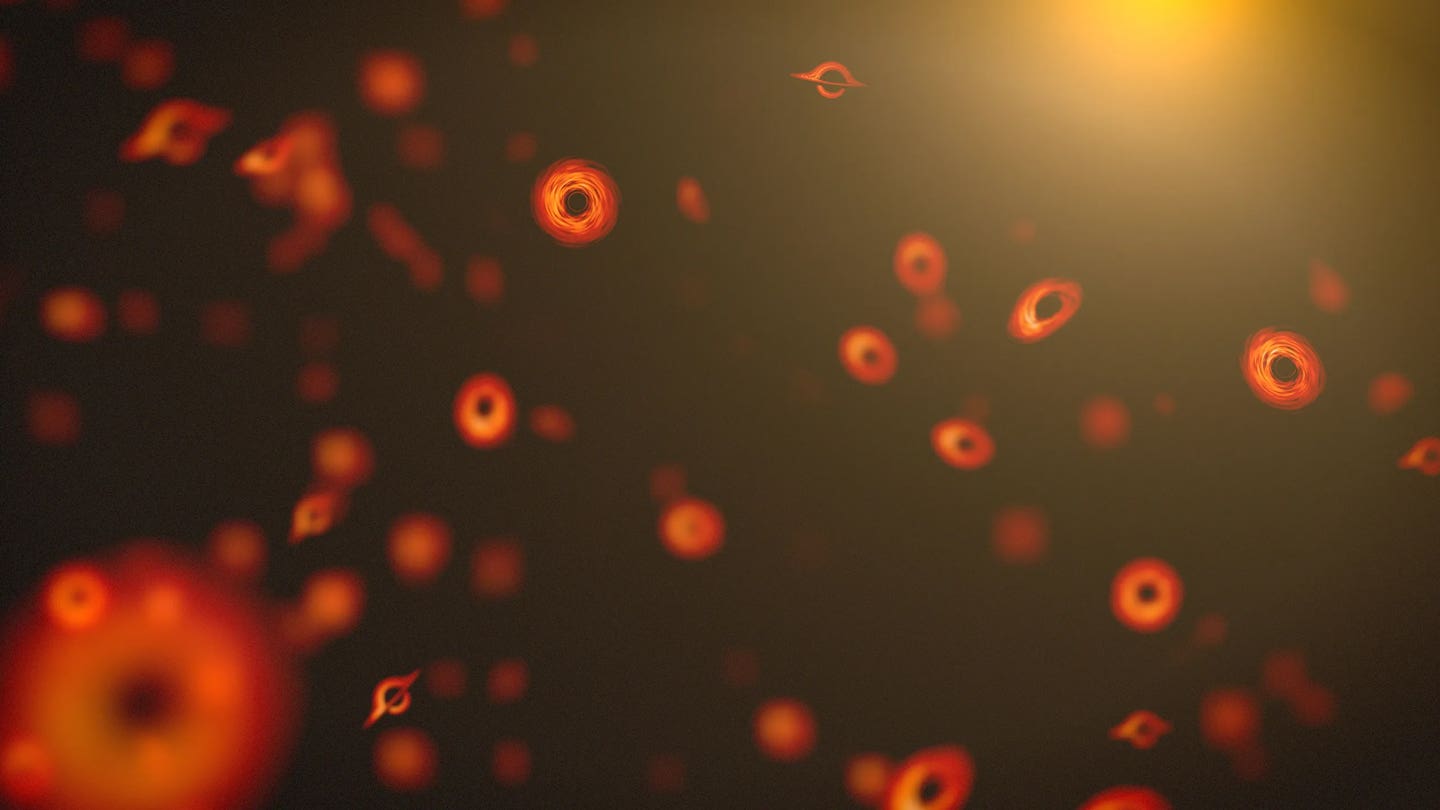
A strange LIGO signal may point to a primordial black hole and a new clue in the search for dark matter. (CREDIT: NASA)
On November 12, 2025, three gravitational-wave detectors on two continents caught a ripple in spacetime. This event did not fit neatly into the usual story of how black holes form.
The signal, labeled S251112cm, appears to have come from a merger involving at least one object lighter than the sun. That is the part that stands out. Black holes formed from collapsing stars are not expected to be that small. If the signal holds up, it may point to something far stranger. For example, it could indicate a black hole born in the early universe itself.
That possibility sits at the center of a new study from the University of Miami. Physicist Nico Cappelluti and doctoral student Alberto Magaraggia argue that the event matches what researchers would expect from a primordial black hole. Such an object may have formed in the dense chaos shortly after the Big Bang. In addition, it could help explain dark matter.
“Our research indicates that these primordial black holes could account for a significant portion, if not all, of dark matter,” Cappelluti said.
Not the kind stars make
Primordial black holes have been discussed for decades. The idea traces back to Yakov Zeldovich and Igor Novikov, and was later developed further by Stephen Hawking and others in the early 1970s. Unlike ordinary black holes, which form when massive stars die, these would have emerged directly from dense pockets of the young universe.
The Miami team focuses on a period known as the QCD epoch, when quarks combined into protons and neutrons. During that phase, the equation of state of the universe may have briefly softened. This change made it easier for especially dense regions to collapse into black holes. In their framework, that process could produce objects across a huge span of masses. For example, masses could range from asteroid-like bodies to supermassive black holes.
That wide mass range matters because dark matter remains one of cosmology’s biggest unsolved problems. It makes up about 85 percent of all matter, yet it has never been directly detected. Primordial black holes have long been considered one possible answer.
The November signal gave the idea new urgency.
S251112cm was reported by the LIGO-Virgo-KAGRA collaboration with a false alarm rate first estimated at about one in six years. This rate was later refined to about one in four years. Its source distance was estimated at 93 ± 27 megaparsecs. The event was picked up by the LIGO Hanford, LIGO Livingston, and Virgo detectors.
The chirp mass, a key quantity inferred from the gravitational-wave signal, was placed mostly between 0.1 and 0.87 times the sun’s mass. The probability that the lighter object was sub-solar exceeded 99 percent.
Rare enough to fit
Instead of treating the scarcity of such events as a problem, the researchers asked whether rarity was exactly what the theory predicts.
“We attempted to estimate how many primordial black holes may exist in the universe and how many of them LIGO should be able to detect,” Magaraggia said. “Our results are encouraging. We predict that subsolar black holes like the one LIGO may have observed should indeed be rare, consistent with how infrequently such events have been seen so far.”
Using an extended primordial black hole mass function, including effects tied to lepton-flavor asymmetries in the early universe, the team calculated how often a detector with LIGO-like sensitivity should catch a merger in the same mass window as S251112cm. Their estimate came out to 0.8 detectable events per year.
That predicted rate falls within the statistical bounds implied by one detection over the roughly 4.35 effective years considered in the study. Based on standard Poisson limits for a single event, the inferred true rate spans from 0.012 to 1.09 events per year at 95 percent confidence. In other words, their model lands in the allowed range.
The study also turns the logic around. Because the merger rate in their late-universe capture model scales with the square of the primordial black hole abundance, the authors use the observed event rate to place a lower bound on how much dark matter these objects could make up. Their conservative estimate puts that floor at fPBH > 0.04.
That does not prove primordial black holes are all of dark matter. It does suggest they could make up a meaningful fraction.
Why the case is still open
The paper is careful not to overclaim.
For one thing, the final offline analysis of S251112cm had not been released publicly when the study was published. The alert could still be revised or even withdrawn. The reported chirp-mass interval also came from a dedicated sub-solar search pipeline, so the exact parameter estimates may shift.
Then there are astrophysical uncertainties in the model itself. The merger calculation depends strongly on local dark matter density and relative velocities inside halos. The authors adopted standard values for a Milky Way-like halo, but they note that the true cosmic average could differ. Their late-universe capture scenario is also not a precision prediction. Recent simulations have produced sharply different merger-rate outcomes depending on environmental assumptions.
They say so plainly.
Their rate estimate should be treated as an illustrative calculation within a commonly used framework, not as a hard constraint.
Alternative explanations remain on the table too. The study notes that unusual stellar pathways, including stripped-envelope supernova processes, might produce sub-solar neutron stars. The probability that S251112cm involved a neutron star is estimated below 8 percent, but not zero.
That question matters because neutron star mergers are expected to produce electromagnetic light, including kilonova emission. Teams searched extensively for such a counterpart across optical and high-energy wavelengths. None was found. Candidate transients were either identified as supernovae or did not match the event’s distance constraints.
“LIGO picked up what is very strong evidence that these types of black holes exist. But we'll need to detect another such signal or even several others to get the smoking-gun confirmation that they are real,” Cappelluti said. “What is clear is that they cannot be excluded as being real.”
One event is intriguing. It is not enough.
Waiting for the next signal
The next step depends less on theory than on hardware.
LIGO is expected to undergo upgrades that could improve its sensitivity to rare events. Farther ahead, the European Space Agency’s Laser Interferometer Space Antenna, planned for launch in 2035, is designed to detect gravitational waves from much earlier cosmic epochs. A proposed U.S. facility, Cosmic Explorer, would be about ten times more sensitive than LIGO.
If primordial black holes exist in the numbers suggested here, future detectors should see more sub-solar mergers.
That is the real test.
Research findings are available online in the Astrophysical Journal.
The original story "Scientists are close to proving that primordial black holes exist" is published in The Brighter Side of News.
Related Stories
- Evidence of primordial black holes could be hiding inside Earth rocks
- Computer models reveal how early black holes grew so quickly after the Big Bang
- Record-breaking neutrino points to exploding primordial black hole
Like these kind of feel good stories? Get The Brighter Side of News' newsletter.
Joseph Shavit
Writer, Editor-At-Large and Publisher
Joseph Shavit, based in Los Angeles, is a seasoned science journalist, editor and co-founder of The Brighter Side of News, where he transforms complex discoveries into clear, engaging stories for general readers. With vast experience at major media groups like Times Mirror and Tribune, he writes with both authority and curiosity. His writing focuses on space science, planetary science, quantum mechanics, geology. Known for linking breakthroughs to real-world markets, he highlights how research transitions into products and industries that shape daily life.