Scientists build the world’s first large-scale quantum sensor network to search for dark matter
A new quantum sensor network spanning two Chinese cities sets the strongest laboratory limits yet on axion dark matter.

 Edited By: Joseph Shavit

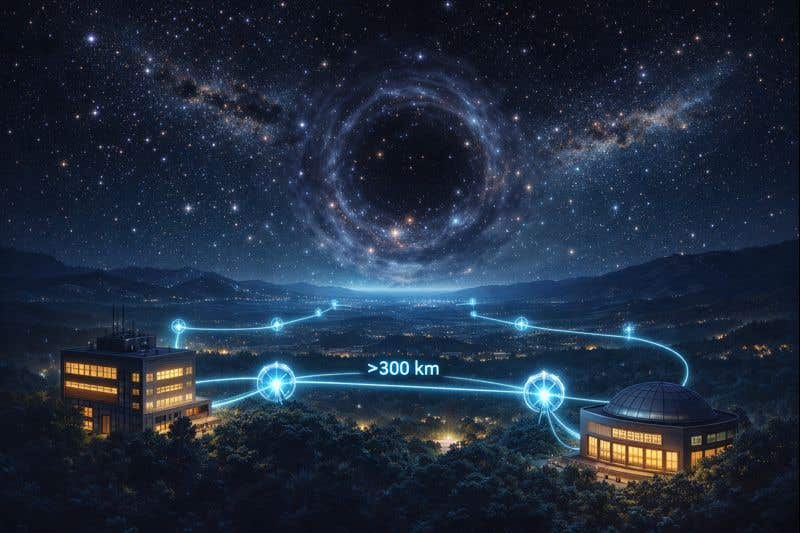
Chinese scientists built the first quantum sensor network to hunt axion dark matter, setting record laboratory limits. (CREDIT: AI-generated image / The Brighter Side of News)
Researchers from China recently announced the creation of the largest quantum network in history to directly investigate the existence of dark matter. The project connects research centers located more than 300 kilometers (186 miles) apart.
The work, coordinated by scientists from the University of Science and Technology of China, involves various precision measurement devices located in Hefei and Hangzhou. Researchers are targeting a theorised particle, called an axion, believed by many to constitute a significant fraction of the dark matter present in our universe.
According to the study published in the journal Nature, dark matter accounts for approximately 26.8 per cent of the total mass and energy content of the known universe, but remains undetected by any means other than its gravitational effects on visible matter.
Background And Scientific Motivation
The researchers involved in the project include physicists with expertise in quantum sensing and nuclear-spin measurements. The objective of this collaboration was to detect extremely faint, transient signals, detectable only with very sensitive equipment, at times when Earth travels through very high densities of axion dark matter.
“The signals that we expect to measure would be incredibly faint,” the authors of the article wrote, drawing an analogy between the potential signal and “a snowflake falling onto a crowded street.”
Previous dark matter search efforts have focused primarily on weakly interacting massive particles (WIMPs). These efforts have yielded null results over time, leading to increased interest in alternative dark-matter candidates, such as axions or axion-like particles.
Axions And Topological Defects
Axions are an attractive choice for dark matter searches due to the fact that they arise naturally in several formulations of the Standard Model of particle physics. A large number of theoretical models predict that, as a result of the Peccei-Quinn symmetry breaking, axions will form after the early universe. Detecting properties of axions is difficult due to the wide range of possible properties predicted.
The team in China focused on one possibility. Instead of thinking of dark matter as a collection of axions moving throughout space, the researchers suggest that dark matter might actually form small compact structures called “topological defects.” In this scenario, the defects take the shape of thin domain walls where the axion field is very sharply concentrated.
If an observer on Earth were to pass through one of the walls, it would create a brief interaction between the axion field and the spins of the observer’s atomic nuclei. This interaction could give rise to a very small, instantaneous rotation of the atomic nuclei.
How Will Axions Passing Through The Earth Leave Traces?
The nature of the trace that would be produced would depend on the mass of the axion. The mass of the axion would determine how thick the domain wall was and therefore how long Earth would take to cross through it.
Because of this relationship, the time for Earth to cross through the domain wall would be very short for heavier axions, on the order of fractions of a second. For lighter axions, it could take much longer, potentially many minutes.
As Earth passes through the domain wall, the axion field would produce a very weak and temporary magnetic field that couples to nuclear spins. In this respect, the interaction with the axion is similar to the interaction of atomic nuclei with magnetic fields in the Zeeman effect. However, in the case of the axion field, the couplings are on a much smaller scale.
Experimental Motivation And Constraints
By studying astrophysical observations of stellar cooling, neutron stars, and the neutrino burst produced by the supernova SN 1987A, researchers have already constrained the upper limit of the interaction strength of axions with ordinary matter. However, those measurements require the use of complicated models and rare cosmic events.
Therefore, testing in a laboratory remains an important complement to these processes.
In order to conduct experiments and gather data from these very brief signals, it was necessary to use more than one instrument.
The Quantum Sensor Network
The team developed a network of quantum sensors. Five of these sensors were created to work together and were based on the xenon-129 nuclei.
At the time of testing, there were four sensors in Hefei and one more sensor located approximately 320 kilometres away in Hangzhou. GPS signals allowed all five sensors to operate at the same time. As a result, all five sensors shared the same time reference.
If a genuine dark matter event were detected in the Hefei sensors, they would detect it within a very short period of time from each other. However, there would be a time delay between the detection of dark matter at the Hefei sensors and Hangzhou that would correspond to the distance and speed of the axion wall.
Sensor Design And Signal Amplification
The sensors also use a combination of two different types of atoms, xenon-129 and rubidium. The rubidium is initially polarized. As the axion passes, if it rotates the spins of the xenon, the motion of the spins would create a very weak oscillating signal that the rubidium would detect and amplify.
Noble gas nuclei, such as xenon, provide two major benefits. First, the magnetic moment of these atoms is very weak, so they are less sensitive to unwanted stray magnetic fields. Second, these atoms have very long coherence times, meaning that any signals they receive will remain for many seconds.
The researchers measured a signal amplification factor of approximately 150. They developed an optimal filter patterned after gravitational wave search methods to apply to their system. These filters reduced the noise while preserving the expected shape of the signal.
Sensitivity And Calibration
With both amplification and filtering in place, the overall sensitivity reached the level of micro-radians of rotation. From experimental calibration, the team showed that their detectors were capable of measuring small amounts of spin rotation at approximately two millionths of a radian.
The team determined their experimental setup by creating very short pulses of magnetic fields, simulating the effects of an axion wall passing through the detector. The noble-gas–alkali-metal system outperformed all alkali-metal-only detectors. This was primarily due to the much longer coherence periods.
“With our distributed network, we were able to reduce the number of false alarms,” the researchers wrote. By requiring a match between multiple locations, the number of spurious events was reduced by about 1,000 compared to using a single detector.
Data Collection And Analysis
So far, the team has accumulated months’ worth of data and has not encountered a signal.
From July 20 to August 31, 2022, the network collected 739 hours of usable data. Calibrating each of the sensors with hourly calibration pulses provided a method to determine how the sensitivity of the sensors changed over time.
The analysis of this data searched for three-dimensional domain wall crossings. Background noise was created from a simulated data set equivalent to ten years of observations by shuffling the real data in time.
The loudest noise event determined the threshold for detection. None of the candidates exceeded this threshold. Therefore, the result is considered a clean null detection.
The Significance Of The Null Detection
The absence of an axion signal is significant because it provides a limit on how axions can couple to neutrons. The coupling to neutrons is the dominant component of the nuclear spin of xenon-129.
In deriving these limits, the researchers considered that axion defects formed the local density of dark matter. They calculated how many times Earth would cross a domain wall. By combining this calculation with the sensitivity of the network, the researchers ruled out a large section of the axion parameter space.
The strongest laboratory limits in the literature to date come from this study. These limits span a wide range of masses from 10 pico-electron volts to 0.2 micro-electron volts. For portions of this mass range, the new constraints exceed existing astrophysical limits by a factor of up to 40.
For the first time, the researchers produced direct laboratory limits on axion masses greater than 100 pico-electron volts. Previously, this region was explored primarily through astronomical observations.
What This Research Means Practically
This research represents a critical step toward detecting dark matter using instruments located on Earth rather than relying on rare cosmic events. The quantum sensor network demonstrated that unpredictable transient signals can be searched for with high precision and systematic control.
Future development of the quantum network may connect additional laboratories around the world or incorporate space-based sensors. This expansion would improve detection directionality and further reduce false alarms.
The researchers also presented the first documented pathway for increasing laboratory sensitivity using helium-3 nuclei and potassium magnetometers. This combination has the potential to improve laboratory sensitivity by several orders of magnitude compared to present-day methods, opening new frontiers for axion searches.
The experiment also has implications for future research on the structure of the universe. It shows how quantum technology can now be used to investigate forms of matter that were previously considered impossible to study using existing experimental techniques.
Research findings are available online in the journal Nature.
Related Stories
- Astronomers produce the sharpest map of dark matter in the Universe
- Scientists reveal how dark matter formed in the early universe and why its still here
- Silicon vibrations add a new twist to dark matter research and quantum computing
Like these kind of feel good stories? Get The Brighter Side of News' newsletter.
Joshua Shavit
Writer and Editor
Joshua Shavit is a NorCal-based science and technology writer with a passion for exploring the breakthroughs shaping the future. As a co-founder of The Brighter Side of News, he focuses on positive and transformative advancements in technology, physics, engineering, robotics, and astronomy. Joshua's work highlights the innovators behind the ideas, bringing readers closer to the people driving progress.