Scientists finally explain how lightning forms inside storm clouds
New research explains how electric fields and electrons trigger lightning and gamma rays inside thunderclouds.

 Edited By: Joseph Shavit

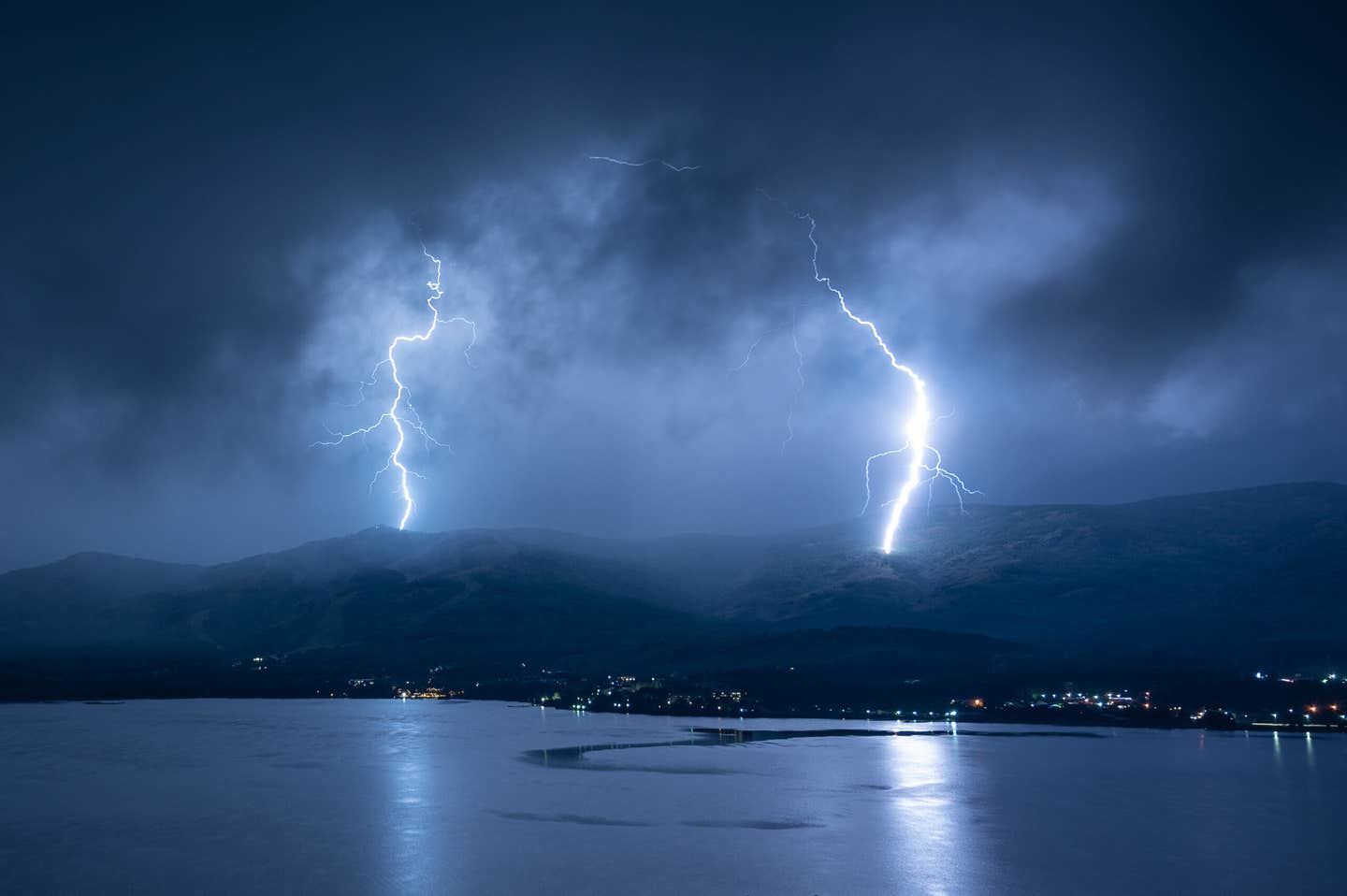
A Penn State-led study reveals the hidden chain reaction that starts lightning, linking electrons, X-rays, and gamma rays. (CREDIT: Shutterstock)
For as long as people have watched storms roll across the sky, lightning has inspired awe and fear. You can see the flash and hear the thunder, but the true beginning of a lightning bolt has remained hidden deep inside clouds. Scientists have known for decades how lightning travels once it forms, but the exact trigger inside a thundercloud stayed uncertain. A new study now offers the clearest explanation yet for how lightning truly begins.
The research was led by Victor Pasko, a professor of electrical engineering in the Penn State School of Electrical Engineering and Computer Science. His team combined advanced mathematical modeling with real-world observations to explain a powerful chain reaction inside storm clouds. This reaction links strong electric fields, high-energy electrons, X-rays, and gamma rays into a single process that starts lightning.
“Our findings provide the first precise, quantitative explanation for how lightning initiates in nature,” Pasko said. “It connects the dots between X-rays, electric fields and the physics of electron avalanches.”
This work does more than solve a scientific puzzle. It reshapes how scientists understand storms and the intense energy hidden within them.
The Role of Electric Fields Inside Thunderclouds
Inside a thundercloud, electric charge builds up as ice particles, water droplets, and air move violently. These motions create powerful electric fields, far stronger than anything found near the ground. For years, researchers questioned how these fields could become intense enough to create lightning without breaking down the air too early.
The new study shows that once the electric field reaches a critical strength, it begins to accelerate tiny particles called electrons. Some of these electrons already exist in the atmosphere, seeded by cosmic rays that constantly rain down from space. Under normal conditions, these electrons do little. Inside a charged storm cloud, they become something else entirely.
As the electric field pushes electrons faster and faster, they slam into air molecules such as nitrogen and oxygen. These collisions release bursts of X-rays. Those X-rays then knock loose even more electrons through a process known as the photoelectric effect. Each new electron can be accelerated again, causing more collisions and more radiation.
What follows is a runaway chain reaction. In a very small region of the cloud, electrons multiply rapidly. Energy builds in a tight space. This sudden surge creates the conditions needed for a lightning bolt to form.
Modeling the Invisible Chain Reaction
To confirm this process, the team relied on a detailed mathematical model called the Photoelectric Feedback Discharge model. Pasko and his collaborators first published this model in 2023. In the new study, they used it to recreate conditions seen during real storms.
Zaid Pervez, a doctoral student in electrical engineering at Penn State, played a key role in testing the model. He compared its predictions with observations collected by other scientists using satellites, ground-based sensors, and even high-altitude research aircraft.
“We explained how photoelectric events occur, what conditions need to be in thunderclouds to initiate the cascade of electrons, and what is causing the wide variety of radio signals that we observe in clouds all prior to a lightning strike,” Pervez said.
The model matched what instruments have detected during storms, including brief flashes of high-energy radiation and unusual radio signals. These signals often appear just before lightning, but until now, no single explanation tied them together.
Connecting Lightning to Gamma Ray Flashes
One of the most important parts of the study explains a strange phenomenon known as terrestrial gamma-ray flashes, or TGFs. These are intense bursts of gamma rays that come from Earth’s atmosphere, not outer space. Satellites first discovered them in the 1990s, and scientists quickly realized they were linked to thunderstorms.
What confused researchers was that TGFs often appeared without bright lightning flashes or strong radio signals. Some storms seemed quiet, yet they produced powerful gamma rays.
The new research explains why. According to the model, the electron avalanches that start lightning can vary widely in strength. In some cases, they remain very compact and short-lived. These events can generate detectable X-rays and gamma rays while producing very little visible light or radio noise.
“In our modeling, the high-energy X-rays produced by relativistic electron avalanches generate new seed electrons driven by the photoelectric effect in air, rapidly amplifying these avalanches,” Pasko told The Brighter Side of News. “This explains why these gamma-ray flashes can emerge from source regions that appear optically dim and radio silent.”
This finding unites lightning and TGFs under the same physical process, offering a single explanation for both.
Explaining Other Mysterious Cloud Events
The study also sheds light on other puzzling electrical events inside storms. Scientists have observed compact intercloud discharges and other short bursts of energy that do not grow into full lightning bolts. These events produce radio signals but little visible light.
Pervez compared the model results with his own work on compact intercloud discharges. He found that the same electron cascade process could explain these events when conditions fall just short of producing lightning.
By understanding how small changes in electric field strength affect electron growth, researchers can now explain why storms produce such a wide range of electrical behavior. What once looked like unrelated phenomena now appear to be different expressions of the same underlying physics.
A Global Effort to Solve a Longstanding Mystery
This research reflects years of collaboration across continents. In addition to Pasko and Pervez, co-authors include Sebastien Celestin of the University of Orléans, Anne Bourdon of École Polytechnique, Reza Janalizadeh of NASA Goddard Space Flight Center, Jaroslav Jansky of Brno University of Technology, and Pierre Gourbin of the Technical University of Denmark.
Support came from organizations including the U.S. National Science Foundation, the Centre National d’Etudes Spatiales, the Institut Universitaire de France, and the Ministry of Defense of the Czech Republic. Together, these efforts brought new clarity to a question scientists have asked for more than 100 years.
Why This Discovery Matters Beyond Curiosity
Lightning strikes Earth about 50 times every second. It damages buildings, disrupts power systems, and threatens lives. A better understanding of how lightning begins could improve storm forecasting and risk assessment.
This research also improves knowledge of atmospheric radiation. Gamma rays and X-rays from storms can affect aircraft electronics and satellite systems. Understanding when and where these emissions occur helps improve safety and monitoring.
Perhaps most importantly, the study shows how complex and energetic Earth’s atmosphere can be. Even familiar storms hide extreme physics that rival processes seen in space.
Practical Implications of the Research
This research provides a clearer foundation for improving lightning prediction and storm modeling. Better models can help forecasters assess lightning risk more accurately. The findings also guide future satellite missions and ground sensors designed to monitor high-energy radiation from storms.
By explaining gamma-ray flashes and other hidden storm signals, the study helps protect aviation, communication systems, and infrastructure.
It also advances basic science by showing how small particles and electric fields interact in powerful ways inside Earth’s atmosphere.
Research findings are available online in the journal JGR Atmospheres.
Related Stories
- Martian dust storms crackle with ‘mini lightning,’ revealing a hidden electric Mars
- A glass bead and a green laser helps scientists observe lightning form in real time
- Gamma-rays trigger lightning and alter atmospheric chemistry
Like these kind of feel good stories? Get The Brighter Side of News' newsletter.
Shy Cohen
Writer