Scientists Find Massive Hidden Rock Layer Beneath Bermuda
A seismic study reveals a thick hidden rock layer beneath Bermuda that may explain why the island’s seafloor remains elevated.

 Edited By: Joseph Shavit

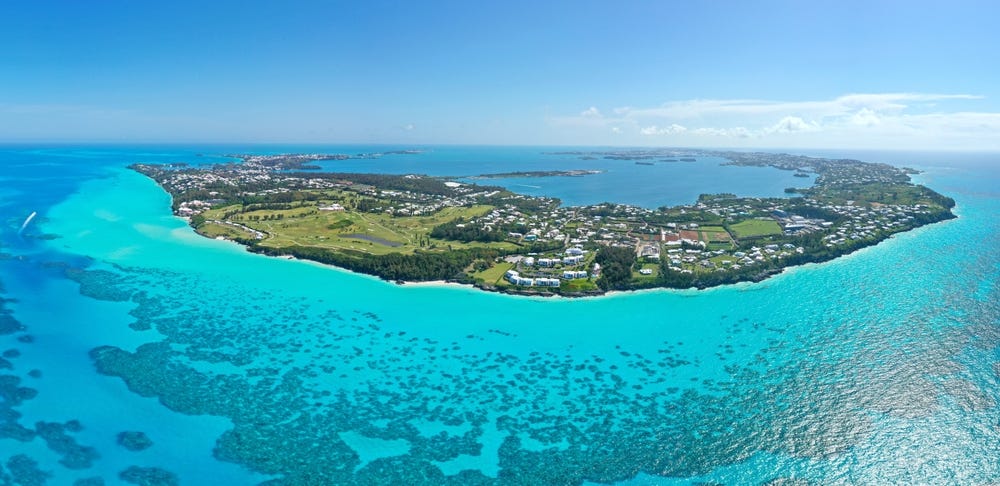
Scientists have uncovered a massive hidden rock layer beneath Bermuda that may explain why the island still sits high above the Atlantic seafloor. (CREDIT: Shutterstock)
Far out in the North Atlantic, Bermuda sits atop a broad rise in the seafloor that has troubled Earth scientists for decades. Many volcanic ocean islands rest on similar swells, which are usually explained by hot, buoyant plumes rising from deep within the mantle. These plumes spread beneath tectonic plates, feed volcanoes, and push the seafloor upward. As plates drift, volcanoes grow older along a chain and slowly sink as the crust cools.
Bermuda breaks that pattern. The island stands on a swell roughly 500 meters high, yet it lacks a long trail of aging volcanoes. Major eruptions ended about 30 to 35 million years ago, and the island has barely subsided since. Seismic images from earlier studies show no clear hot plume rising from deep within Earth beneath the island. Geochemical evidence suggests Bermuda’s magma came from recycled, volatile rich material stored in the mantle transition zone. That origin alone does not explain why the island still sits high today.
A new seismic study offers a different answer. Instead of searching for heat rising from the deep mantle, the researchers looked just beneath Bermuda itself. Their question was simple but bold. Could hidden layers of rock beneath the island still be holding it up?
Listening to Earth’s Echoes
To explore what lies below Bermuda, scientists relied on a single seismic station drilled into the island’s bedrock. Known as BBSR, the station has recorded earthquakes from around the globe for years. The team analyzed signals from 396 large earthquakes, each with a magnitude of at least 5.5. These quakes occurred far enough away to send seismic waves cleanly through Earth before reaching Bermuda.
As these waves pass through the planet, they change speed and direction when they cross boundaries between different rock layers. Some compressional waves convert into shear waves, creating faint echoes called receiver functions. By isolating these echoes, researchers can map changes in rock type with depth.
The team applied strict quality controls to the data. Only signals with strong clarity across several frequency bands were included. They also tested the stability of their results using repeated resampling. By converting time delays into depth estimates, they reconstructed a detailed vertical profile of Earth beneath Bermuda, reaching about 50 kilometers down.
Four Distinct Layers Revealed
The seismic data revealed four clear boundaries beneath the island. The shallowest lies about 3.5 kilometers down and marks the base of Bermuda’s volcanic pile. Below that sits a several kilometer thick zone linked to the upper oceanic crust, made of sheeted dikes and solidified magma.
At roughly 11 kilometers depth, the team identified the fossil Moho. This boundary separates oceanic crust from the underlying mantle and indicates a crustal thickness typical for ocean basins.
The most surprising feature appeared much deeper. About 21 kilometers below the surface, the researchers detected a thick layer with seismic properties unlike normal mantle rock. This layer stands out clearly from noise and persists across different analysis methods. Its thickness, close to 20 kilometers, far exceeds what has been observed beneath most other volcanic islands.
An Unusual Underplated Layer
The team interprets this deep feature as underplating. This occurs when magma stalls beneath the crust instead of erupting, forming a broad body of solid rock. Under Bermuda, this underplated layer appears both thick and relatively buoyant.
Based on seismic speeds, the layer is slightly less dense than the surrounding mantle. That small difference matters. If the underplated rock replaced denser mantle material, it could provide enough lift to support Bermuda’s swell without help from deep heat. The researchers estimate that a density reduction of only about 1.5 percent would be enough to raise the seafloor by several hundred meters.
They tested alternative scenarios as well. Changes in crust thickness or magma intrusion slightly alter the density needed, but the basic conclusion holds. Even across these variations, the underplated layer remains thick, unusual, and capable of keeping Bermuda afloat.
Rethinking How Islands Stay Elevated
The findings suggest that Bermuda’s rise is not driven by an active mantle plume today. Instead, the island may be riding on a long lasting cushion of solidified magma formed tens of millions of years ago. Several processes could have helped build this layer. Magma may have pooled beneath the crust during Bermuda’s volcanic phase. Volatile rich melts could have altered the upper mantle, leaving behind lighter material. More than one process may have worked together.
When asked by the Brighter Side of News "How might such a thick, solidified magma, underplate have formed?", study co-author Jeffrey Park, a professor of Earth and planetary sciences at Yale University responded, "The study outlines several possible processes. Some magma may have stalled beneath the Moho instead of erupting, building a mafic pluton over time. We found volatile rich melts rising beneath Bermuda could also have efficiently depleted and modified the uppermost mantle, leaving behind a lighter residue."
"Another possibility is metasomatic underplating, where hot upwelling material cracks the crust, lets seawater in, and partially serpentinizes the mantle. That process can lower density but would tend to create even higher P wave speeds than we observed", he continued.
The study also found no evidence for a mid lithosphere boundary often seen elsewhere. That absence supports the idea that Bermuda’s structure is distinct.
Other clues fit this picture. The island shows positive topography but negative gravity anomalies, a sign of low density material below. Regional heat flow appears normal, not elevated. These observations are hard to reconcile with a hot plume but make sense if buoyant underplating supports the swell.
Independent experts find the results compelling. Sarah Mazza, a geologist at Smith College, noted that Bermuda’s unusual lavas point to carbon rich material recycled deep within Earth. She links this history to the breakup of the supercontinent Pangea, which may have seeded the mantle beneath the young Atlantic with unique material.
Study lead author William Frazer, a seismologist at Carnegie Science, now plans to examine other islands worldwide. He wants to know whether Bermuda is truly unique or simply the clearest example of a broader process.
Practical Implications of the Research
These findings reshape how scientists understand volcanic islands and oceanic swells. They show that islands can remain elevated long after volcanism ends, without active heat from deep plumes.
This insight helps refine models of Earth’s interior and plate behavior. It also improves understanding of how recycled materials move through the mantle over geological time.
In the long run, such work deepens knowledge of Earth’s evolution and the forces shaping ocean basins.
Research findings are available online in the journal Geophysical Research Letters.
Related Stories
- Bermuda Triangle myths debunked by experts
- Earth’s lower mantle trapped far more early water than previously thought
- 4.5 billion-year-old proto-Earth fragments found in Earth’s mantle
Like these kind of feel good stories? Get The Brighter Side of News' newsletter.
Joshua Shavit
Writer and Editor
Joshua Shavit is a NorCal-based science and technology writer with a passion for exploring the breakthroughs shaping the future. As a co-founder of The Brighter Side of News, he focuses on positive and transformative advancements in technology, physics, engineering, robotics, and astronomy. Joshua's work highlights the innovators behind the ideas, bringing readers closer to the people driving progress.