Scientists reveal a four-dimensional twist on photonic quantum logic
Two photons, four states each, and a heralded gate that can entangle them, without leaning on polarization.

 Edited By: Joseph Shavit

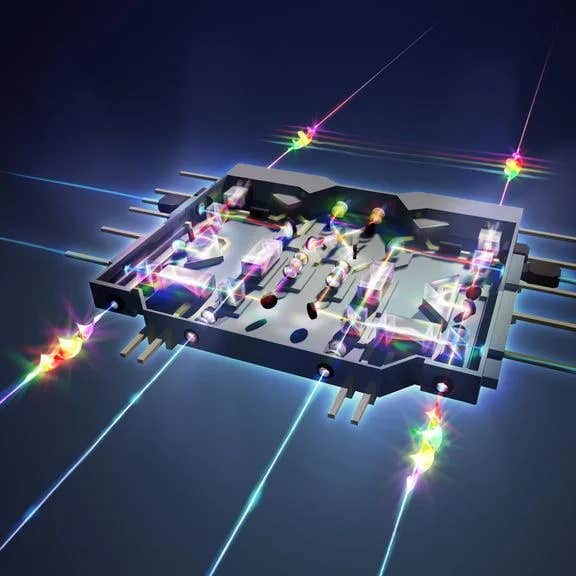
Novel quantum gate. A new heralded photonic gate entangles two four-level qudits, using orbital angular momentum instead of polarization. (CREDIT: Alexander Rommel / TU Wien)
A pair of photons enters an optical maze, and sometimes they leave as something new.
Not new in the everyday sense, since both were still photons when they came out. But new in the way they share information. In the experiment described this week, two photons could be pushed into a joint, entangled state while each photon carried not just two options, but four.
That matters because most quantum computing hardware still lives in a two-choice world. Classical bits hold 0 or 1. Quantum bits, or qubits, can hold combinations of 0 and 1 at once. Yet quantum theory does not stop at two. A single system can occupy superpositions across many possible outcomes. When a quantum “digit” has more than two levels, physicists call it a qudit.
Researchers at TU Wien, working with collaborators in China, report a key step toward computing directly with those higher-level units. They designed and demonstrated a new kind of entangling logic gate for light, built around two photons whose quantum states span four dimensions. The work appears in Nature Photonics.
When two levels are not enough
In many photonics experiments, researchers use polarization as the information carrier. Polarization gives you two measurement outcomes, which maps neatly onto a qubit. But a photon has other degrees of freedom that offer more than two possibilities.
“We use photons in a fundamentally different way”, says Nicolai Friis of the Institute of Atomic and Subatomic Physics at TU Wien. Rather than polarization, the teams used the photon’s spatial wave form, which can exist in many distinct patterns tied to orbital angular momentum.
In this study, they focused on four such states. Friis describes it with a walking analogy: if polarization feels like choosing between north-south and east-west, then adding extra axes starts to feel like moving through a higher-dimensional space. Here, the “space” was four-dimensional, and the photons could occupy superpositions across those four options.
Working with qudits can pay off. The paper argues that packing more quantum information into the same number of carriers can boost the utility of quantum protocols. For computing, the appeal includes accessing larger state spaces with a fixed-size register and reducing how many entangling operations you need for certain tasks, since some multi-qubit logic can be embedded into fewer, higher-dimensional units.
A gate that entangles four-by-four photonic states
Having a richer alphabet is not useful if you cannot make the letters interact. For quantum computing, you need controlled operations between two quantum systems. For photons, that is hard, because photons do not directly interact in linear optical media.
The teams tackled that bottleneck with a two-qudit “controlled phase-flip” gate. In plain terms, this gate flips the phase of one chosen basis state of a target qudit, but only when the control qudit sits in a specific basis state. Combined with single-qudit operations, the paper says this kind of gate can serve as a building block for more complex two-photon and multi-photon logic.
The TU Wien group, including researchers Xiaoqin Gao, Zhi-Feng Liu and others, developed the scheme. An experimental group in China led by Hui-Tian Wang carried out the laboratory implementation. The demonstration used two four-dimensional qudits, each encoded in the orbital angular momentum of a single photon.
A central practical point is feedback. Some optical gates only work through post-selection, where you learn the gate succeeded by measuring the output, which blocks you from using the output in a larger circuit. This work instead used a heralded approach, meaning the setup can signal when the gate succeeded without relying on an output measurement to verify success.
“We can entangle the photons, and we can do so in a heralded fashion, meaning that we can tell, when the protocol worked”, Friis says. “And if it did not, we can repeat the procedure.”
The engineering behind “heralded”
To pull off the gate, the experiment used four photons total: two carried the input qudits, and two acted as auxiliary photons. The design relies on interference and measurement in a way that makes the gate non-destructive when it succeeds.
In the four-dimensional demonstration, the computational basis used four orbital angular momentum states with azimuthal quantum numbers ℓ = −3, −1, 1 and 3. The phase-flip operation targeted one of those basis states.
The setup required high stability. Two-photon interference took place inside Mach–Zehnder interferometers, and the gate’s performance depends on keeping the phase steady. The researchers report an active phase-locking scheme for orbital angular momentum interferometers to stabilize the phase using a dedicated locking laser.
The experiment produced a measured four-photon rate of 0.6 counts per second after the protocol ran. The paper links the low brightness to two factors: the gate efficiency and transmission losses through the optical system.
The authors describe an “optimal achievable” controlled phase-flip efficiency of 1/8 when the Bell-state measurement includes feedforward with 1/2 efficiency. In this experiment, the Bell-state measurement did not use feedforward, so the Bell-state measurement efficiency was 1/4 and the achieved gate efficiency was 1/16. Transmission through the interferometers was 35%, while photons passing through the Bell-state measurement path had 65% transmission, for an overall transmission efficiency of about 5%.
How well did it work, and where it strains
To evaluate the gate, the team measured process fidelity bounds using two complementary input bases. They report average fidelities of 0.86 ± 0.01 and 0.85 ± 0.01 in those tests, yielding a process fidelity in the range F ∈ [0.71 ± 0.01, 0.85 ± 0.01]. The paper notes that exceeding 0.5 supports the claim that the gate can generate entanglement.
They also tested the gate on selected superposition inputs. For one case, the gate converted a product state into an entangled output, with a measured fidelity of 0.78 ± 0.02.
Most of the gate characterization focused on operations within two-dimensional subspaces inside the overall four-dimensional space, using different pairs of orbital angular momentum eigenstates. The team also reports a test that directly involved the full four-dimensional space, reconstructing an entangled output state with fidelity 0.84 ± 0.03 compared with the ideal target.
The study flags trade-offs and limits. Only two of four Bell states could be distinguished unambiguously in the experiment. The paper also warns that while the gate can, in principle, extend to arbitrary dimension, its entangling power drops as dimension rises, approximately following an inverse-square relationship with the dimension d.
That scaling reflects an intrinsic trade-off for single-phase controlled phase-flip operations, though the authors suggest that combining multiple phase-flip components could improve entangling power in higher-dimensional photonic systems.
Marcus Huber, also at TU Wien’s Institute of Atomic and Subatomic Physics, frames the attraction of qudits in resource terms: “We need fewer particles to carry the same amount of quantum information.”
Research findings are available online in the journal Nature Photonics.
The original story "Scientists reveal a four-dimensional twist on photonic quantum logic" is published in The Brighter Side of News.
Related Stories
- Scientists observe quantum wave behavior in positronium for the first time
- Physicists measured time without a clock at the quantum scale
- What costs more energy — running a quantum clock or observing it?
Like these kind of feel good stories? Get The Brighter Side of News' newsletter.
Shy Cohen
Writer