Sun-like star’s nine-month eclipse exposes a violent planetary past
Astronomers tracked a Sun-like star that dimmed for nine months and uncovered evidence of a massive disk born from planetary violence.

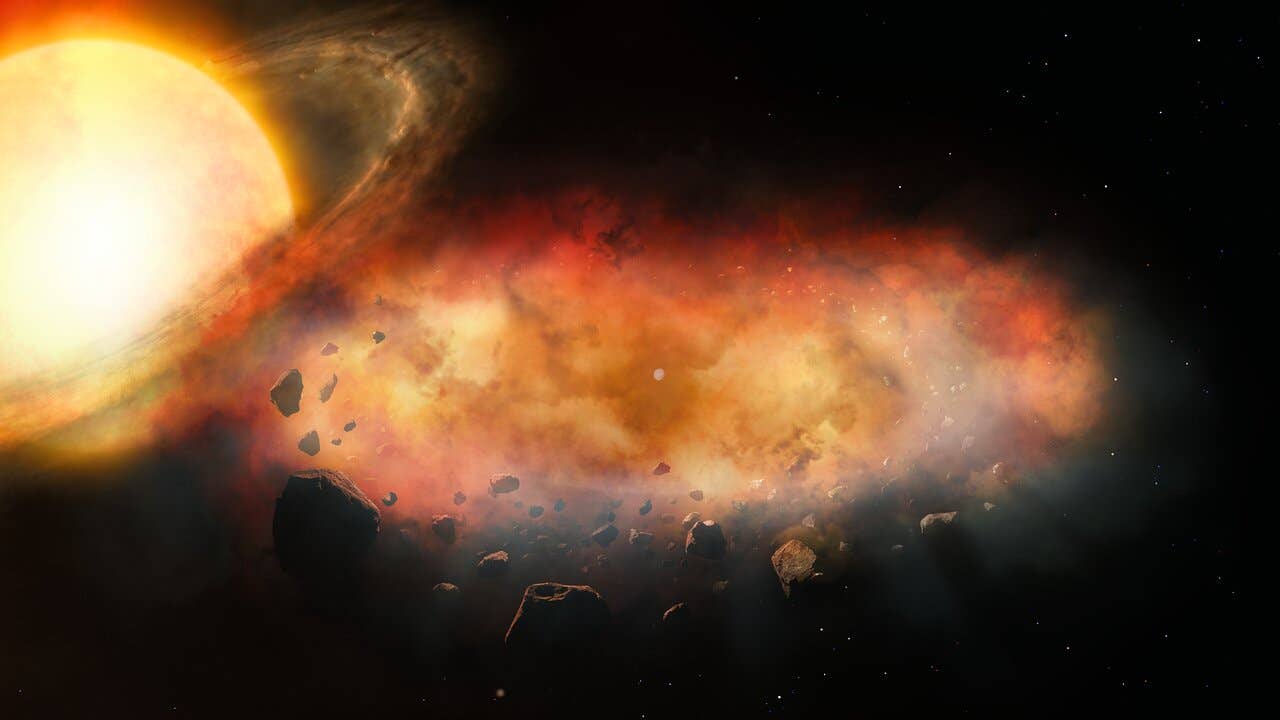
This artist’s illustration depicts a large disk of planetary debris, surrounded by a thick cloud of dust and gas, as it passes in front of a star. (CREDIT: International Gemini Observatory/NOIRLab/NSF/AURA/P. Marenfeld & M. Zamani)
A Sun-type star situated nearly 3,000 light-years from Earth has provided astronomers with a unique opportunity to observe an unusual after-effect of a planetary system's evolution. When this star, designated J0705+0612, underwent a complete dimming event in September 2024, it remained dim for around nine months. This dimming was an incredible 40 times the usual brightness of this star, something which immediately concerned Nadia Zakamska, an astrophysicist at Johns Hopkins University.
“Stars like the Sun don't just spontaneously cease shining,” said Zakamska. “The likelihood of such a significant dimming event occurring naturally is very small.”
Working together with a multi-institutional group, Zakamska quickly arranged for access to several telescopes located in Chile, including the Gemini South telescope from the International Gemini Observatory supported by NSF NOIRLab. This was in addition to data obtained from the Apache Point Observatory and the Magellan Telescopes. Their findings were published in The Astronomical Journal.
An Eclipse Rather Than Stellar Death
The scientists did not discover any signs of an impending star death. Instead, they witnessed an eclipse caused by the passage of a massive plume of gas and dust moving through space between the observing team and the star.
By following up with decades of archival images from photography taken years before, specifically from 1937 and 1981, and by comparing this modern information against those older photographs, researchers demonstrated that the dim appearances observed 44 years apart identified the presence of an orbiting body affecting the overall outlook of the star system. This ruled out the possibility that the dimming was the result of random stellar activity.
The disk is located about 14 AU from the star, which is approximately the distance from Uranus to the Sun, and has a radius of about 0.7 AU. Its slow speed as it passes in front of the star accounts for the eclipse lasting for 254 days.
Constraints On The Hidden Object
The object that is causing the disk to exist is unknown. However, it must have enough mass to keep the disk together, which is estimated to be several times the mass of Jupiter. It could be anywhere up to the mass of brown dwarfs or small stars.
Gas and dust disks are found around young stars where planets are formed. However, what makes this system so exceptional is that J0705+0612 is over 2 billion years old based on stellar models and data from the Gaia mission. It also has motion in the galaxy similar to older stellar populations.
When the orbit of the disk is around a low-mass star, it is considered circum-secondary. When it orbits a planet, it is classified as circum-planetary. Both circumstances of observing a disk like this pass in front of a mature star are very unusual, and there are only a few known examples.
Clues From The Light Curve
Additionally, the smooth and symmetrical nature of the light curve provides another piece of evidence. The star gradually dimmed and then brightened. There was no sudden jump or sharp edges. This indicates that the structure is thick and extended, unlike a very thin or clumpy ring.
"To examine the composition of the disk, our team utilized Gemini South’s newest instrument, the Gemini High-Resolution Optical Spectrograph, known as GHOST. While the self-eclipsing phenomenon was still in progress, GHOST took two hours of high-detail spectra in March of 2025," Zakamska told The Brighter Side of News.
“I had high hopes for the spectroscopic observation of the occultation,” she said. “I was anxious to learn something about the chemical makeup of the cloud, but it has exceeded all my expectations.”
Measuring Gas Motion For The First Time
The spectral absorption and emission detected by GHOST is attributable to over 20 metallic elements, including iron, calcium, magnesium, and sodium. In addition, the data obtained details the motion of the metallic gas in three dimensions.
“The GHOST instrumentation was so sensitive that it allowed us not only to detect the gaseous metallic elements within this cloud, but also allowed us to measure their actual velocity of motion,” described Zakamska. “This was a first for the science of astronomy, as we have never been able to measure gas motion inside a secondary object’s disk.”
The data showed gas being expelled from the disk at speeds of approximately 27 kilometers per second toward the star. This represents the first direct measurement of the internal motion of gases within the vicinity of a secondary object.
Instrument Capabilities And Rapid Response
“The research completed in this study shows the exceptional capabilities of GHOST, the newest tool available at Gemini,” declared Chris Davis, program manager of NSF NOIRLab. He noted that the team was able to capture such accurate observations due to the instrument’s capability for rapid response to rare occurrences such as dimming stars.
While the star was dimming, it was also observed to change color in a very similar fashion. It became slightly redder than before, but it was not nearly as red as would be expected from normal interstellar dust. The disk blocked approximately four magnitudes of visible light with only a slight color change.
This trend indicates that the dust is mostly composed of larger dust grains than those associated with standard interstellar dust. Larger particles block wavelengths of light more equally than smaller grains and produce what astronomers describe as nearly grey extinction.
Evidence From Infrared Emission
These larger grains likely form either due to multiple collisions of dust grains or due to a lack of supplying smaller grains. Supporting evidence comes from observing infrared radiation emitted after the eclipse.
During this time period, an excess of infrared radiation was observed coming from the star. This radiation typically accounts for around 9 to 14 percent of the star’s total energy. This amount of radiation is generally found in young stars rather than in ones that have existed for billions of years.
Another twist on this theory is observed through the use of hydrogen emission lines, which were detected during the eclipse. Some hydrogen lines, such as H-alpha, appeared at significantly reduced levels compared to those seen in truly young stars.
Signs Of A Violent Origin
Despite being weaker, these hydrogen lines were wider than would be expected if they were associated only with the dust nucleus. Together, these two sets of data suggest that the disk originated from a high-energy event.
The model proposed by Zakamska and her colleagues suggests that this material was released from two larger planetary bodies colliding with one another in the outer regions of this planetary system. This collision could have released a large amount of gas, dust, and metal-rich material that will transition into becoming a component of a surviving companion body.
“This is the first time we have seen evidence that large cataclysmic events can take place even after a planetary system has matured and is not static,” stated Zakamska. “It is an important reminder that the universe is forever growing and changing.”
Implications For Planetary Science
This area of research has changed the outlook on the ways in which scientists envision older planetary systems. Scientists have discovered that planetary systems experience both cataclysmic events related to planet formation and the creation of disk-forming material after billions of years.
This insight allows researchers to develop a better understanding of the long-term stability and evolution of planets, including Earth-based systems throughout the universe. By understanding the nature of the motion of gas contained within disk environments, these observations create new opportunities to study how planets interact with their surrounding environments.
Future observations will provide additional insight into the timing, survival potential, and amount of debris produced during cataclysmic collisions occurring well after planetary system formation. By examining this information, researchers will gain a clearer understanding of how these processes impact planetary systems and refine models of planetary evolution and the search for unusual worlds.
Research findings are available online in The Astronomical Journal.
Related Stories
- JWST observations reveal massive helium clouds escaping from exoplanet WASP-107 b
- Astronomers discover massive star-forming cloud near our solar system
- Two monstrous black holes are consuming a massive gas cloud
Like these kind of feel good stories? Get The Brighter Side of News' newsletter.

Joseph Shavit
Writer, Editor-At-Large and Publisher
Joseph Shavit, based in Los Angeles, is a seasoned science journalist, editor and co-founder of The Brighter Side of News, where he transforms complex discoveries into clear, engaging stories for general readers. With vast experience at major media groups like Times Mirror and Tribune, he writes with both authority and curiosity. His writing focuses on space science, planetary science, quantum mechanics, geology. Known for linking breakthroughs to real-world markets, he highlights how research transitions into products and industries that shape daily life.