The Eye of Sauron: Helix Nebula Reveals How Sun-like Stars Die
James Webb Space Telescope reveals how the Helix Nebula predicts the future of our Sun and the recycling of star material.

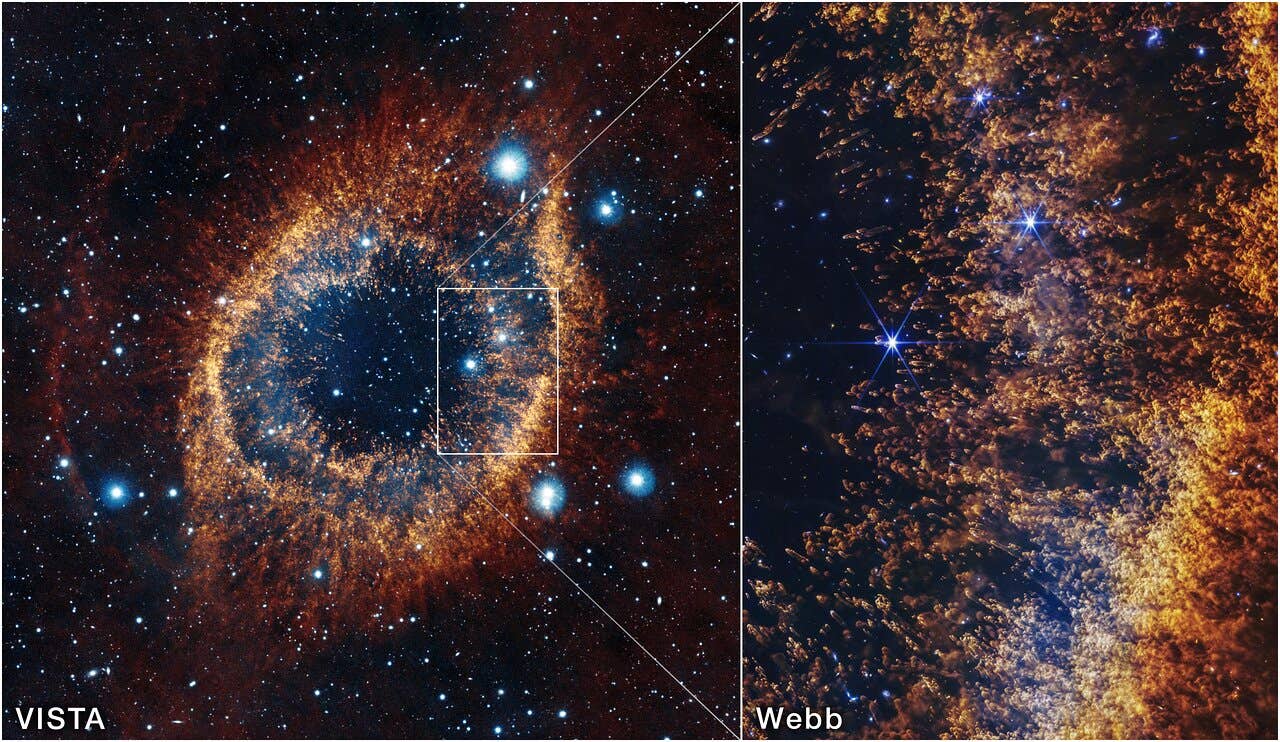
This image of the Helix Nebula from the Visible and Infrared Telescope for Astronomy (left) shows the full view of the planetary nebula, with a box highlighting the smaller field of view from the James Webb Space Telescope’s NIRCam (right). (CREDIT: NASA, ESA, CSA, STScI, A. Pagan (STScI))
You can predict the Sun’s distant future by looking far beyond the Solar System. Across the Milky Way, astronomers study older stars that resemble the Sun to understand how stellar lives end. These observations show that stars do not simply fade away. Instead, they go through dramatic final stages that reshape their surroundings and seed space with new material.
When a Sun-like star exhausts its hydrogen fuel, it leaves the stable phase known as the main sequence. The star swells into a red giant and begins to lose its grip on its outer layers. Those layers drift into space, forming an expanding cloud of gas. As the exposed stellar core heats and radiates energy, it illuminates the surrounding material. The result is a planetary nebula, one of the most striking sights in the night sky.
Among the most famous examples is the Helix Nebula. Located about 650 light-years from Earth in the constellation Aquarius, it is one of the closest bright planetary nebulas known. Its bold, ring-like shape has made it a favorite target for amateur astronomers and professional researchers alike since its first recorded observations in the early 1800s.
From Hubble to Webb, a Clearer View Emerges
For decades, space-based observatories have revealed the Helix Nebula in increasing detail. A well-known image from the NASA and ESA Hubble Space Telescope, captured during a nine-orbit campaign by the Hubble Helix Nebula Team, helped cement its reputation. The nebula’s circular form and central darkness give it the appearance of a giant eye, earning it the playful nickname “the Eye of Sauron.”
The arrival of the James Webb Space Telescope has deepened that view. Operated by NASA in partnership with ESA and the Canadian Space Agency, Webb provides the most detailed infrared images ever taken of the Helix Nebula. Its instruments allow scientists to peer into cooler regions of gas and dust that earlier telescopes could not resolve clearly.
Webb’s Near-Infrared Camera, known as NIRCam, reveals dense structures embedded within the nebula. These features appear as small, comet-like knots with bright heads and long trailing tails. Astronomers often call them globules or cometary knots because of their shape.
The Cometary Knots Inside the Helix
The Helix Nebula contains roughly 40,000 of these cometary knots. Each one likely spans a region larger than the Solar System when measured out to Pluto’s orbit. Despite their size, they contain far less mass than a planetary system.
Powerful winds and radiation from the dying star push against the gas it expelled earlier. Most of that material drifts outward, but denser knots resist the flow. Their illuminated heads face the central star, while cooler, less energized gas streams behind them, forming tails. You can only see these structures clearly in nearby planetary nebulas, but astronomers suspect they are common throughout the galaxy.
These knots help explain how planetary nebulas gain their complex, textured appearance. Fast, extremely hot winds collide with cooler layers of dust and gas released earlier in the star’s life. Those collisions carve and shape the nebula over time.
A Brief Phase in a Long Stellar Story
Planetary nebulas are short-lived on cosmic timescales. The Helix Nebula is estimated to be between 10,000 and 12,000 years old, already mature for this stage. Its original star began shedding its outer layers roughly 15,000 to 20,000 years ago.
Over the next several thousand years, the nebula will continue to expand. As the gas spreads out, it will grow thinner and dimmer. The central white dwarf, the hot stellar core left behind, will gradually cool. With less radiation to energize the gas, the nebula’s glow will fade. Around 50,000 years after its formation, the Helix Nebula will disperse and merge with the interstellar medium.
At the center of this process lies the white dwarf. Although it appears just outside some of Webb’s images, its influence shapes everything around it. Closest to the core, you find hot, ionized gas. Farther out lie cooler regions rich in molecular hydrogen. In the most sheltered pockets, dust clouds allow more complex molecules to begin forming.
What the Helix Reveals About the Sun
The Helix Nebula offers a preview of the Sun’s own destiny. In about five billion years, the Sun will swell into a red giant. It will lose its ability to hold onto its outer layers, which will drift into space. The remaining core will become a white dwarf, a fading stellar ember that releases residual heat for billions of years.
The glowing nebula that forms will mark the Sun’s final dramatic act. Its colors will trace temperature and chemistry. In Webb’s images, blue tones show the hottest gas shaped by ultraviolet radiation. Yellow regions highlight cooler zones where hydrogen forms molecules. Red hues trace the coldest material, where dust begins to take shape.
This stellar exhalation spreads elements forged inside the star into space. That material can later take part in new rounds of star and planet formation. Some of it may one day become part of a rocky world with liquid water, continuing the cosmic cycle.
Practical Implications of the Research
By studying the Helix Nebula in detail, you gain insight into how stars recycle material back into the galaxy. These findings help scientists refine models of stellar evolution and better understand how elements essential for planets and life spread through space.
The observations also show how complex molecules can form in harsh environments, guiding future research into the origins of planetary systems.
Over time, this knowledge improves predictions about the fate of stars like the Sun and informs the search for habitable worlds elsewhere in the universe.
Related Stories
- Strange iron 'bar' discovered inside the Ring Nebula
- Butterfly Nebula’s Hidden Heart Reveals the Building Blocks of Planets
- Astronomers spot an 'impossible' shock wave around a dead star system
Like these kind of feel good stories? Get The Brighter Side of News' newsletter.

Joshua Shavit
Writer and Editor
Joshua Shavit is a NorCal-based science and technology writer with a passion for exploring the breakthroughs shaping the future. As a co-founder of The Brighter Side of News, he focuses on positive and transformative advancements in technology, physics, engineering, robotics, and astronomy. Joshua's work highlights the innovators behind the ideas, bringing readers closer to the people driving progress.