The hidden cost of the mobile sports betting and binge drinking
Online sports wagering is driving heavier drinking among young male binge drinkers, a new causal study finds, with effects that don’t fade over time.

 Edited By: Joseph Shavit

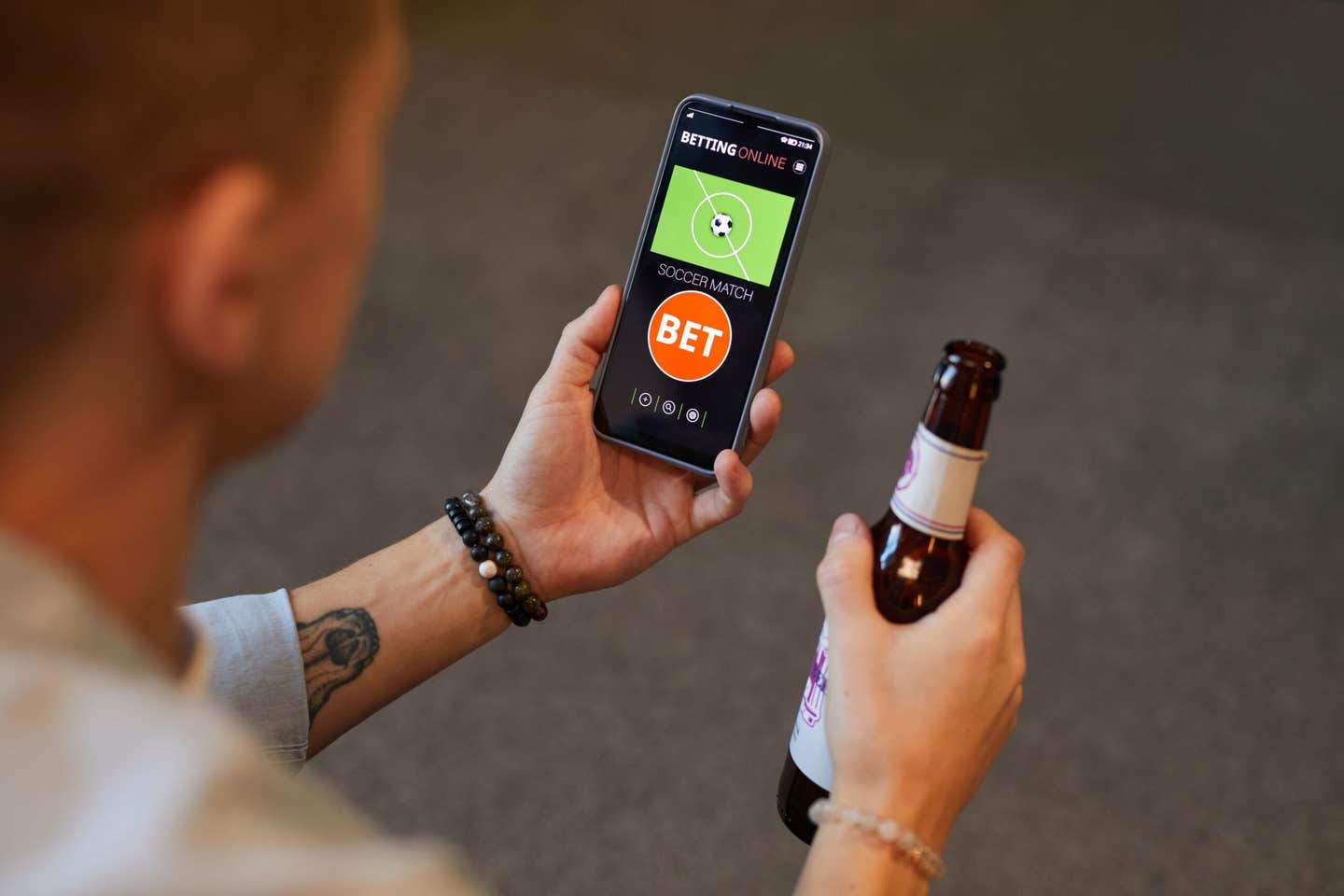
A new study links online sports betting legalization to a 10% rise in binge drinking among men 35 and under who already drink heavily. (CREDIT: Shutterstock)
The bet takes seconds. A few taps, a game loading on a second screen, and suddenly an otherwise ordinary Saturday afternoon carries financial stakes. For millions of young men across the United States, that scenario has become routine since 2018, when the Supreme Court cleared the way for states to legalize sports wagering. What researchers are now finding is that the ritual doesn't always stop with the bet.
A study published in Health Economics draws a direct causal line between the spread of online sports betting and heavier drinking among young men, specifically those who were already binge drinking before their state legalized wagering.
Using health survey data collected across all 50 states from 2016 through 2023, researchers found that legalizing online sports betting pushed binge-drinking frequency up by roughly 10 percent among men aged 35 and under who already reported binge episodes. Smoking rates, by contrast, stayed flat.
"As sports betting continues to spread across states, these findings raise important public health concerns and highlight the need for policymakers to consider the broader behavioral impacts of gambling liberalization," said co-author Keshar M. Ghimire, PhD, of the University of Cincinnati.
What the Data Actually Tracked
The research team pulled its data from the CDC's Behavioral Risk Factor Surveillance System, a long-running national health survey that tracks drinking, smoking, and other behaviors across a representative cross-section of American adults.
To isolate the effect of sports betting laws specifically, the researchers used a method called difference-in-differences, which compares outcomes in states that passed betting laws against those that hadn't, while accounting for economic conditions, political environment, existing marijuana laws, and alcohol and tobacco taxes.
Because states didn't all legalize at once, the researchers used a more sophisticated statistical technique designed to handle that kind of staggered rollout without introducing bias. The result is a cleaner causal argument than most observational studies can make.
At the population level, almost nothing changed. Across the full sample of American adults, sports betting legalization showed no statistically meaningful effect on drinking or smoking behavior. That's actually an important finding on its own, suggesting that the risk isn't spread evenly.
The picture shifted sharply when researchers looked at young men in isolation.
A Specific Group, a Specific Risk
Among men 35 and younger who already reported binge-drinking episodes in the past 30 days, online sports betting access increased the number of those binge days by about 0.46 on average. That translates to roughly a 10 percent increase over a pre-legalization baseline of 4.6 binge days per month. The effect was statistically significant and held up across multiple sensitivity tests, including a version that excluded pandemic years to account for any COVID-related shifts in drinking behavior.
Crucially, the increase was concentrated on intensity, not prevalence. The share of young men who binge drank at all didn't change much. It was the men already doing it who did it more. That distinction matters for how the risk gets framed, because it points not to a wave of new problem drinkers but to deeper entrenchment among those already engaging in risky behavior.
Young women showed no statistically significant effects in either direction.
The study also found differences by race, education, and marital status among young men. Statistically significant increases in binge frequency appeared among Black respondents, unmarried individuals, and those without a college degree. Among age bands, the 25-to-34 range drove most of the signal; the 18-to-24 group didn't show the same effect.
Online Access vs. a Physical Sportsbook
One of the more telling distinctions in the data involves how betting access was delivered. Retail sports betting, meaning physical sportsbooks attached to casinos or stadiums, showed weaker and shorter-lived effects on binge drinking. Online access showed effects that hadn't faded even five years after legalization.
That durability matters. Researchers point to prior work suggesting that online gambling, by removing friction from the activity, carries stronger behavioral risks than its in-person equivalent. The findings here align with that picture: it's not just that betting became legal, but that it became available on a phone at any hour, during any game, without requiring travel or a separate decision to leave the house.
Google search data reinforces this framing. Nationwide searches for "sports betting" roughly doubled in the period after the 2018 Supreme Court ruling. State-by-state trends showed spikes in online interest that closely tracked the timing of local legalization, paralleling reported surges in sports betting revenue, almost all of which now flows through online platforms.
What This Leaves Unresolved
The researchers are careful about what their data can and can't establish. The study captures roughly the first five years of the post-legalization era, so whether binge frequency among young men continues to climb, plateaus, or eventually moderates is still unknown. The behavioral data also relied on self-reporting, which typically understates actual consumption.
The analysis also can't yet separate what's driving the drinking increase. It could be that bets and beers reinforce each other in the moment; it could be that financial stress or anxiety from losing wagers leads to heavier drinking afterward. Likely it's some combination. Untangling those pathways, the researchers note, would help clarify what kind of intervention, if any, could interrupt the cycle.
What the study adds to a growing body of literature is causal credibility. Earlier work had documented associations between gambling and alcohol use without being able to rule out the possibility that the same people who gamble also tend to drink, for reasons having nothing to do with one another. The design here leans harder against that explanation.
Practical Implications
For the roughly 30 states that now offer some form of legal sports betting, and the others that may follow, this research suggests that gambling policy has health consequences that extend beyond addiction treatment and mental health services. A segment of the young male population appears to be drinking more, and drinking more frequently, in direct response to the availability of online wagering.
Public health infrastructure built around sports betting has so far focused heavily on problem gambling hotlines and responsible betting campaigns. Whether those tools are reaching the men most affected by binge-drinking risk is a separate question worth asking.
Age-targeted alcohol messaging, integration of betting behavior into primary care screening, and stricter limitations on the hours or formats of mobile betting promotions are all levers that policymakers haven't widely tested in this context.
The evidence now exists to at least put them on the table.
Research findings are available online in the journal Health Economics.
The original story "The hidden cost of the mobile sports betting and binge drinking" is published in The Brighter Side of News.
Related Stories
- March Madness: Why sports betting is booming among young adults
- The rise of sports betting is driving a growing public health crisis
- This Alexandria company created a platform to host virtual charity poker events
Like these kind of feel good stories? Get The Brighter Side of News' newsletter.