The unprecedented link between quantum physics and artificial intelligence
Identical photons in optical circuits can act like neurons in a Hopfield network, until disorder triggers a memory blackout.

 Edited By: Joseph Shavit

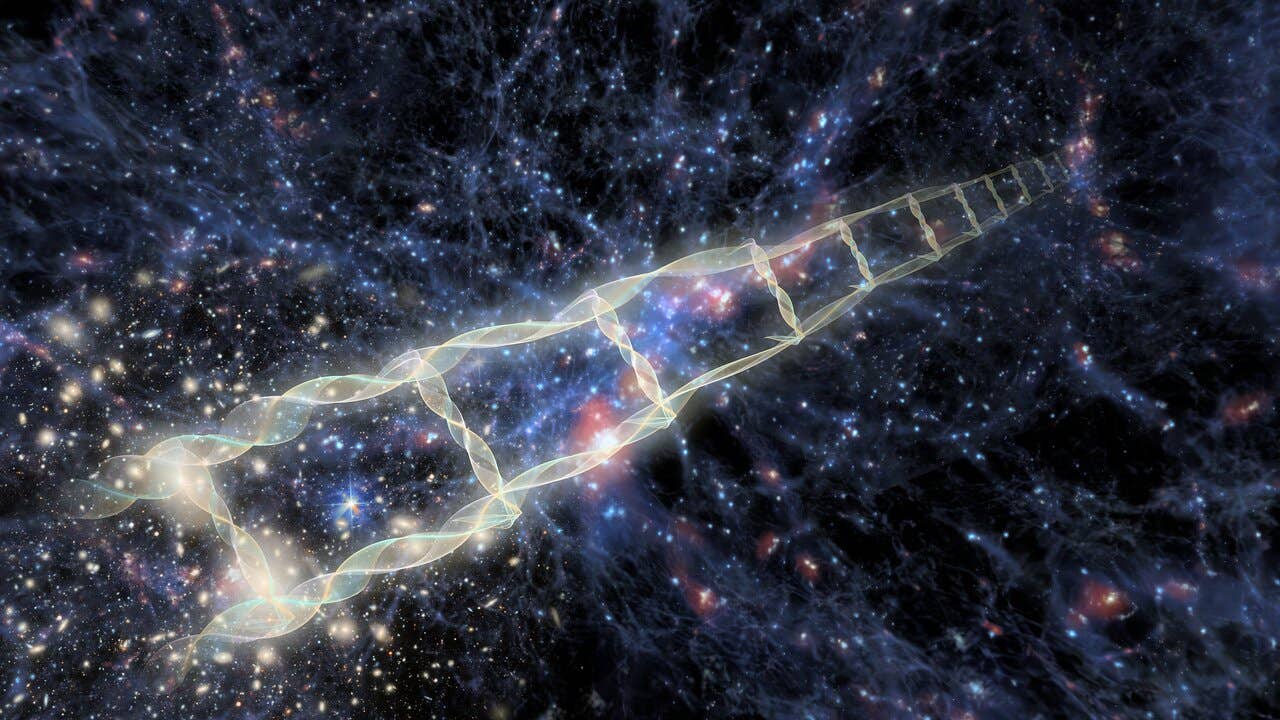
Quantum interference in photonic chips can mimic Hopfield associative memory, and it hits a spin-glass blackout limit. (CREDIT: AI-generated image / The Brighter Side of News)
Light does not “think” in any human sense. Still, under the right conditions, it can behave in a way that looks uncannily like a memory system.
In a new international study, researchers report that identical photons moving through an optical circuit can spontaneously mimic a Hopfield Network, a classic mathematical model used to describe associative memory. This model helps a brain retrieve a whole pattern from partial clues. The work links a familiar idea from neuroscience-inspired computing to a very different arena. Specifically, this arena is quantum interference inside photonic chips.
The collaboration involved the Institute of Nanotechnology of the National Research Council (Cnr-Nanotec), the Italian Institute of Technology (IIT), and Sapienza University of Rome. International institutions were also involved.
The key twist is that the photons do not just carry information. In this setup, they play the role of the “neurons” themselves.
Marco Leonetti, a senior researcher at Cnr-Nanotec and affiliated with the Center for Life Nano- and Neuro-Science at IIT in Rome, coordinated the project and served as corresponding author. “Instead of using traditional electronic chips, we exploited quantum interference, the phenomenon that occurs in photonic chips when particles of light overlap and interact with one another to encode and retrieve information,” Leonetti said. “In this system, photons are not merely carriers of data, but themselves become the ‘neurons’ of an associative memory.”
A neural-network model hiding in an optical circuit
Hopfield networks have been a milestone in describing memory storage and retrieval using tools from statistical physics. In the study, the researchers connect that tradition to “bosonic quantum interference.” This is the quantum behavior that emerges when many identical photons evolve coherently through a linear-optical network.
Their photonic system has three main ingredients: Nph photons prepared in a superposition across M optical modes, a layer of M phase shifters, and an interferometer that implements a general scattering matrix across those modes. The phase shifters can take two values, 0 or π. The study maps those binary choices onto “spins,” σ = ±1, the same kind of variables used in Ising models.
From there, the authors show that the statistics of where photons end up at the output can be described through a Hopfield-type energy function, or Hamiltonian. The specific version they connect to optics is a generalized “p-body” Hopfield model with multisynaptic connections. In their mapping, p equals 2Nph. With two photons, that corresponds to a 4-body Hopfield model.
That detail matters because, in generalized Hopfield models, p > 2 can increase memory capacity compared to the original pairwise version. The study describes a capacity scaling. In their approach, the number of stored patterns can grow as a power of M, depending on p.
At the same time, the paper is careful about a practical hurdle: fully connected p-body dynamics become extremely costly to simulate on a conventional computer as the system grows. This happens because the effective connectivity rises rapidly with M. Their argument is that a photonic platform can act as an analog simulator. It turns the hard part of the computation into a physical process.
When memory works, and when it collapses
The researchers did not just propose a conceptual link. They also describe behavior that will sound familiar to anyone who has studied associative memory models. Retrieval works only within certain limits.
Gennaro Zanfardino, a research fellow at the University of Salento and first author of the study, framed it in terms of a quantum-to-disorder transition. “When the amount of stored information is limited, the system is able to retrieve it correctly thanks to quantum coherence,” he said. “However, as the volume of data increases, a transition emerges toward a memory black-out phase, in which the system enters a state of disorder, technically defined as a spin glass, losing its retrieval capability.”
In their analysis of the two-photon, 4-body case, the authors examine how behavior changes with two knobs: a storage capacity ratio α and a temperature-like parameter T that represents synaptic noise in the model. At low α and low T, the system sits in a retrieval regime where the network relaxes toward a stored pattern. This produces a plateau in a self-correlation function over time. As noise increases, that correlation fades and retrieval fails.
As α increases, memory becomes harder to recover even at low T. The study points to “spurious states,” local minima in the energy landscape that can trap the dynamics even though they do not correspond to any stored pattern. If you push α high enough, the landscape becomes dominated by disorder. That is the spin-glass phase Zanfardino referred to, where the system effectively blacks out.
The work also identifies a paramagnetic phase at higher T. In this phase, spins behave independently and both memory overlaps and replica correlations peak near zero.
This “phase diagram” language is not just decorative. It is the paper’s way of saying that the same tradeoffs seen in theoretical models of memory show up in a quantum photonic circuit. This happens even though the hardware looks nothing like a brain or a silicon accelerator.
Why spin glasses show up again
The study situates itself in the broader field of complex systems, specifically the study of spin glasses, which explore how disorder and frustration create rugged landscapes with many competing states. It also draws a line to the scientific tradition associated with Giorgio Parisi. He won the 2021 Nobel Prize in Physics for work on complex systems and spin glasses.
The authors emphasize that this link is not accidental. They argue that the “laws of disorder” known from classical systems appear again in the quantum photonic setting.
“With this study, of which we are particularly proud, we demonstrate that the laws of disorder observed in classical systems also emerge in quantum photonic circuits,” said Fabrizio Illuminati, director of Cnr-Nanotec and a co-author. “Light thus becomes a true miniature laboratory, capable of exploring the complex phenomena that govern natural and artificial systems, from climate to biological networks.”
Practical implications of the research
Luca Leuzzi, a Cnr-Nanotec research director affiliated with Sapienza University of Rome and a co-author, argues the most obvious target is computing hardware. “These results open new perspectives for the use of quantum optics and integrated photonics in the development of artificial intelligence systems,” he said. “Devices of this kind could ensure high performance with drastically lower energy consumption compared to current data centers.”
Even if that vision takes time, the study offers a concrete near-term use: photonic platforms as simulators for complex, disordered systems that challenge conventional computation. The same optical ingredients that map onto a memory model could also be used to probe when order gives way to glassy behavior. The study addresses how that transition depends on controllable parameters like phase settings, stored patterns, and noise.
In other words, the photons are not being promoted as magical thinking machines. They are being used as physical building blocks for memory-like dynamics and as a testbed for disorder itself.
Research findings are available online in the journal Physical Review Letters.
The original story "The unprecedented link between quantum physics and artificial intelligence" is published in The Brighter Side of News.
Related Stories
- Oxford physicists achieve teleportation between two quantum supercomputers
- UCSD physicists develop efficient way to decode quantum systems
- Quantum computing occurs naturally in the human brain, study finds
Like these kind of feel good stories? Get The Brighter Side of News' newsletter.
Shy Cohen
Writer