Three million years of climate history, captured in Antarctic ice
Ancient Antarctic ice shows Earth cooled sharply over 3 million years while CO2 and methane changed only modestly.

 Edited By: Joseph Shavit

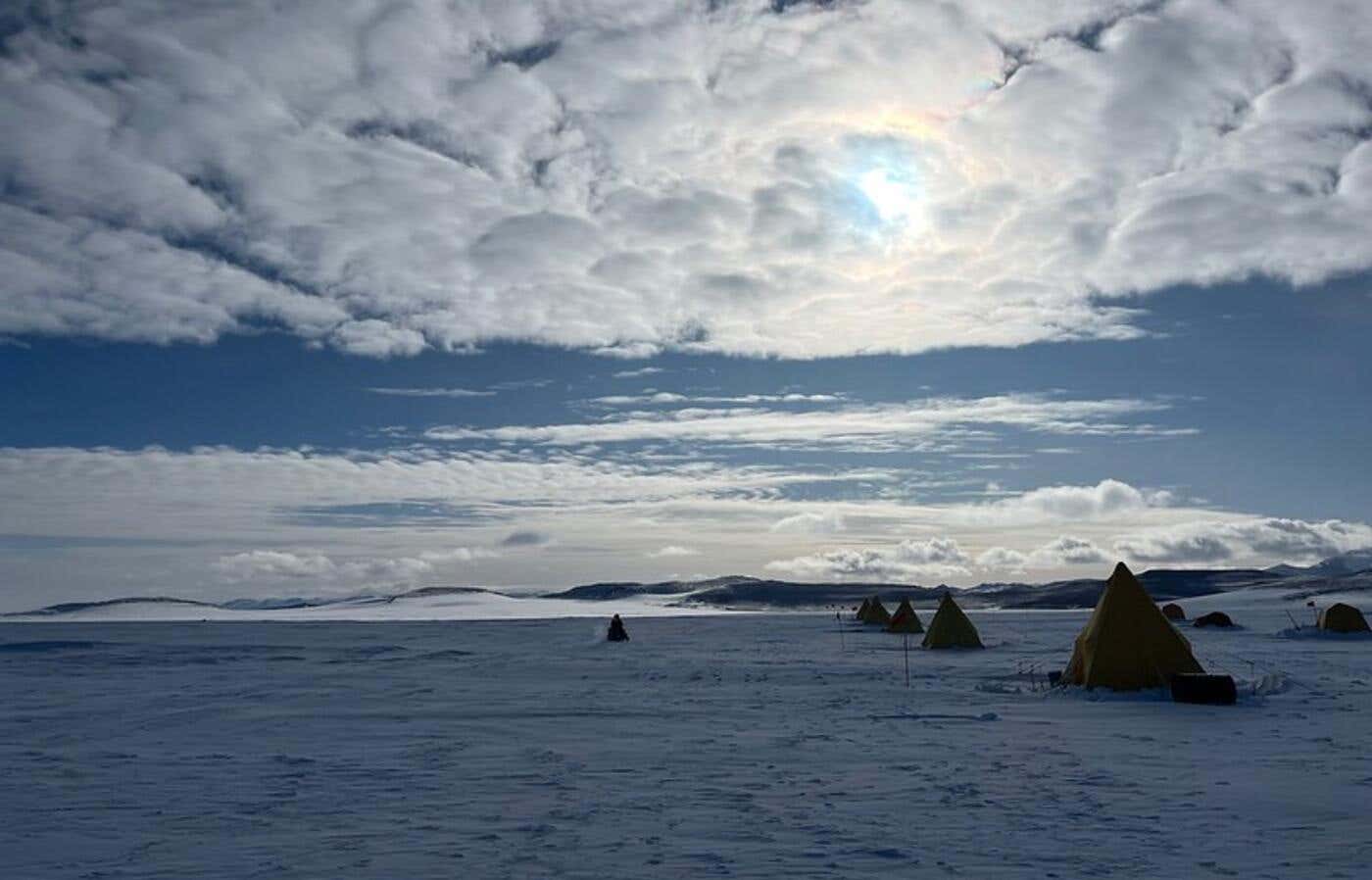
Antarctic ice reveals 3 million years of climate history, with cooling tied to only modest greenhouse gas changes. (CREDIT: OSU)
Frozen air from Antarctica is giving scientists a longer look at a climate mystery that has lingered for decades: why Earth cooled so much over the past 3 million years even though its greenhouse gas levels seem to have changed only modestly.
Two new studies in Nature push direct records of ancient atmospheric carbon dioxide and methane far beyond the 800,000-year span covered by the oldest continuous ice core. Using ice from Allan Hills, an unusual blue ice area at the edge of East Antarctica, researchers found that average carbon dioxide levels likely stayed below 300 parts per million over the past 3 million years. Methane, meanwhile, appears to have remained roughly steady at about 500 parts per billion.
That is a striking result because the same ice suggests the planet cooled a great deal over the same stretch of time.
“The noble gases in ice provide a unique way to look at ocean temperature change,” Sarah Shackleton, now a professor at Woods Hole Oceanographic Institution, said in one of the papers. “Other methods can give you information about ocean temperature at a single site, but this gives a more global view.”
Ice that works more like snapshots
Scientists have long known that Earth was warmer around 3 million years ago. Fossils of temperate and subtropical forests found in Alaska and Greenland, along with ancient beaches from Georgia to Virginia, point to a world with much higher sea levels and milder conditions.
What has been much harder to pin down is why that warm period faded.
The new work, led by researchers tied to the National Science Foundation Center for Oldest Ice Exploration, used ice from Allan Hills, where flow patterns and strong winds bring ancient ice to the surface. That makes the site valuable, but messy. The layers are folded, thinned and sometimes broken apart, so the ice does not preserve a clean year-by-year climate record. Instead, the samples act more like snapshots of average conditions from different periods.
Those snapshots still reach much farther back in time than standard ice cores.
“Those snapshots extend climate records from ice much further than previously possible,” said Ed Brook, director of COLDEX and a paleoclimatologist at Oregon State University. “These longer records are also now raising new questions about Earth’s climate evolution and how far back in time we might be able to go with ice core data.”
A cooler planet, but only a small greenhouse gas shift
One study, led by Julia Marks-Peterson, a doctoral student at Oregon State University, reconstructed carbon dioxide and methane from trapped air in the ice. The team found carbon dioxide levels around 250 ppm about 2.7 million years ago, followed by a decline of roughly 20 ppm by 1 million years ago. Mean methane levels stayed near 500 ppb.
That is not much movement for gases that play a central role in trapping heat.
A second study, led by Shackleton, used noble gases preserved in the same ice to estimate changes in ocean temperature. It found that mean ocean temperature fell by about 2 to 2.5 degrees Celsius over the last 3 million years. The cooling appears to have started early, around 3 million years ago, and continued for about a million years, around the same time large ice sheets began growing in the Northern Hemisphere.
Surface ocean temperatures told a somewhat different story. They cooled more gradually until about 1 million years ago. The researchers suggest that this mismatch may reflect changes in how heat moved between the ocean surface and the deep ocean.
Put together, the papers point to a climate system in which greenhouse gases mattered, but were probably not the whole story. The authors say changes in Earth’s reflectivity, vegetation, ice cover and ocean circulation likely also played major parts in the planet’s long cooling trend.
What the ice can, and cannot, say
The Allan Hills archive comes with caveats, and the papers are direct about them. The oldest ice is stratigraphically discontinuous and probably heavily compressed. Some samples may average conditions over one or more glacial cycles rather than capture shorter swings. The site may also preserve interglacial conditions a bit better than glacial ones, which could bias values slightly high.
The researchers estimate that this preservation bias is small, about 10 ppm for carbon dioxide and about 30 ppb for methane, but they do not claim the record is perfect. They also found evidence that some deep samples contained metabolic carbon dioxide produced within the ice, forcing them to correct some values and exclude others.
Even with those uncertainties, the authors say the long-term trend remains: carbon dioxide declined only modestly, methane barely changed, and the planet still cooled sharply.
That result also puts the new ice-core data at odds with some earlier carbon dioxide reconstructions from marine sediments, especially boron-based estimates that suggested much higher ancient CO2 levels. Not all sediment-based studies agreed with one another, and the new papers argue that direct ice-core evidence is badly needed to sort out the dispute.
“Our hope is that this work will refine our view of past warmer climates and sharpen our understanding of how different elements of the Earth system interact,” Marks-Peterson said.
COLDEX researchers have already found ice as old as 6 million years in one core, and more drilling has recently been completed.
Practical implications of the research
These studies give scientists a better baseline for comparing natural climate change with what is happening now. The ancient record suggests Earth cooled over millions of years with only a small drop in carbon dioxide and little change in methane, meaning other parts of the climate system can strongly shape global conditions.
At the same time, modern greenhouse gas levels are far above those ancient values. According to NOAA, carbon dioxide averaged 425 ppm in 2025 and methane averaged 1,935 ppb in 2025.
That makes today’s atmosphere stand out sharply from the long climate history preserved in Antarctic ice.
Research findings are available online in the journal Nature.
The original story "Three million years of climate history, captured in Antarctic ice" is published in The Brighter Side of News.
Related Stories
- 228-meter sediment core may predict future Antarctic ice sheet loss
- Melting Antarctic ice could cripple a deep ocean climate engine
- Ocean storms under Antarctic ice found to rapidly boost melting
Like these kind of feel good stories? Get The Brighter Side of News' newsletter.
Joshua Shavit
Writer and Editor
Joshua Shavit is a NorCal-based science and technology writer with a passion for exploring the breakthroughs shaping the future. As a co-founder of The Brighter Side of News, he focuses on positive and transformative advancements in technology, physics, engineering, robotics, and astronomy. Joshua's work highlights the innovators behind the ideas, bringing readers closer to the people driving progress.