Tiny flapping drone matches insect speed with an AI brain
MIT microrobot using AI control flies with insect agility, doing flips and tight maneuvers — a step toward rescue robots in rubble.

 Edited By: Joseph Shavit

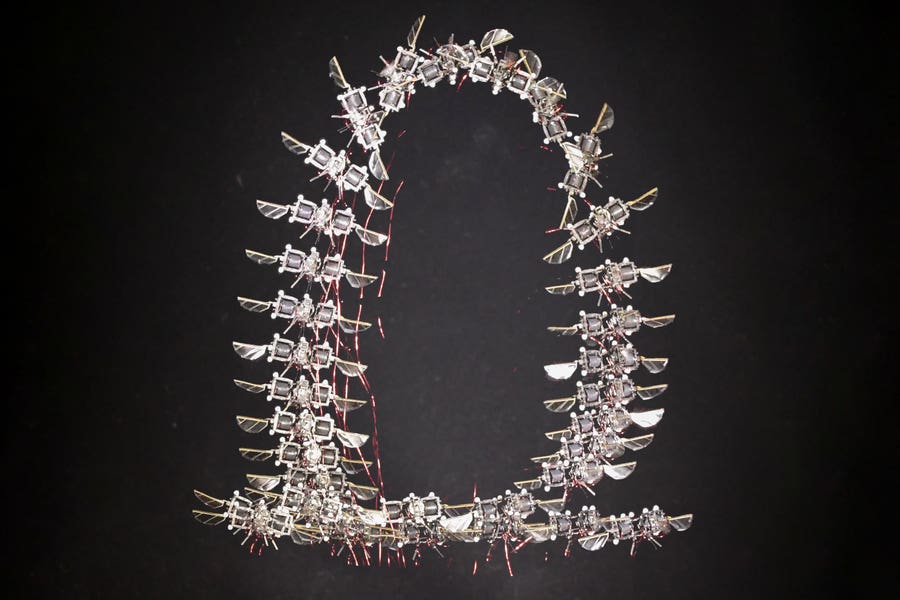
An MIT team taught a micro-robot to fly like an insect. With AI control, the tiny flapping machine leapt to 447% more speed and pulled off 10 somersaults in 11 seconds, even in windy tests. (CREDIT: MIT)
Tiny drones could one day crawl through collapsed buildings to help find survivors after earthquakes. These micro-robots, inspired by insects, now show flight skills close to the real thing. In lab tests, they zipped and flipped with a speed and agility that would have amazed even the most nimble bug.
From Fragile Flyers to Fast Fliers
For years, small flying robots — often called aerial microrobots — hovered slowly along smooth paths. They lacked the agility of real insects and often struggled whenever conditions got tricky. That changed thanks to work by researchers at MIT.
They built a tiny robot no bigger than a matchbox, with flapping wings driven by soft, flexible muscles. The hardware was ready. What held it back was its brain — the controller that tells it how to move. Until recently, that controller had to be tuned by hand. That limited how fast or how sharply the robot could fly.
Teaching the Robot to Fly Like a Bug
The breakthrough came when the team switched from manual tuning to artificial intelligence. Instead of hand-crafting every motion, they built a two-part control system. First, a high-powered mathematical planner maps out exactly how the robot should move to perform a maneuver. That planner works offline. Then the team uses that data to train a fast AI controller to fly in real time.
This approach captures the best of both worlds: the precision of advanced planning and the speed needed to react in mid-air. The result is a robot that can do aerobatic tricks — including 10 somersaults in 11 seconds — anything from tight turns to sharp pitches. Even gusts of wind that would knock many drones off course barely slowed it down.
“We want to be able to use these robots in scenarios that more traditional quad copter robots would have trouble flying into, but that insects could navigate,” said Kevin Chen, associate professor at MIT’s Department of Electrical Engineering and Computer Science and one of the lead authors.
Performance That Rivals Nature
In their tests, the microrobot’s flight performance exploded. Speed increased by 447 percent. Acceleration jumped 255 percent compared with prior versions. The robot never strayed more than a few centimeters from its planned path.
The team also demonstrated “saccade” – fast, abrupt motion insects use to stabilize vision and avoid obstacles. That kind of movement could help future versions carry cameras or sensors and move through cluttered, unstable terrain without crashing.
For you, that matters because it hints at a future where tiny robots do jobs too risky or too tight for people or larger machines. Think searching through collapsed buildings for survivors, exploring cramped tunnels after disasters, or reaching remote places in collapsed mines.
From Carbon Copy to Real-World Use
Of course, today’s tests happen under ideal lab conditions with motion-tracking cameras and controlled air currents. Real environments are messier. For these robots to help in real disaster zones, they will need onboard sensors. Cameras, lidar, or other systems could help them avoid obstacles and find victims in low light, dust, or falling debris. The researchers acknowledge this is the next major challenge.
"Adding these systems will increase weight and complexity. The soft wings and tiny motors will need to carry sensors while still flapping fast. Battery life, robustness against dust and moisture, and communication with rescuers will all need improvement", Kevin Chen told The Brighter Side of News. "The control method we developed makes this future even more possible."
Despite challenges ahead, the demonstration shows that these microrobots might do more than hover gently in clean air. They can flip, dart, and dive with strength and grace — the kind that makes you hope for a world where insects and machines work side by side to save lives.
Practical Implications of the Research
This advance in microrobotics could revolutionize search-and-rescue operations. Tiny flying robots might soon navigate through rubble to locate survivors when human rescue crews cannot safely go. Their speed, agility, and small size could allow access into narrow gaps and unstable rubble where larger robots or humans cannot reach.
Beyond rescue, the control method could enable new types of environmental monitoring, infrastructure inspection or disaster response tools that rely on small, low-weight drones with high maneuverability. With onboard sensors, these machines might map collapsed buildings, detect hazardous gas leaks or relay live images back to first responders.
Future electronics, too, could benefit from the AI-driven control framework. The same principles might allow other ultra-lightweight devices — such as sensor swarms — to operate under harsh or uncertain conditions.
The success of this project also opens new directions for robotics research. Demonstrating that soft, micro-scale machines can achieve insect-level flight challenges assumptions about size, stability, and control. It invites further work on integrating sensors, improving autonomy, and scaling production so these robots can move from the lab into real-world use.
Overall, the authors’ work brings us closer to a future where small flying machines help humans instead of simply mimicking nature.
Research findings are available online in the journal Science Advances.
Related Stories
- Tiny, insect-eye-inspired camera captures high-speed motion in near darkness
- Scientists combine magnetic microrobots with ultrasound stimulation to grow new neurons
- Autonomous microrobot sets new standard for precision surgery deep inside the body
Like these kind of feel good stories? Get The Brighter Side of News' newsletter.
Shy Cohen
Writer