TRAPPIST-1’s solar flares could reshape the search for habitable planets
New studies reveal how TRAPPIST-1 flares shape planets and how scientists cut through stellar noise to find distant atmospheres.

 Edited By: Joshua Shavit

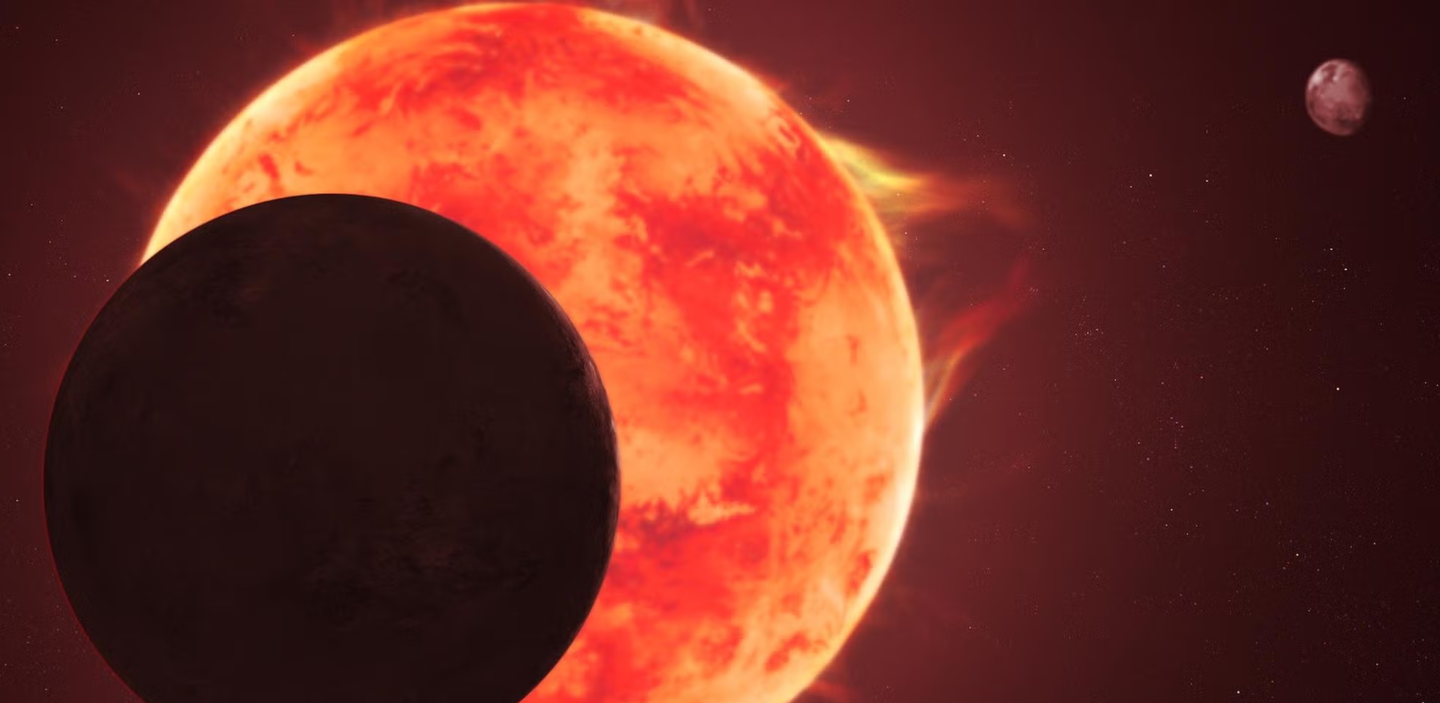
Artist’s concept of a planet called TRAPPIST-1d passing in front of the star TRAPPIST-1. (CREDIT: NASA, ESA, CSA, Joseph Olmsted/STScI)
TRAPPIST-1 looks small and calm from Earth. Up close, it is anything but. The cool red star about 40 light-years away erupts with bursts of energy many times each day, sending radiation racing across a tight family of seven rocky worlds. Three of those planets circle in the narrow zone where liquid water could exist. That promise keeps astronomers staring. The trouble is the star itself.
TRAPPIST-1 is a noisy neighbor. Its flares wash over the planets in erratic waves, and the same outbursts also spill into the data from NASA’s James Webb Space Telescope. The signal scientists seek is faint, the chemical trace of a thin atmosphere wrapped around a distant Earth-sized world. The star’s glare often drowns it out.
Two new lines of research now offer hope and a warning.
The Star That Gets in the Way
For years, TRAPPIST-1 has been a top target because its planets line up just right for Webb to study their skies when they pass in front of the star. More than 260 hours of telescope time have gone into those observations. Yet flares and starspots shift the star’s brightness by hundreds or even thousands of parts per million. A planet’s atmosphere might change that light by only 50 to 100.
Scientists have learned that they cannot wish the noise away. Instead, they must understand it.
A team working with Webb data built the largest library yet of real TRAPPIST-1 flares, gathering hours of observations from the telescope’s near-infrared instruments. From that archive, they focused on six strong flares, measured how hot each became, then grouped the data by temperature. They stacked similar moments together to create high-quality “reference flares,” fingerprints that capture how the star changes as it erupts.
Those fingerprints revealed ripples tied to molecules already known to exist in the star’s cooler background glow. In other words, a flare does not just add light. It reshapes what was already there.
That insight led to a practical fix. By matching each moment in the data to a reference flare of the right temperature, the team could subtract most of the stellar noise. The result was a cleaner view that pushed leftover errors down to about 60 parts per million at certain wavelengths. It is not perfect, but it is close to what astronomers need to spot the breath of an alien world.
A Peek Inside the Outbursts
Another study, led by the University of Colorado Boulder, went after the other half of the riddle: what drives TRAPPIST-1’s tantrums in the first place.
Ward Howard, a NASA Sagan Fellow at CU Boulder, and his colleagues used Webb data alongside computer simulations known as RADYN models to rewind each flare to its start. The models trace how magnetic fields snap and fling beams of electrons into the star’s outer gas. That impact blasts the gas until it glows.
The group examined six flares recorded in 2022 and 2023. Their work appeared in The Astrophysical Journal Letters.
“We think that the innermost TRAPPIST-1 planets are just bare, denuded rocks because the star has blown away their atmospheres,” Howard said.
The results brought a surprise. Compared with flares from similar stars, TRAPPIST-1’s outbursts appear relatively mild. The electron beams that power them seem about ten times weaker than expected.
“These flares were a little wimpier than we expected,” Howard said.
Do not confuse weak with harmless. Even modest flares release floods of X-rays and ultraviolet light. Over time, that radiation can peel away a planet’s air or scramble the chemistry needed for life.
Can a Planet’s Air Still Be Seen?
With better cleanup methods in hand, the Webb teams ran a key test. They planted a fake atmosphere into the real flare data, a thick cloak of carbon dioxide, then tried to recover it after removing the star’s noise.
Both the empirical method and the physics-based RADYN approach succeeded when the signal was strong enough. They reached reliable detections at roughly 200 parts per million. A simpler correction failed more often.
The result does not prove that any TRAPPIST-1 planet has an atmosphere. It shows that the search is not hopeless.
There is a catch. Many of the flares used in the study took place outside of planet crossings. Real observations will also suffer from starspots sliding across the face of the star and flares that ignite mid-transit. Those hazards will add confusion.
Even so, the progress matters. It means scientists can now tell when the star is lying to them.
What the Star Does to Its Worlds
Understanding flares is about more than cleaning up data. It is also about the planets’ fate.
From the models, researchers estimated how much high-energy radiation each flare throws into space. They found that a single event can pour out trillions of trillions of ergs in X-rays and ultraviolet light. By linking those numbers to simpler telescope measurements, they created a way to estimate years of radiation exposure from a list of flares.
That matters when you wonder if a planet could stay wet or warm. A steady rain of intense light can strip away an ocean in geologic time.
One world still stands out: TRAPPIST-1e. Some early studies hint it could retain a thin, Earthlike air. The new work gives scientists a better ruler to measure how that air might change under a restless sun.
“If we can simulate these events using a computer model, we can reverse engineer how a flare might influence the radiation environment around each of these planets,” Howard said.
Practical Implications of the Research
These advances give astronomers a fighting chance to read planetary atmospheres around active stars. The new tools can separate stellar flare noise from true chemical signals, helping to decide which worlds still have air and which are already stripped bare.
On Earth, the findings sharpen models of how radiation drives climate and chemistry on distant planets. They also guide where to aim precious telescope time. Worlds around calmer stars may offer clearer views and better odds for life.
For TRAPPIST-1, the work delivers both caution and promise. Some planets likely lost their skies long ago. Others may still cling to thin blankets of gas. With smarter methods, researchers can now test those ideas rather than guess.
The star will keep flaring. Scientists, at last, are learning how to listen through the noise.
Research findings are available online in the journal The Astrophysical Journal Letters.
Related Stories
- Exoplanet TRAPPIST-1e may hold Earth-like atmosphere, JWST finds
- JWST detects phosphine gas in the atmosphere of brown dwarf star, stunning astronomers
- Red dwarf stars are unlikely to host planets with advanced life and civilizations
Like these kind of feel good stories? Get The Brighter Side of News' newsletter.
Joseph Shavit
Writer, Editor-At-Large and Publisher
Joseph Shavit, based in Los Angeles, is a seasoned science journalist, editor and co-founder of The Brighter Side of News, where he transforms complex discoveries into clear, engaging stories for general readers. With vast experience at major media groups like Times Mirror and Tribune, he writes with both authority and curiosity. His writing focuses on space science, planetary science, quantum mechanics, geology. Known for linking breakthroughs to real-world markets, he highlights how research transitions into products and industries that shape daily life.