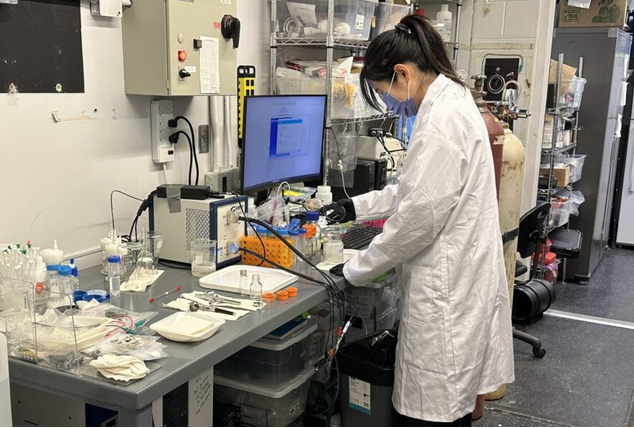
UPenn researchers trained dogs to sniff out canine cancer by scent
Trained dogs can identify a hemangiosarcoma scent signature in canine blood serum under double-blind tests.

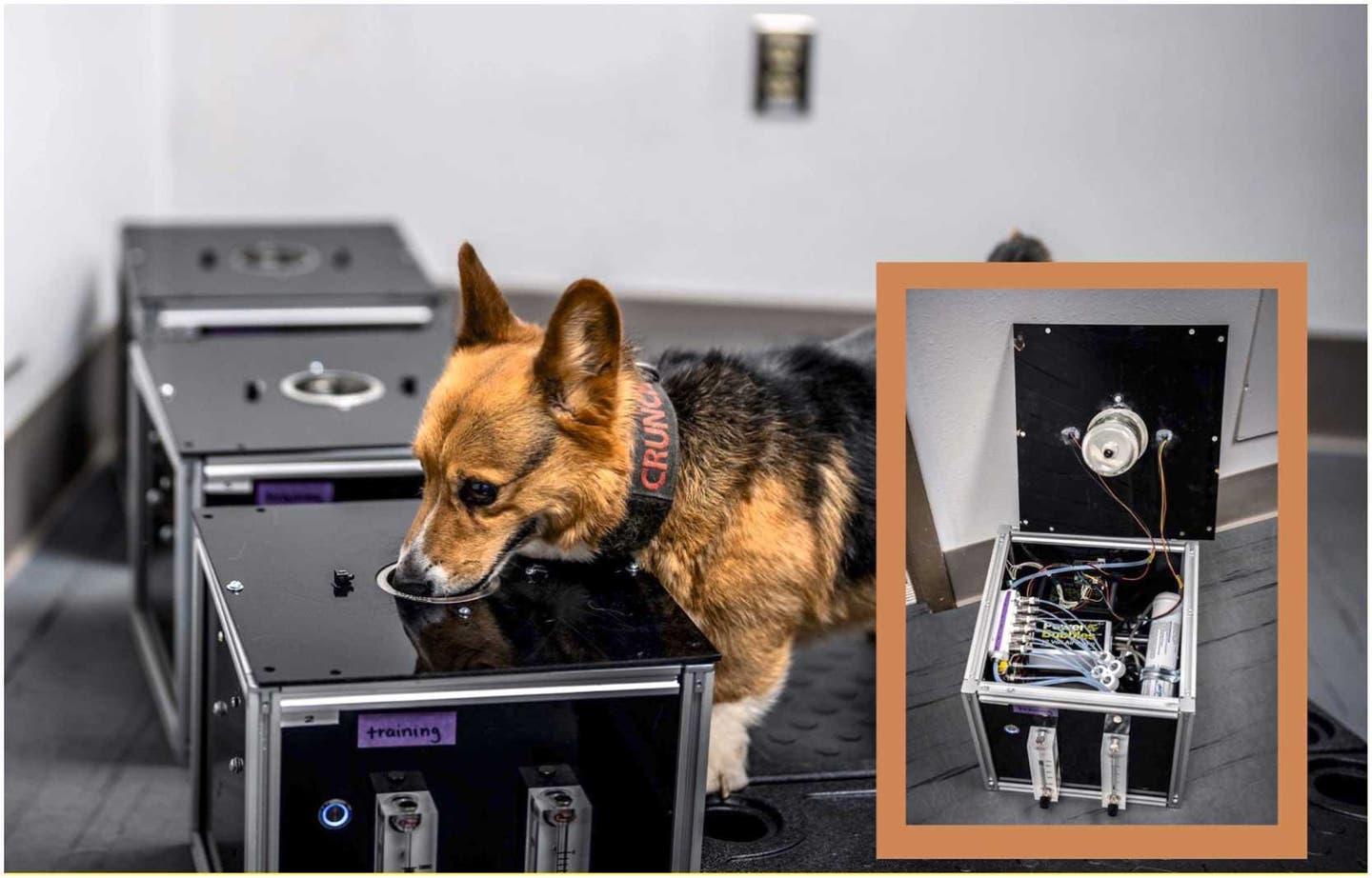
An image of the olfactometer line-up. Embedded image shows the inner workings of the olfactometer. (CREDIT: The Veterinary Journal)
Cancer kills many people and pets each year. Studies suggest that between one-third and one-half of dogs will develop cancer during their lifetime. One of the most feared forms is hemangiosarcoma, an aggressive cancer that starts in blood vessel cells and can grow unnoticed until a crisis.
Researchers at the University of Pennsylvania’s School of Veterinary Medicine want to change that timeline. Cynthia M. Otto and colleagues, working with the Penn Vet Working Dog Center, tested whether hemangiosarcoma leaves a distinct odor trace in blood. Their results, published in The Veterinary Journal, suggest trained dogs can pick out that scent from blood serum under tightly controlled conditions.
Clara Wilson, a postdoctoral research fellow at Penn Vet’s Working Dog Center, explains what the dogs are keying in on. “We’re picking up on volatile organic compounds every time we smell something,” she told The Brighter Side of News. “The dogs have an ability to detect them at much lower levels than we can. These compounds are important because they seem to be the key to how dogs are able to smell things like cancer.”
Why this disease is so hard to catch
Hemangiosarcoma has earned a grim nickname as a “silent killer.” A dog can seem healthy, then suddenly collapse when a tumor ruptures and causes internal bleeding. Veterinarians often confirm the diagnosis only after invasive sampling and lab analysis of tissue.
The stakes are high because the outlook is poor once the disease is found. Reports in the field place median survival at about 2 to 3 months after spleen removal alone. With chemotherapy, survival often rises but still commonly stays under a year, depending on stage. The problem is not only how deadly the cancer is. It is also how late it appears on the radar.
Some breeds show reported predispositions, including German Shepherds, Golden Retrievers, and Labrador Retrievers. Hemangiosarcoma also makes up an estimated 45% to 51% of canine splenic cancers, and about 2% to 7% of all canine tumors. Across the U.S. dog population, that could translate to hundreds of thousands, and possibly millions, of lifetime cases.
How researchers put dogs to the test
The team drew serum samples from several sources, including the Morris Animal Foundation’s Golden Retriever Lifetime Study, Ryan Veterinary Hospital of the University of Pennsylvania, Tufts University, and Colorado State University. Pathologists confirmed hemangiosarcoma cases through histopathology from biopsies or necropsies.
To avoid a simple “sick versus healthy” shortcut, the study used three kinds of samples in matched sets: dogs with confirmed hemangiosarcoma, dogs with noncancer illnesses, and healthy dogs. The diseased controls included conditions such as inflammatory, endocrine, gastrointestinal, or benign organ disease. The researchers matched samples for age and sex within each collection site to reduce handling and storage effects.
Five bio-detection dogs completed training and entered double-blind testing. Each dog evaluated 12 matched sample sets, with seven trials per set. None of the test samples had appeared during training. The dogs had prior experience detecting odors linked to other conditions, including chronic wasting disease, post-traumatic stress disorder, human ovarian cancer, and human pancreatic cancer.
The researchers used automated olfactometers to present samples and record decisions. Wilson describes the setup. “We used olfactometers, which are very high-tech—they actually have a little infrared laser beam going across the top,” Otto said. “When that beam is broken, it will register that the dog is interrogating the sample. And if they then stay in that beam for long enough—and it's the correct sample—they'll hear a tone, and they’ll know to come and get their treat.”
What the dogs found, and what it means
During double-blind testing, neither handlers nor people in the room knew whether a target sample appeared in a given trial. The software also hid which port held the target when present. That design helps prevent subtle cues from shaping results.
On average, the dogs correctly identified hemangiosarcoma samples 70% of the time. Wilson said that result sits in the range seen in studies of dogs detecting human cancers. “This is very encouraging,” she said. “Detecting cancer is incredibly hard—it’s a very complex smell.”
A more detailed analysis showed the dogs alerted far more often to hemangiosarcoma samples than to either control type. Alerts to diseased controls and healthy controls did not differ much from each other. That pattern matters because it suggests the dogs did not simply learn to flag “illness.” Instead, they appeared to respond to an odor profile tied more closely to the cancer category.
The study also surfaced a real-world complication. One sample produced unusually poor performance and later drew conflicting pathology interpretations. When researchers excluded that disputed case, accuracy and related measures rose modestly, but the overall conclusion stayed the same.
Otto frames the clinical urgency in straightforward terms. Detected early, she said, “we could prevent the disease from spreading, because it’s the spread that’s really devastating.” She added that veterinarians could consider removing the spleen before it ruptures or starting chemotherapy sooner to save lives.
Wilson points to how a future screening tool could fit into routine care. “It could flag a potential issue so that the owner could get further testing, such as ultrasound or CT scans,” she said. “It could really help catch it early for these dogs where we're just finding it far too late.”
Practical implications of the research
This study does not argue that detection dogs should become the standard screening system. Training, access, and scale make that unlikely. Instead, the dogs provide biological evidence that hemangiosarcoma leaves a measurable scent signature in blood serum.
That evidence can guide the next step: identifying the specific volatile organic compounds behind the odor profile and turning them into practical tests. In the long run, a minimally invasive screening approach could help veterinarians spot risk earlier, order confirmatory imaging sooner, and begin treatment before a sudden collapse.
Earlier detection could also strengthen research. If clinicians find cases sooner, researchers can enroll dogs in clinical trials at stages when therapies have a better chance to work. Wilson calls the work “an initial kernel of hope.” For families, that hope could translate into more time, fewer emergencies, and clearer decisions.
Research findings are available online in The Veterinary Journal.
Related Stories
- Breakthrough cancer therapy extends lives of terminally ill dogs
- Prostate cancer antibody drug shows success in dogs
- Dogs can detect Parkinson’s disease by sniffing skin, study finds
Like these kind of feel good stories? Get The Brighter Side of News' newsletter.

Hannah Shavit-Weiner
Medical & Health Writer
Hannah Shavit-Weiner is a Los Angeles–based medical and health journalist for The Brighter Side of News, an online publication focused on uplifting, transformative stories from around the globe. Passionate about spotlighting groundbreaking discoveries and innovations, Hannah covers a broad spectrum of topics—from medical breakthroughs and health information to animal science. With a talent for making complex science clear and compelling, she connects readers to the advancements shaping a brighter, more hopeful future.