Whale fossils reveal evidence of ancient shark attacks
Embedded shark teeth in fossil whale skulls reveal how ancient predators fed in the North Sea millions of years ago.

 Edited By: Joseph Shavit

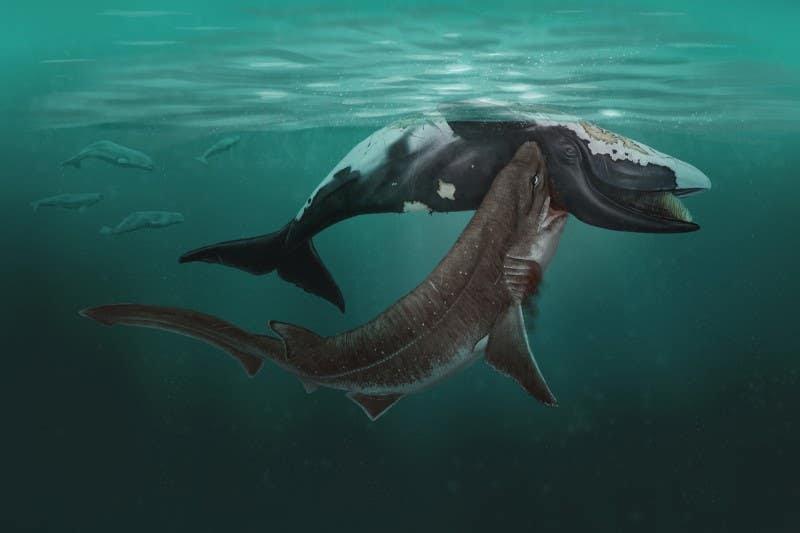
A painted reconstruction of a bluntnose six-gill shark (or cow shark) scavenging on a tiny extinct right whale carcass during the Early Pliocene of the southern North Sea. (CREDIT: Alexander Lovegrove)
A broken tooth lodged deep in bone can outlast the animal that lost it. In two whale skulls from Belgium, those fragments have done exactly that, preserving a moment of violence from roughly five million years ago.
The skulls, both from the Early Pliocene, carry more than scratches. Embedded within them are pieces of shark teeth, snapped off during feeding. That detail matters. Bite marks alone can be ambiguous, but a tooth fragment ties predator and prey together with unusual clarity.
Dr. Olivier Lambert of the Institute of Natural Sciences in Brussels led the analysis using CT scans, which revealed the hidden fragments without damaging the fossils. “Our knowledge of past marine mammal assemblages in the North Sea remains rather fragmentary, so any new fossil may prove informative,” he said. “In this case, the studied skulls revealed some unexpected and fascinating clues about the way these whales' life ended.”
A closer look inside ancient bone
One skull belonged to a small extinct right whale, Balaenella brachyrhynus. The other came from a juvenile monodontid, a relative of today’s beluga and narwhal. Both were recovered from the Antwerp region, though decades apart by fossil enthusiasts.
For years, the bones sat as typical specimens. Only recently did micro-CT imaging expose what lay inside.
In the right whale skull, researchers found a fragment matching the bluntnose sixgill shark, Hexanchus griseus. The position of the bite marks told a specific story. They sit on the upper part of the skull, suggesting the whale was already dead and floating belly-up when the shark fed on it.
That detail shifts the interpretation from hunting to scavenging.
The marks themselves appear in parallel grooves, consistent with the multi-cusped teeth of sixgill sharks. At some point during the bite, the tip of a tooth snapped and remained embedded in the bone.
A single moment, preserved.
A different kind of attack
The second skull tells a more forceful story.
Here, the embedded tooth belongs to Carcharodon plicatilis, an extinct relative of modern great white sharks. The fragment sits deep in the back of the skull, near the base of the head.
To reach that point, the shark’s teeth would have had to pass through thick muscle. That suggests a powerful bite, possibly aimed at separating the head from the body.
Researchers note that similar behavior appears in modern sharks, which sometimes sever parts of marine mammals before consuming them. The fossil evidence aligns with that pattern.
The skull also carries multiple bite marks across the snout, including the region where fatty tissue would have been concentrated. That area, rich in energy, may have made it an attractive target.
Still, one question remains unresolved.
Hunting or scavenging?
In both fossils, there are no signs of healing. The whales did not survive the encounters. What remains unclear is whether the sharks killed them or fed after death.
The right whale specimen leans toward scavenging, based on body position and bite placement. The monodontid skull leaves more room for interpretation, with signs pointing toward active predation but no definitive proof.
Professor John Stewart, who discovered one of the skulls as a teenager, emphasized the importance of the find. “Palaeontologists often have to make assumptions about the interactions between many of the species from this period,” he said. “This study provides them with actual evidence they can work with – not just bite marks, but fragments from the predators who made the bites.”
That distinction matters in paleontology, where direct evidence is rare.
A very different North Sea
The fossils also reshape how you picture northern European waters millions of years ago.
Today, large predatory sharks are mostly absent from the southern North Sea. During the Pliocene, the region supported a far richer ecosystem, with whales and large sharks interacting regularly.
Several of the shark species identified in the fossils still exist today, including the sixgill shark. Yet they no longer inhabit these waters in the same way.
Dr. Lambert pointed to shifting conditions as a possible explanation. “These findings are a first step towards understanding changes through time in the availability of prey in the southern North Sea and the loss of large predatory sharks in this area,” he said.
Climate, prey distribution, and habitat changes likely all played a role.
He added that modern changes could again reshape these patterns. “Given that ongoing climate change is altering the distribution of marine mammals, including in the North Sea, it is likely that the distribution of their predators will also change. Could great white sharks return to the North Sea to feed on local seal populations?”
It is not just a question about the past.
It is also about what might come next.
Practical implications of the research
These fossils offer rare, direct evidence of predator-prey interactions in ancient oceans, helping scientists understand how marine ecosystems shift over time.
By linking shark species to specific feeding behaviors, the study improves models of how predators respond to changes in prey availability.
That insight could help researchers anticipate how modern marine food webs may reorganize as climate change alters the distribution of whales, seals, and large sharks.
Research findings are available online in the journal Acta Palaeontologica Polonica.
The original story "Whale fossils reveal evidence of ancient shark attacks" is published in The Brighter Side of News.
Related Stories
- Filmed for the first time: Killer whales attack and kill great white sharks
- Fossils show giant sharks evolved far earlier than expected
- Bull sharks have friends, and they choose them carefully
Like these kind of feel good stories? Get The Brighter Side of News' newsletter.
Rebecca Shavit
Writer
Based in Los Angeles, Rebecca Shavit is a dedicated science and technology journalist who writes for The Brighter Side of News, an online publication committed to highlighting positive and transformative stories from around the world. Her reporting spans a wide range of topics, from cutting-edge medical breakthroughs to historical discoveries and innovations. With a keen ability to translate complex concepts into engaging and accessible stories, she makes science and innovation relatable to a broad audience.