300-million-year-old sea creature mistaken for the world’s oldest octopus
Hidden teeth inside a famous fossil show the world’s oldest “octopus” was really a nautiloid.

 Edited By: Joseph Shavit

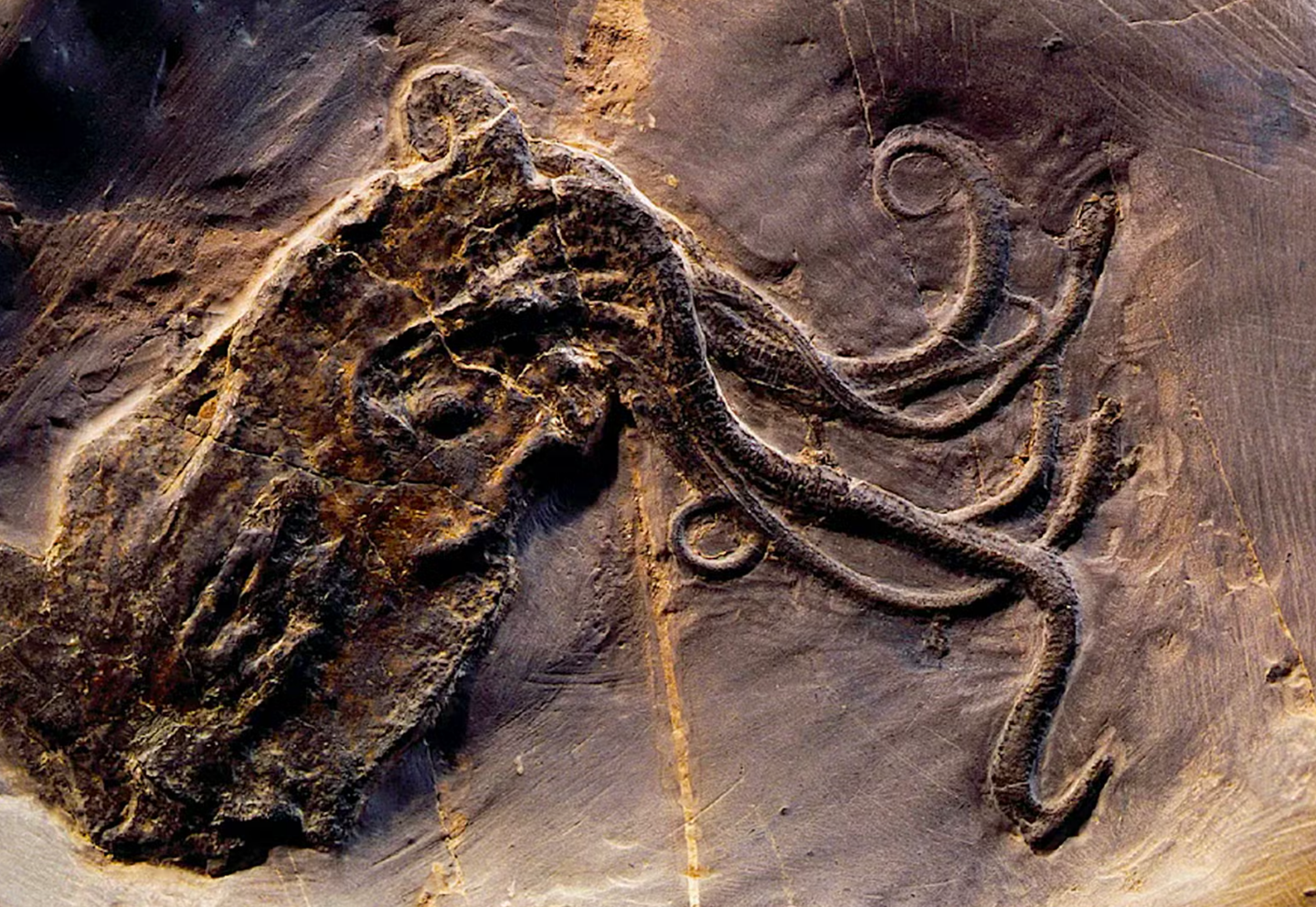
A famous 300-million-year-old “octopus” fossil was actually a nautiloid, hidden by decay before fossilization. (CREDIT: Isabelle Kruta et al., in Palaeontology)
For years, this fossil seemed to tell a thrilling story. Here was an animal from more than 300 million years ago that appeared to look like an octopus, complete with what were described as arms, fins and no visible shell. It was so important that it helped push the origin of octopuses far deeper into Earth’s past than many scientists had expected.
Now that story has collapsed.
A new reexamination of Pohlsepia mazonensis, a famous fossil from Illinois, has found that the supposed “oldest octopus” was not an octopus at all. Instead, researchers say it belonged to a nautiloid, a group related to today’s Nautilus, the shelled marine animal often called a living fossil. The real clue came from tiny teeth hidden inside the rock for hundreds of millions of years.
“It turns out the world’s most famous octopus fossil was never an octopus at all,” said Dr. Thomas Clements, lead author of the study and a lecturer in invertebrate zoology at the University of Reading. “It was a nautilus relative that had been decomposing for weeks before it became buried and later preserved in rock, and that decomposition is what made it look so convincingly octopus-like.”
The study appears in Proceedings of the Royal Society B Biological Sciences.
A fossil that changed the timeline
When Pohlsepia mazonensis was first described in 2000, it caused a stir. The fossil came from the late Carboniferous Mazon Creek Lagerstätte in Illinois, dated to about 311 to 306 million years ago. Researchers at the time interpreted it as a cirrate octopus, a kind of deep-sea octopus with fins.
That mattered because it would have made Pohlsepia the oldest known octopus by more than 150 million years. The fossil then became a major reference point in studies of cephalopod evolution. Its existence helped support the idea that octopuses and their close relatives split much earlier than the fossil record had otherwise suggested.
Yet the fossil never sat comfortably with everyone.
Scientists had pointed out for years that many of its supposed octopus traits were uncertain. The fossil lacked some key features expected in a cirrate octopus, including signs of an internal shell vestige, a single row of suckers and arm cirri. Even the paired “eyespots” raised doubts. Earlier work found no evidence of melanosomes, the pigment-related structures that often preserve in fossil cephalopod eyes from Mazon Creek.
So the fossil remained famous, but uneasy.
The teeth inside the rock
This time, researchers took a much closer look.
They examined the specimen with several imaging methods, including scanning electron microscopy, micro-CT scanning, multispectral imaging and synchrotron micro-X-ray fluorescence. The synchrotron work, carried out at the SOLEIL facility in France, let them detect structures beneath the rock surface that ordinary observation could not resolve.
What emerged was the turning point in the case: a radula.
A radula is a ribbon-like feeding structure lined with rows of teeth, found in mollusks. In Pohlsepia, the researchers identified at least 11 elements in each row, along with beak-like mouthparts. That was enough to settle one question immediately. The fossil was definitely a mollusk.
It also ruled out an octopus.
Modern crown coleoids, the group that includes octopuses, squids and cuttlefish, have only seven or nine elements in each radula row. Nautiloids have 13. The researchers argue that Pohlsepia probably had 13 as well, but some parts were not preserved clearly enough to detect.
With that, the old identity gave way.
The radula also closely matched that of a fossil nautiloid already known from the same site, Paleocadmus pohli. The team concluded that Pohlsepia mazonensis is actually the same animal and should be treated as a junior synonym of Paleocadmus pohli.
Decay created the illusion
Part of what made the fossil so misleading was not anatomy alone, but decay.
The researchers argue that the animal had already begun to rot before it was geologically sealed inside a siderite concretion. That decay blurred or distorted soft tissues, creating shapes that could be mistaken for fins, arms and other octopus-like features.
The paper notes that the body outline and soft tissues remain difficult to interpret even after the new analysis. Some structures once read as fins may instead reflect decayed muscles or digestive tissues. The specimen also preserves no shell, which added to the confusion, though the authors think the soft body likely separated from its shell before burial.
That uncertainty matters because the study is also a cautionary tale. The fossil had long been used in broader arguments about cephalopod evolution, despite being based on one ambiguous specimen.
“Scientists identified Pohlsepia as an octopus 25 years ago, but using modern techniques showed us what was beneath the surface to the rock, which finally cracked the case,” Clements said. “We now have the oldest soft tissue evidence of a nautiloid ever found, and a much clearer picture of when octopuses actually first appeared on Earth.”
One row of hidden teeth changed the whole argument.
Octopus history shifts again
The reclassification removes a major problem from the octopus family tree.
Without Pohlsepia anchoring octopus origins in the Paleozoic, the fossil evidence lines up much better with studies that place the rise of crown octopods in the late Jurassic. The new paper says the fossil no longer conflicts with the broader body of evidence supporting a Mesozoic origin for octopuses and their relatives.
That means the split between octopuses and ten-armed forms such as squids likely happened much later than the old identification implied.
The newly interpreted fossil also sets a different record. According to the study, Paleocadmus now represents the oldest known nautiloid soft tissue in the fossil record, older than the previous record by about 220 million years.
That is a striking reversal. The fossil once seemed to rewrite octopus evolution. Now it strengthens the case that octopuses appeared later, while giving nautiloids a rare and much older soft-tissue record.
“Sometimes, reexamining controversial fossils with new techniques reveals tiny clues that lead to really exciting discoveries,” Clements said.
Practical implications of the research
This study changes more than the label on a museum fossil. It removes a misleading calibration point that had been used in studies of cephalopod evolution and helps bring fossil and molecular evidence into better agreement. It also gives scientists a clearer benchmark for when true octopuses likely emerged.
Just as important, the work shows how easily decay can disguise an animal before fossilization. A specimen that looked like a landmark octopus turned out to be something else because its body had already started breaking down.
That makes a strong case for reexamining famous fossils with newer imaging tools, especially when big evolutionary claims rest on a single, difficult specimen.
Research findings are available online in the journal Proceedings of the Royal Society B Biological Sciences.
The original story "300-million-year-old sea creature mistaken for the world’s oldest octopus" is published in The Brighter Side of News.
Related Stories
- Scientists rethink animal consciousness: Reptiles, fish, and insects may be sentient
- Scientists engineer microbe that mass-produces camouflage pigment
- Octopus-inspired glove securely grips objects underwater
Like these kind of feel good stories? Get The Brighter Side of News' newsletter.
Hannah Shavit-Weiner
Medical & Health Writer
Hannah Shavit-Weiner is a Los Angeles–based medical and health journalist for The Brighter Side of News, an online publication focused on uplifting, transformative stories from around the globe. Passionate about spotlighting groundbreaking discoveries and innovations, Hannah covers a broad spectrum of topics—from medical breakthroughs and health information to animal science. With a talent for making complex science clear and compelling, she connects readers to the advancements shaping a brighter, more hopeful future.