6,800 feet below ground, in the search for dark matter, something has gone very, very cold
Deep in a Canadian nickel mine, a detector colder than outer space has reached the milestone needed to begin searching for dark matter.

 Edited By: Joseph Shavit

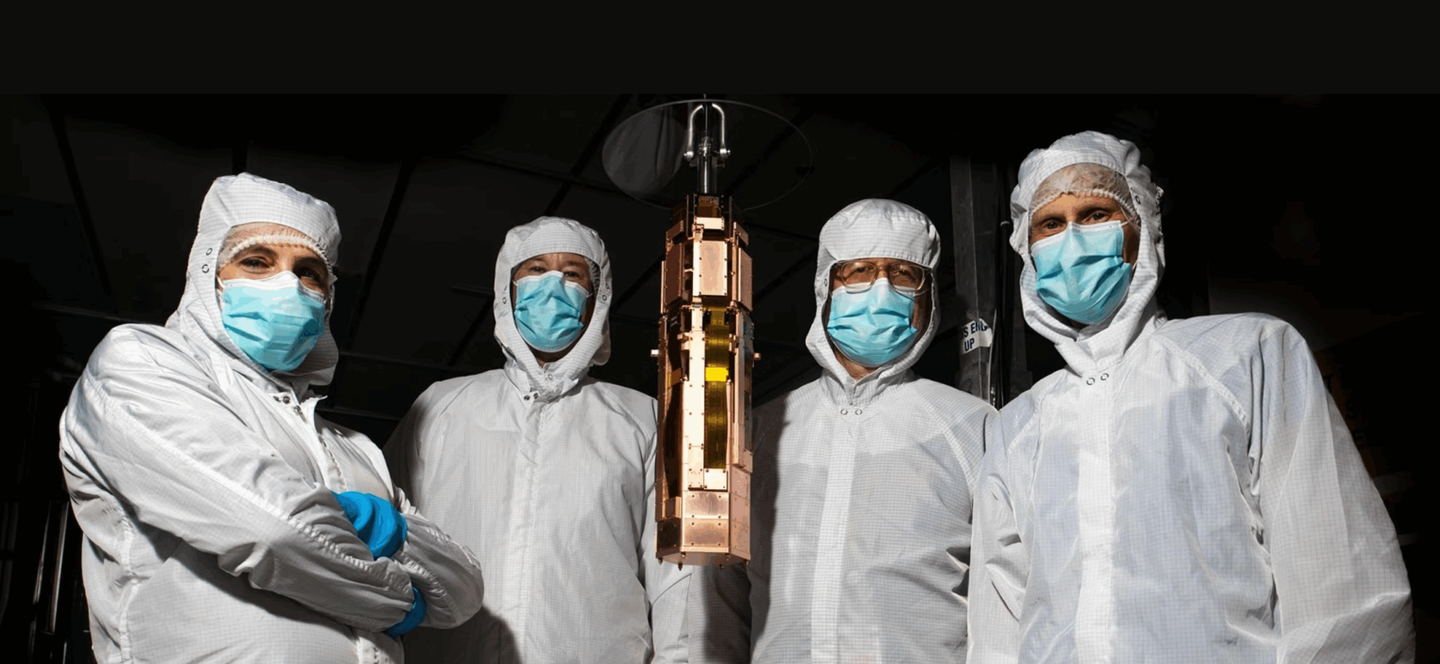
From left, SLAC research technical manager Concetta “Tina” Cartaro, staff scientist Paul Brink, senior staff scientist Richard Partridge and Santa Clara University physics professor Betty Young with the fourth, and final, SuperCDMS tower, in the SLAC Building 033 clean room. (CREDIT: Jacqueline Ramseyer Orrell/SLAC National Accelerator Laboratory)
Six thousand eight hundred feet below the floor of an active nickel mine in northern Ontario, something has gone extremely cold. Not cold in the way of a walk-in freezer, or a liquid nitrogen tank, or even the surface of the moon. Cold in a way that barely exists anywhere else in the universe: thousandths of a degree above the point where atomic motion itself ceases.
The temperature, several thousandths of a degree above 0 Kelvin (about -273°C or -460°F), was achieved during the final cooling stages of the international assembly of scientists and engineers involved with this experiment. The SuperCDMS experiment is designed to detect and measure dark matter.
"When we say that the base temperature is the temperature that our system reaches once the complete thermal load of the experiment has been applied," Kelly Stifter, a Panofsky Fellow at SLAC National Accelerator Laboratory and member of the SuperCDMS team, stated, "we mean at that point, our detectors can function in the way we designed them."
The accomplishment effectively transitions this experiment from a construction project into a functioning scientific instrument aimed at investigating one of the fundamental mysteries of physics.
Understanding Dark Matter
How do we know that dark matter exists? What is it like? Why is it so difficult to identify or detect? The simplest answer to these questions is that there is no direct evidence indicating what dark matter might be like.
It is only possible to conclude from current cosmological models of the Universe that the majority of mass is completely invisible. Around eighty-five percent of the Universe is composed of dark matter. This matter does not emit visible light, nor does it reflect light.
It interacts with regular (baryonic) matter only through the force of gravity, and scientists have yet to find a way to observe dark matter directly. Many scientists are convinced that there is a great deal of dark matter because galaxies rotate in ways that are only possible if there are very large amounts of unseen mass keeping them together.
The observed large-scale structure of the Universe compares very well to how scientists expect the Universe to be structured when dark matter is included in simulations. According to Stifter, "We have strong astrophysical evidence that the Milky Way is surrounded by a region of dark matter."
Detecting The Invisible
"Dark matter is passing through us constantly. We just need to make a sensitive enough particle detector with very low outside noise to detect when an interaction between dark-matter particles and regular (baryonic) matter occurs."
The engineering challenge lies in designing a detector that can be quiet enough. Dark matter particles are expected to interact with ordinary matter at an extremely low rate and with very little energy.
Any vibration caused by a vehicle on the road, any cosmic ray that hits the detector, or any trace of radioactivity in the surrounding rocks will generate signals. These signals can overwhelm the detectors when trying to measure an interaction of dark-matter particles with baryonic matter.
One way to eliminate many sources of background noise is to place the detector deep below the Earth's surface. The SNOLAB facility is approximately 6,800 feet underground and is relatively sheltered from background radiation, including cosmic rays.
Engineering Extreme Conditions
The rock above the laboratory site serves as a filter. It permits only the most penetrating and rare particles to reach the lab, while blocking nearly all others.
The "cold" refers to the extremely low temperatures required for the detectors to operate. SuperCDMS utilizes 24 crystal detectors composed of extremely pure silicon and germanium, each about the size of a hockey puck.
When a dark matter particle collides with a crystal, it produces a minor vibration, known as a phonon, and a weak electronic signal. Superconductors are used to detect these signals, and they can only do this when cooled to a specific temperature range.
According to SLAC scientist Richard Partridge, who oversees the installation of the experiment, "the superconductors cannot operate unless they have been cooled to the temperature range required for them to be in the superconducting regime (roughly 15 to 30 millikelvins)."
Cooling To Near Absolute Zero
In comparison, the average temperature of the universe is approximately 2.7 kelvins. The SuperCDMS detectors must operate at 0.015 to 0.030 kelvins, or around 90 to 180 times colder than the cosmic background radiation.
At these extremely low temperatures, the constant random motion of atoms, which can mask signals, effectively ceases. "When everything is at these temperatures, the energy deposited is tiny and therefore can be detected," said Partridge.
The cooling process was completed in multiple steps. It began at 293 kelvins, then moved to approximately 50 kelvins, then 4 kelvins, 1 kelvin, and finally to the millikelvin range.
An additional cooling system was installed to cool the readout cables of the experiment. This prevents them from transferring heat back to the detectors. "It is not a simple procedure of just pressing a button and observing a temperature decrease," Stifter said.
Eliminating Background Noise
Noah Kurinsky, a scientist at SLAC, said there are numerous ways of checking that all elements of the system are running smoothly. "There are mechanical checks, thermal checks, vacuum integrity checks. There is a lot of checking, and for a system that is unique, it went very well," he shared with The Brighter Side of News.
Although the detector must reach the correct temperature, that alone is not enough. A detector that is cold enough to detect dark matter is also sensitive enough to detect other forms of noise.
This includes low levels of radioactivity from the environment, gamma rays produced when cosmic rays hit the cavern walls, and neutrons generated by similar interactions.
The University of Minnesota Twin Cities team was responsible for shielding the experiment from this background noise. The team designed and assembled a four-meter-high, four-meter-diameter cylindrical enclosure made of ultra-pure lead to absorb gamma rays.
A New Frontier In Detection
High-density polyethylene was also used to slow down and capture neutrons. "Getting to the lowest temperature was a huge accomplishment for creating a place to safely store our extremely sensitive, low-background, baselined facilities that will house our cryogenic solid-state detectors," said Priscilla Cushman.
SuperCDMS is not only sensitive to dark matter, but is also unique in the range it can study. Most past experiments have focused on detecting dark matter particles with masses much heavier than a proton.
SuperCDMS will instead search for lighter dark matter. The detectors are designed to probe a mass range that has not been accessible to previous experiments.
"Few searches have ventured deep into this area yet," Stifter said. This region is expected to deliver world-leading sensitivity.
Preparing For Discovery
Meanwhile, the team is continuing to commission the detectors. Over the next few months, they will activate, calibrate, and optimize multiple readout channels for each of the twenty-four detectors.
Even an initial one-day run will yield results. According to Kurinsky, "Because there are more sensors for each detector in comparison to past SuperCDMS experiments, along with new simulation techniques and artificial intelligence-assisted reconstructions, the amount of raw data we will acquire will exceed the original target by far."
"Every day will be different, and this is truly scientific exploration."
The newly achieved sensitivity could allow for research beyond dark matter. This includes studying rare isotopes and making measurements in ranges that no existing instrument has reached.
Broader Implications
It may also lead to the discovery of new kinds of particle interactions that exist outside currently accepted theories.
Dark matter has long been a hypothetical construct inferred through gravitational effects without direct observation. Proving the existence of dark matter particles would represent an entirely new class of matter.
It would also open a new chapter in particle physics.
However, there is no guarantee that SuperCDMS will produce definitive evidence. Dark matter may have properties outside the detectable range of the experiment.
Looking Ahead
For example, it may have a greater mass than the detectors can measure, or it may interact through mechanisms that the detectors are not sensitive to.
Even so, investigating unexplored mass ranges helps narrow the range of possibilities. The infrastructure developed for SuperCDMS has broader implications beyond this single experiment.
The extreme cryogenic techniques, ultra-low background shielding, and artificial intelligence methods used to reconstruct rare event signals can be applied to many future experiments across physics, materials science, and medical imaging.
The SNOLAB underground laboratory currently hosts multiple experimental programs. The engineering knowledge gained from SuperCDMS will contribute to the development of future instruments.
Until then, the team will continue to build, calibrate, and optimize each detector over the coming months, working nearly two kilometers below the surface. Everything will take place out of sight and sound, as researchers wait for the first signal from something that has never been directly observed before.
The original story "6,800 feet below ground, in the search for dark matter, something has gone very, very cold" is published in The Brighter Side of News.
Related Stories
- Dark matter and neutrinos are linked and interact with each other
- Nearly invisible galaxy may be built mostly of dark matter, Hubble finds
- Dark matter may consist of particles with different masses
Like these kind of feel good stories? Get The Brighter Side of News' newsletter.
Shy Cohen
Writer