Ancient Ocean Volcanoes Linked to Repeated Triassic Extinctions
New research from the Tibetan Plateau links repeated underwater volcanic eruptions to multiple marine extinctions during the Triassic Period.

 Edited By: Joseph Shavit

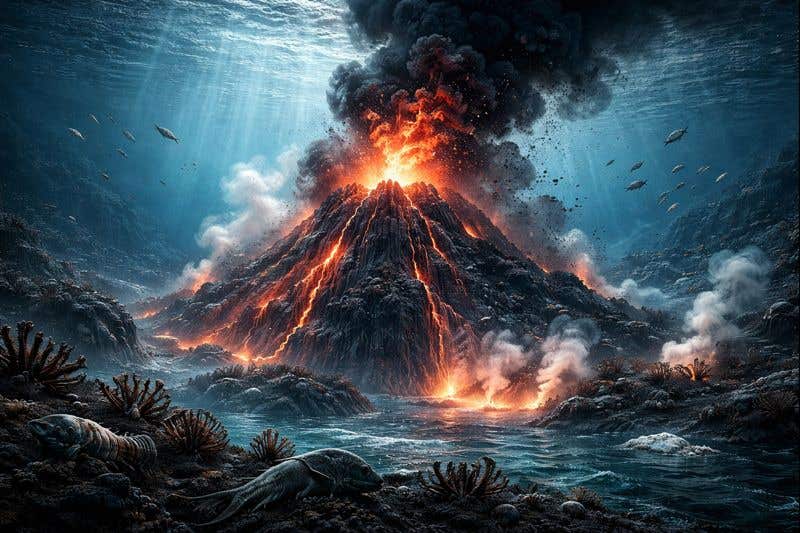
Ancient underwater volcanoes may explain why marine life repeatedly collapsed during the Triassic, according to new geological evidence. (CREDIT: AI-generated image / The Brighter Side of News)
Mass extinction events throughout Earth's history are characterized as significant disruptions to life on the planet. There have been five major extinction events that have fundamentally changed how life exists on Earth; however, many smaller but equally significant extinction events also occurred.
The primary focus of scientists regarding mass extinction events has been on identifying what caused the five major extinction events. There has not been nearly as much work done to determine what caused the many lower-level extinction events that occurred repeatedly, especially during the Triassic Period, when life experienced repeated failures to recover.
Research conducted by Jian-Jun Fan and his co-authors from the College of Earth Sciences at Jilin University, provides insight into the mystery of what triggered these lower-level extinctions. They studied volcanic deposits formed along the Tibetan Plateau, a region that was once part of a large ocean. Their findings, published last month in the journal Geology, provide evidence that repeated volcanic eruptions at the ocean floor were responsible for causing at least four extinction events in marine organisms during the Triassic.
Forensic studies of the remains of very large volcanic systems, known as marine large igneous provinces (LIPs), were used in this research. LIPs develop from the active eruption of lava and other materials, which occurs when deep mantle plumes are active and significant amounts of magma are released at or near the seafloor.
The authors of this study, after analyzing the fossil and chemical records from the Triassic, identified three distinct eruption periods: approximately 250 to 248 million years ago; approximately 233 to 231 million years ago; and approximately 210 to 208 million years ago. Each of these events coincided with major disruptions to marine organisms.
Traces Of The Ill-Fated Ocean
The authors of the study determined, by combining the results of their geological analyses with information obtained from other sources, that nearly half of all known Triassic extinctions can be attributed to LIPs. The evidence indicates that underwater eruptions resulted in significant decreases in oxygen levels in the oceans. In turn, these eruptions produced highly toxic conditions to which marine organisms could no longer adapt.
In the Triassic time period, Pangaea, Earth's supercontinent, was comprised of all continents meshed together, while two of the world's oceans, Meso-Tethys and Neo-Tethys, split the supercontinent apart. New studies indicate that these oceans likely merged to form a contiguous basin in the eastern part of Pangaea, called the “Meso(Neo)-Tethys Ocean.”
The ocean has long since disappeared, but many parts of its former seafloor exist today on the Tibetan Plateau. When tectonic plates collided, the ocean plates closed up, and sections of the oceanic crust were scraped off and preserved at narrow locations referred to as sutures. These sutures represent areas comprised of volcanics and sediments created in the ocean at locations distant from any continent.
"Our research team examined remnants of volcanoes located at Gufeng, Gongzhuco, Nare, Nadong, Tarenben, and Maqiaco. These sites represented former areas of the ocean floor where islands, underwater mountains, and plateaus were created through volcanic eruption," Fan shared with The Brighter Side of News.
Pinning Down When The Vent Eruptions Occurred
The analysis indicates not only evidence for one specific voguet, but evidence of multiple instances of mantle plume activity. These hot spots of molten rock from below Earth’s crust continued to grow through the oceanic plate and transform the marine ecosystem over millions of years.
To establish when these eruptions occurred, researchers dated zircon and titanite crystals using high-resolution uranium-lead biostratigraphy. These two minerals form during voguet activity and store radioactive chronostratigraphic records of their formation ages.
Two prominent intervals of Triassic eruption activity were identified. The first interval occurred during the Early to Early Middle Triassic, approximately 249 to 237 million years ago. Large volcanic plateaus and island chains formed during this period at sites such as Gufeng, Gongzhuco, Nadong, and Nare. A later phase, dated to approximately 210 to 204 million years ago, created volcanic systems at Tarenben and Maqiaco.
The ages of zircon crystals from volcanic rocks at Gufeng cluster around 248 million years old. At Gongzhuco, both zircon and titanite dating indicate eruptions occurred between 249 and 246 million years ago. The volcanic record from Nadong indicates two distinct volcanic periods, one during the Middle Triassic and another during the Late Triassic.
Fossil evidence supports these age estimates. For example, chert layers at Nadong contain radiolarian fossils found in Carnian- and Norian-aged sediments. These correspond to the ages of volcanic ashes in nearby deposits.
Chemical Signatures Of Deep Mantle Plumes
The formation of these rocks can be understood by examining their chemistry. Using more than 160 rock samples and synthesizing new results with previously published data, Fan and colleagues determined the chemical composition of the volcanic rocks.
The chemical signatures fall into two main categories. One category resembles modern mid-ocean ridge basalts, which exhibit minor enrichments in rare earth elements and likely formed in a manner similar to present-day oceanic plateaus.
The second category shows greater enrichments in rare earth and high-field-strength elements. The chemical signatures of these samples closely match those of modern ocean island basalts, which are created above mantle plumes. Some samples exhibit extremely high ratios of samarium relative to ytterbium, indicating they were produced by melting beneath a region of very thick oceanic lithosphere.
Clear examples of this effect are found in picritic basalts from both Gufeng and Nare. These samples show very high concentrations of magnesium, chromium, and nickel. Calculated mantle temperatures from which these basalts originated reach up to 1662°C, which is significantly higher than temperatures typically associated with mid-ocean ridges. These results indicate that the samples originated from a very deep, very hot thermal plume.
Repeated Volcanism And Ecological Stress
Volcanism during the Triassic Period was not a single event, but occurred in several distinct bursts. Each eruption released large amounts of heat, gas, and metal into the ocean. Large igneous provinces cause significant changes to ocean chemistry, decrease oxygen levels, and drive dramatic shifts in climate.
The timing of these volcanic bursts coincided with several marine extinction events during the Triassic Period. The repeated environmental stress likely prevented ecosystems from fully recovering between eruptions. This resulted in a pattern of extinction followed by partial recovery rather than complete ecological collapse.
Fan and his co-authors note that as ocean basins closed and their associated crust was subducted back into the mantle, evidence of ancient marine LIPs was permanently lost. “The destruction of these records makes it very difficult to locate and interpret such records; thus, once they are located, it is difficult to provide them with accurate dates,” the authors state. They add that many LIPs, referred to as “ghosts,” are hidden within mountain belts formed during the disappearance of ancient ocean basins.
Broader Implications For Earth And Beyond
This research alters how scientists think about trigger mechanisms for past extinction events on Earth. It shows that repeated undersea volcanic eruptions can create long-lasting environmental instability rather than a single short-term catastrophic event. The findings therefore provide insight into extinction events that previously appeared to lack clear triggers.
Understanding how undersea volcanism altered ocean chemistry and reduced oxygen levels is also relevant to modern studies of Earth’s systems and climate. Today’s environment faces a different set of stresses than those present during the Triassic.
Still, the results illustrate how easily marine environments can be altered by intermediate changes in ocean chemistry and temperature. The study provides valuable insight into how deep, internally generated forces can influence planetary habitability.
Research findings are available online in the journal Geology.
Related Stories
- AI helps scientists read dinosaur footprints, offering new clues to ancient life
- Tectonic research finds that Earth has six continents not seven
- Fossil tracks in Italy record a turtle stampede from 80 million years ago
Like these kind of feel good stories? Get The Brighter Side of News' newsletter.
Rebecca Shavit
Writer
Based in Los Angeles, Rebecca Shavit is a dedicated science and technology journalist who writes for The Brighter Side of News, an online publication committed to highlighting positive and transformative stories from around the world. Her reporting spans a wide range of topics, from cutting-edge medical breakthroughs to historical discoveries and innovations. With a keen ability to translate complex concepts into engaging and accessible stories, she makes science and innovation relatable to a broad audience.