Asteroid Ryugu fragments carry a magnetic record from the birth of the solar system
Magnetic minerals in Ryugu samples hold clues about the solar nebula and the environment where planets formed.

 Edited By: Joshua Shavit

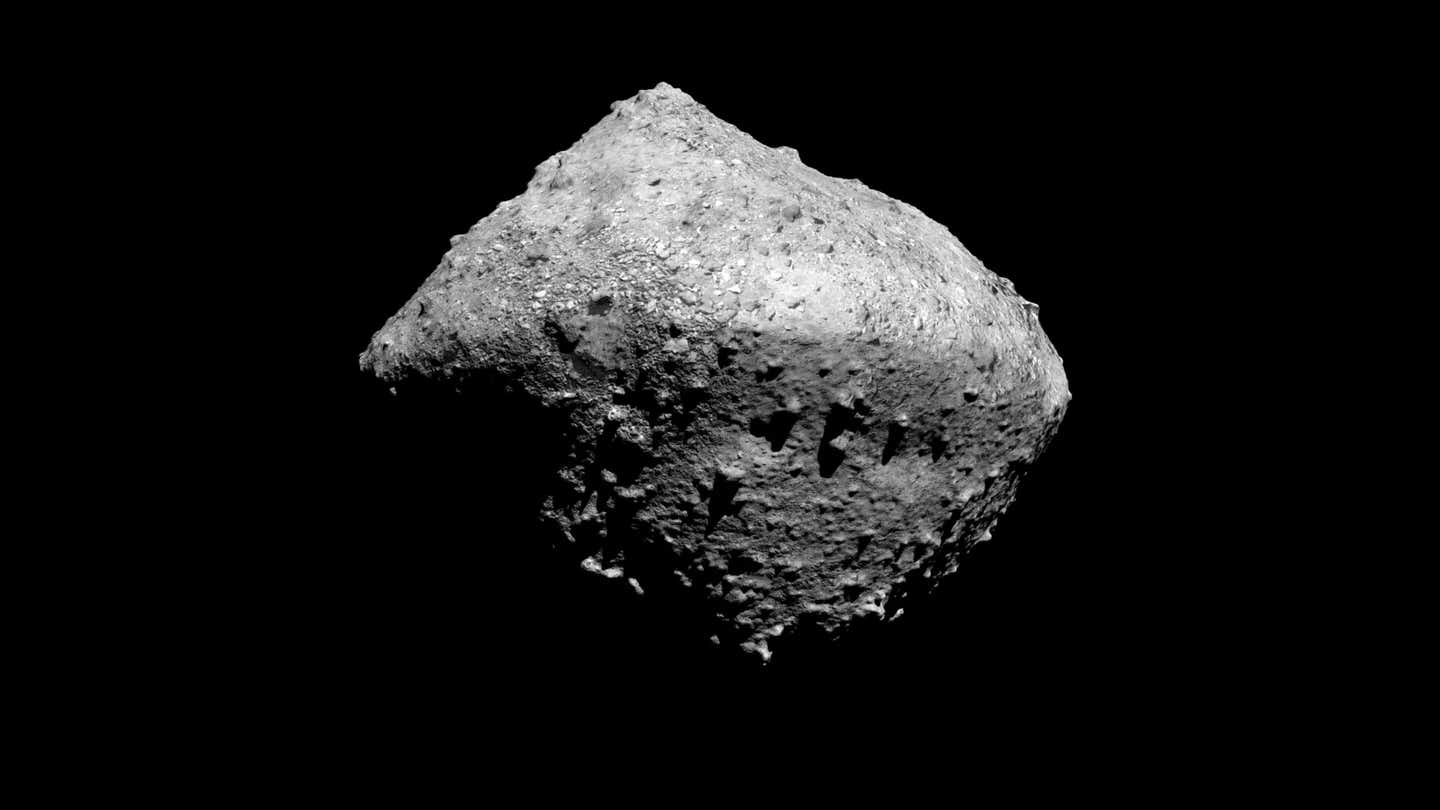
Ryugu asteroid samples preserve magnetic signals from the early solar system, revealing clues about the solar nebula. (CREDIT: JAXA / University of Aizu/Kobe University)
A small, round piece of asteroid Ryugu (sample #91), called "S-lunar," contains tiny particles (less than 1 mm) that will allow planetary scientists to study the magnetic signature of the early solar system. Using advanced magnetic techniques, the research team had previously detected several faint but measurable magnetic signatures emanating from the S-lunar particle. These features were present when the solar system was forming.
The research team now provides more evidence to support the previously established hypothesis that the S-lunar particles contain the original magnetization caused by the fields present at the time of the solar nebula's formation. They also demonstrate that many S-lunar particles have been impacted by the same natural remanent magnetization (NRM) mechanism.
The research was led by Associate Professor Masahiko Sato of the Department of Physics at Tokyo University of Science and was published in the Journal of Geophysical Research Planets.
"Our sensitive magnetic measurements on these microsamples allowed us to clarify and reconcile the various interpretations of the experimental data previously reported by other research groups," Sato said. "These data represent valuable evidence toward understanding how the early solar system evolved."
Traces of the Solar Nebula
The solar nebula, which was the rotating gas and dust disk that surrounded the sun when the solar system formed more than 4.5 billion years ago, had weak magnetic fields produced by the interaction of charged gases.
These magnetic fields affected the movement and accumulation of matter within the disk. Ultimately, they played a major role in the development of the planets.
It is difficult to directly measure the magnetic fields found in the planetary-forming regions of the solar system. Observations of distant protoplanetary disks typically show that the only areas where magnetism has been recorded are at locations far away from the star.
Thus, meteorites and asteroid samples provide one of the few ways scientists can reconstruct the magnetic environment closer to where the planets formed.
Magnetic Records Preserved in Minerals
Old magnetic information can still be preserved by certain minerals that exhibit magnetic properties.
Certain kinds of magnetic minerals form while they are being deposited. As they form, their internal structures align with the magnetic field around them.
When the minerals solidify, they become magnetized and can retain that magnetism for billions of years.
A "rubble pile" of old materials such as Ryugu is an excellent opportunity to study ancient records of the early solar system.
Ryugu is a carbon-type asteroid considered to be a small, carbon-rich Near-Earth asteroid. It is a "rubble pile" made from pieces of material that were once part of a much larger parent body that broke apart in the distant past.
Samples Returned From Ryugu
Because of this breakup, Ryugu is composed of primitive materials from the very early formation of the solar system. As a result, it preserves many records from that time.
The Hayabusa2 spacecraft collected samples from Ryugu at two different locations during touchdown operations in February and July 2019. The spacecraft returned the samples to Earth on December 14, 2020.
Careful handling of the samples during the mission reduced the chances of contamination from Earth's magnetic field. The samples were also stored and transported in ways that prevented Earth's magnetic field from influencing the material.
This careful preservation allowed scientists to monitor possible magnetic effects during the samples' journey to Earth.
Measuring Ancient Magnetism
To study the magnetic history of the asteroid, Sato and colleagues investigated 28 particles with sizes ranging from several hundred micrometers to about one millimeter in diameter.
Each particle was subjected to a series of stepwise alternating field demagnetization tests. This process carefully removed magnetic contributions from each particle and allowed researchers to identify stable signals from older magnetized materials within the fragments.
At the University of Tokyo, measurements of the minerals were carried out using a superconducting quantum interference device (SQUID) magnetometer.
Data collected from this instrument revealed the complex history of how these rocks became magnetically influenced.
Evidence From Mineral Structures
Of the 28 particles measured, 23 exhibited stable components of magnetism. This indicates that these particles recorded a magnetic field at some point during their formation.
Eight of the particles had two separate and distinct stable magnetic signals recorded within them. Five of the measured samples showed no stable magnetic component.
Some particles exhibited contradictory magnetic alignments within a single fragment of rock. This suggests that these particles were magnetized before the rock fully solidified.
Recognizing this is critical for understanding how the particles became magnetized.
If the magnetic recordings had occurred later, such as during spacecraft transport or after arrival on Earth, the magnetic alignment would likely have been uniformly oriented.
Formation of Magnetic Minerals
Evidence for the ancient generation of minerals was provided by studies using an optical microscope.
Among the magnetic minerals found in the samples, magnetite and pyrrhotite were detected. Most stable magnetic recorders appeared to consist of framboidal magnetite, which is a structural arrangement of small aggregates of mineral particles.
Collectively, these aggregates form a stable magnetic structure capable of retaining a magnetic signal over extremely long periods of time.
Researchers suggest that the processes forming this type of magnetite occurred during water-mediated chemical alteration within Ryugu's parent body.
Water and Chemical Alteration
The development of these magnetite grains occurred in the presence of liquid water within the parent body. This water may have been standing or flowing through the rock.
Chemical reactions driven by this water altered the minerals and produced magnetite grains.
As the grains formed, they aligned with the surrounding magnetic field. This alignment captured a record of the magnetic environment present at that time.
According to Sato, these particles provide important information about the early magnetic environment of the solar system.
Estimating Ancient Magnetic Field Strength
The timing of the alteration was determined using dating studies of other Ryugu minerals.
These studies indicate that the alteration occurred between 3.1 and 6.8 million years after the formation of the oldest solids in the solar system, known as calcium-aluminum-rich inclusions.
Measurements of the magnetic fields preserved in these particles revealed an unexpectedly wide range of field strengths.
By measuring remanent magnetization, the researchers estimated the intensity of the preserved magnetic fields. Values ranged from approximately 16.3 microteslas to 174 microteslas for 10 high-quality samples, with an average of about 86 microteslas.
Interpreting the Magnetic Signals
Using an alternate thermal method, one particle produced a similar estimate of approximately 56.9 microteslas.
These results suggest that the preserved magnetic fields were on the order of tens to hundreds of microteslas.
Such values are consistent with expectations for portions of the early solar nebula.
However, the large variation in magnetization between samples may reflect the complex internal structure of the asteroid fragments.
Resolving a Scientific Debate
Most Ryugu particles consist of several breccia domains, which are tiny fragments of rock that formed separately before being cemented together.
If these fragments possessed different magnetization directions when they formed, their magnetic contributions would partially cancel out when combined into a single particle.
The larger dataset from this study helps address a long-standing scientific disagreement. Researchers have debated whether Ryugu particles preserved their original magnetic record or whether their signals were contaminated after collection or during spacecraft handling.
The results challenge the idea that the signals resulted from spacecraft exposure or from Earth's magnetic field.
Clues to Early Solar System Evolution
Many particles that experienced identical storage conditions still preserved stable magnetic components, while others did not.
This pattern supports the conclusion that the preserved magnetic fields originated within the asteroid's parent body.
The findings will help scientists better understand how magnetism developed within Ryugu.
They also provide insight into how the early solar system's magnetic environment shaped the distribution of gas and dust in the solar nebula and influenced the formation of planetary building blocks.
Magnetically recorded clues within asteroid materials offer a rare view of regions of the protoplanetary disk that cannot be observed directly with telescopes.
Further studies of Ryugu samples will refine estimates of ancient magnetic field strength. These studies may also determine whether the recorded magnetizations originated in the solar nebula or from magnetic activity around the young sun.
Each tiny grain of material retrieved from Ryugu adds another piece to the ancient puzzle.
Research findings are available online in the Journal of Geophysical Research Planets.
The original story "Asteroid Ryugu fragments carry a magnetic record from the birth of the solar system" is published in The Brighter Side of News.
Related Stories
- Historical first: Scientists discover the ingredients of life on asteroid
- Why the most valuable meteorites rarely make it to Earth
- Martian microbes can survive being blasted into space by a large asteroid strike
Like these kind of feel good stories? Get The Brighter Side of News' newsletter.
Joseph Shavit
Writer, Editor-At-Large and Publisher
Joseph Shavit, based in Los Angeles, is a seasoned science journalist, editor and co-founder of The Brighter Side of News, where he transforms complex discoveries into clear, engaging stories for general readers. With vast experience at major media groups like Times Mirror and Tribune, he writes with both authority and curiosity. His writing focuses on space science, planetary science, quantum mechanics, geology. Known for linking breakthroughs to real-world markets, he highlights how research transitions into products and industries that shape daily life.