Black hole-powered blazars may explain the highest-energy neutrino ever detected
A 220 PeV neutrino detected near Sicily may trace back to blazars, not a single cosmic outburst.

 Edited By: Joseph Shavit

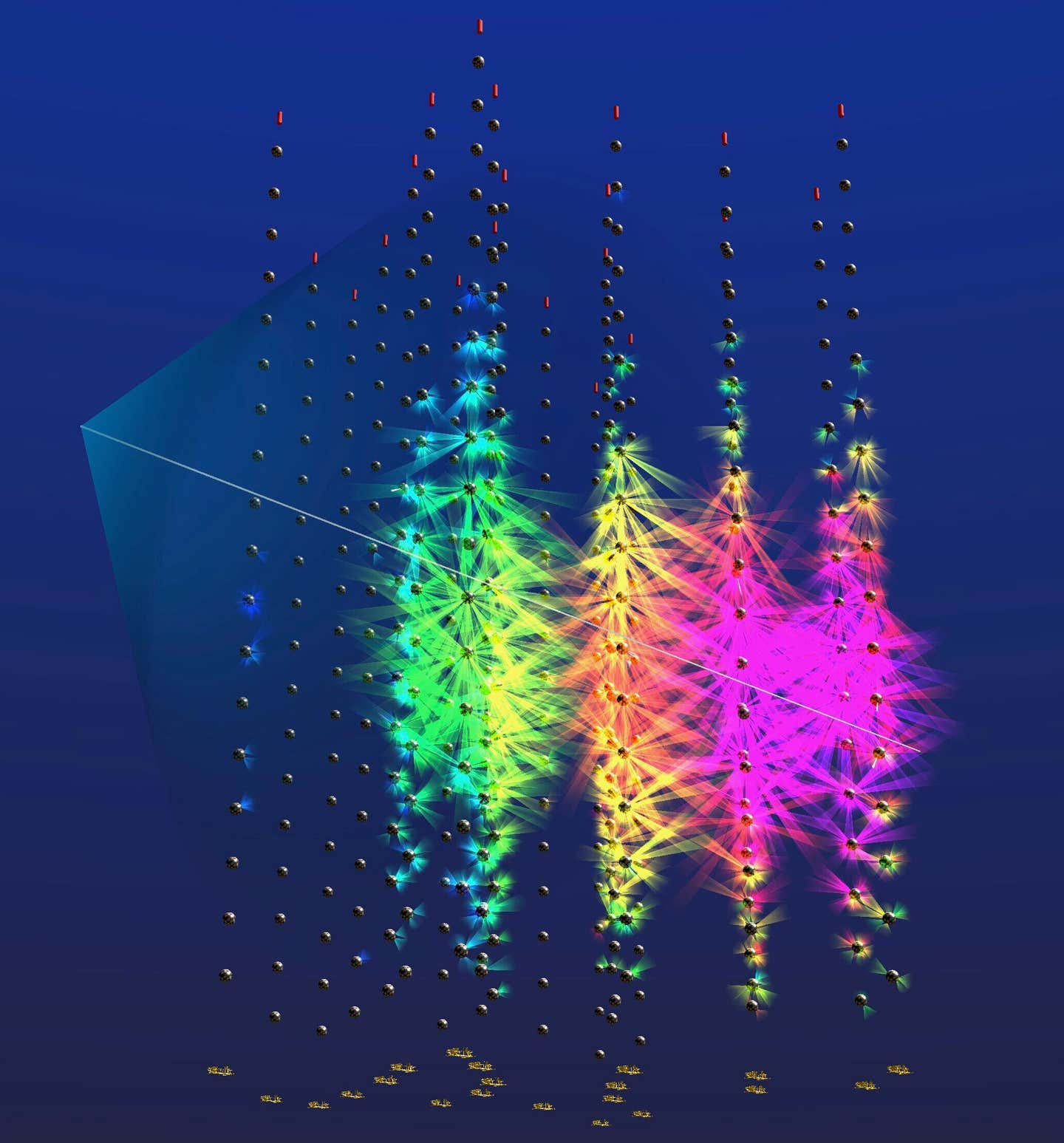
Visualization of the ultra-high-energy neutrino event detected by the KM3NeT/ARCA detector in the Mediterranean Sea. The colored tracks show the Cherenkov light produced as secondary particles travel through the water and are recorded by the detector’s optical modules. (CREDIT: KM3NeT)
A single particle cut through the Mediterranean in February 2023 carrying an almost absurd amount of energy. Detected deep off the coast of Sicily by the KM3NeT/ARCA neutrino telescope, the neutrino clocked in at about 220 petaelectronvolts, making it the most energetic neutrino ever recorded.
That one event, known as KM3-230213A, stood out immediately. Its energy was more than an order of magnitude above previously observed high-energy neutrinos, and no one could say for sure where it came from. Now, a new paper in the Journal of Cosmology and Astroparticle Physics argues that the particle may not have come from one dramatic outburst at all. Instead, it may have emerged from a wider population of blazars, active galactic nuclei powered by supermassive black holes whose jets point toward Earth.
The idea does not solve the mystery outright. It does, however, offer a physically consistent explanation that fits what astronomers have seen, and what they have not.
No obvious culprit in the sky
Scientists often try to trace an extreme neutrino back to an electromagnetic counterpart, a matching signal in radio, optical, X-ray, or gamma-ray light from the same patch of sky. In this case, none was found.
“This does not completely rule out the possibility of a point-like source,” said Meriem Bendahman, a researcher at INFN Naples and a member of the KM3NeT collaboration. “But it leads us to consider that our neutrino may come from a diffuse background, that is, from a flux of neutrinos including contributions from many sources.”
That pushed the team toward a broader scenario. Rather than pinning the event on a single flare or explosion, they tested whether a whole population of blazars could collectively produce a neutrino flux capable of explaining the detection.
“There are several possible explanations for the origin of this particle,” Bendahman said. “For example, it has been proposed that such neutrinos are generated when ultra-high-energy cosmic rays interact with the cosmic microwave background radiation, the residual light from the early Universe. But there is also the possibility that the neutrino originates from a diffuse flux produced by a population of extreme accelerators, such as blazars.”
The paper notes other possibilities already discussed in the literature. Cosmogenic neutrinos remain one option, though that route would require a large flux and very specific assumptions about cosmic-ray injection. A powerful Galactic accelerator has also been considered, but the lack of a gamma-ray counterpart and the need for the source to reach about 4 × 10^18 electronvolts make that explanation very unlikely, according to the source material.
Building a blazar population
To test the blazar idea, the researchers used an open-source program called Astro-Multimessenger Modeling, or AM3. The software simulates emissions from a single blazar jet using a one-zone model, then allows those source properties to be scaled up into a population.
Many parameters were fixed to average values drawn from earlier studies, including the magnetic field, jet speed, emission-region size, and electron luminosity. The team then varied two main ingredients: baryonic loading, which tracks how much energy protons carry compared with electrons, and the proton spectral index, which affects how proton energies are distributed.
Those two knobs matter because neutrinos in these models arise from proton interactions inside the jet. For each parameter combination, the team calculated both the diffuse neutrino flux and the accompanying gamma-ray flux.
Their best-fit solution landed at a baryonic loading of about 10 and a proton spectral index of about 1.8. The analysis also found that values above 100 for baryonic loading were strongly disfavored above the 3 sigma level, and that harder proton spectra, with αp at or below 2, were preferred.
One sentence in the results stands out: blazars in this scenario contribute negligibly to the diffuse neutrino flux below about 1 PeV.
The case depends on what other observatories did not see
The study did not rely on KM3NeT alone. The researchers folded in constraints from the IceCube Neutrino Observatory and the Fermi Large Area Telescope aboard NASA’s Fermi mission.
That mattered because any explanation for the Mediterranean event has to survive two basic checks. First, if blazars are producing these ultra-high-energy neutrinos, the predicted neutrino flux cannot contradict the lack of similar detections in IceCube and Auger datasets. Second, because neutrino production is typically tied to gamma-ray production, the model cannot overshoot the extragalactic gamma-ray background measured by Fermi-LAT.
It passed both tests.
The best-fit gamma-ray output from blazars amounted to about 42 percent of the extragalactic gamma-ray background. That is below the 86 percent fraction used in the paper as a conservative upper bound to avoid overproducing gamma rays. The predicted neutrino spectrum also remained compatible with upper limits from IceCube, Auger, and ANTARES.
Still, the paper does not present a confirmed source. The authors explicitly frame the blazar population as a plausible interpretation, not a settled answer. The event is not associated with a specific blazar, and the detector that saw it was operating with just 21 detection units, about 10 percent of its final planned volume.
“We need more observational data,” Bendahman said. “KM3NeT is still under construction, and we detected this ultra-high-energy neutrino with only a partial configuration. With the full detector and more data, we will be able to perform more powerful statistical analyses and open a new window on the ultra-high-energy neutrino universe.”
Practical implications of the research
If this interpretation holds up, blazars may be able to accelerate particles to even more extreme energies than previously established.
That would sharpen their role in the search for the sources of cosmic rays and the origin of the universe’s most powerful particles.
It would also raise the scientific value of next-generation neutrino observations, especially as KM3NeT expands and gathers more events strong enough to test whether this Mediterranean outlier was a rare fluke or part of a larger astrophysical pattern.
Research findings are available online in the Journal of Cosmology and Astroparticle Physics.
The original story "Black hole-powered blazars may explain the highest-energy neutrino ever detected" is published in The Brighter Side of News.
Related Stories
- Dark matter and neutrinos are linked and interact with each other
- Milky Way neutrino map predicts how many ghost particles will reach Earth
- Record-breaking neutrino points to exploding primordial black hole
Like these kind of feel good stories? Get The Brighter Side of News' newsletter.
Joshua Shavit
Writer and Editor
Joshua Shavit is a NorCal-based science and technology writer with a passion for exploring the breakthroughs shaping the future. As a co-founder of The Brighter Side of News, he focuses on positive and transformative advancements in technology, physics, engineering, robotics, and astronomy. Joshua's work highlights the innovators behind the ideas, bringing readers closer to the people driving progress.