Continent formation may have set the stage for life on Earth
Earth’s first continents may have regulated boron in ancient oceans, creating conditions that favored life’s earliest chemistry.

 Edited By: Joseph Shavit

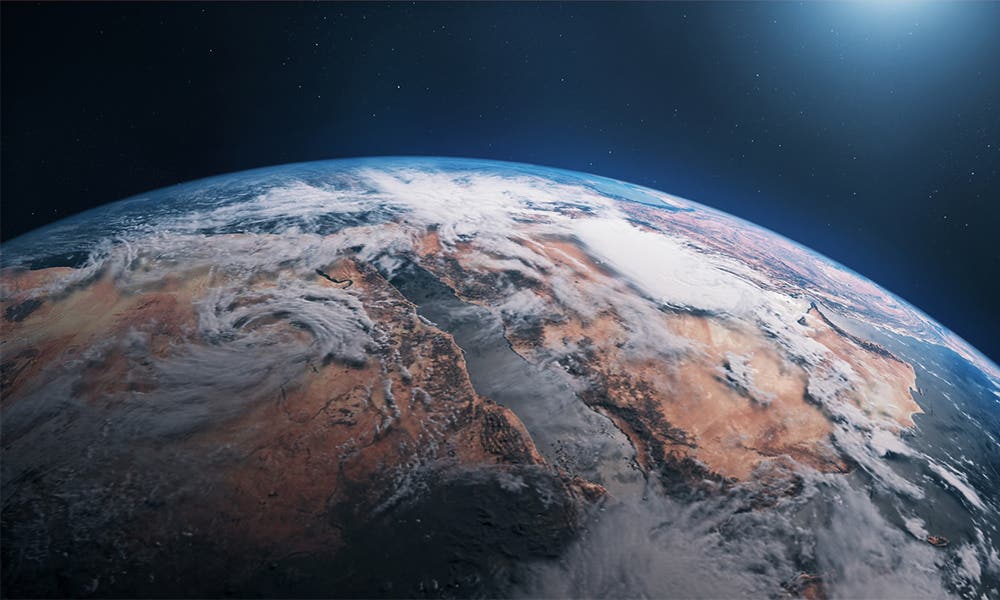
The rise of Earth’s continents may have tuned ancient oceans to just the right boron concentration for life to emerge, according to a new research study. (CREDIT: Wikimedia / CC BY-SA 4.0)
Long before forests, fish, or even single cells, Earth may have needed something as unglamorous as growing continents to make life possible.
A study in Terra Nova argues that the planet’s earliest continental crust did more than reshape the surface. In addition, it may have acted as a chemical regulator, drawing down dangerously high levels of boron from ancient oceans. Eventually, this helped create conditions that favored the chemistry behind life’s beginnings.
That idea turns on a delicate balance. Boron has long been considered useful in prebiotic chemistry because borate can help stabilize ribose, a fragile sugar tied to RNA, the molecule many scientists think came before DNA. Yet boron is only helpful in the right range. Too little may have made it irrelevant. Too much may have pushed surface waters into forms that life could not use.
“What we’re talking about is a geological control system for Earth’s surface chemistry,” said Dr. Brendan Dyck, an associate professor of Earth and environmental sciences at UBC Okanagan’s Irving K. Barber Faculty of Science. “The growth of continents didn’t just reshape the surface of the Earth, it may have helped set the chemical conditions that made life possible in the first place.”
The work, led by Dyck with Dr. Jon Wade of the University of Oxford, links that chemical shift to a mineral better known to many people as a gemstone.
A gemstone with a planetary job
The mineral is tourmaline, a boron-bearing crystal abundant in continental rocks, especially granite-rich crust. The researchers argue that as early continents formed, tourmaline became a long-term sink for boron. It locked boron into the crust instead of leaving it concentrated in the ocean.
That would have mattered because boron followed water early in Earth’s history. The authors say outgassing from the primitive mantle during roughly the planet’s first 100 million years moved a large share of Earth’s boron into the hydrosphere. Since then, its movement has been tied to the global water cycle. This includes magmatic, hydrothermal, and later tectonic recycling.
Today, only a small fraction of Earth’s total boron sits in the oceans, around 10^15 kilograms, while much larger shares reside in the undepleted mantle, depleted mantle, and continental crust. The study cites estimates that about 30 percent of Earth’s boron is now stored in continental crust. Much of it is in tourmaline-group minerals.
That modern balance may hide how different the early planet looked.
Before large volumes of continental crust emerged, the team argues, tourmaline formation would have been kinetically difficult. The problem was not just chemistry, but crystal growth. Experimental work has shown that tourmaline does not readily nucleate on its own. Its crystal structure is large and complex, which hinders homogeneous nucleation.
How tourmaline got a foothold
The authors focused on the minerals biotite and chlorite, mica-group minerals common in peraluminous continental crust. In natural rocks, tourmaline often appears intergrown with them. Dyck and colleagues tested whether those minerals offered the kind of surface tourmaline needs to start growing more easily.
To do that, they examined samples spanning much of Earth’s history. One set came from about 18-million-year-old Himalayan granites in Nepal’s Langtang Valley. Another came from the roughly 3.7-billion-year-old Isua Greenstone Belt in Greenland. They used electron backscatter diffraction and found a recurring structural relationship between tourmaline and the mica minerals. This is evidence of epitaxy, a process in which one crystal nucleates in an ordered way on the surface of another.
The geometry mattered. Their measurements suggest that when tourmaline nucleated on biotite, the activation energy needed to begin crystal growth dropped by 92 percent to 99 percent compared with homogeneous nucleation. In plain terms, tourmaline could form far more easily when the right continental minerals were present.
That helps explain how continental crust became such an important boron reservoir even though tourmaline is hard to nucleate under laboratory conditions.
The researchers also point to trace-element maps from Himalayan rocks showing what looks like mimetic replacement, where tourmaline appears to have grown by replacing pre-existing biotite. They argue this same epitaxial relationship operated in both metamorphic and magmatic settings. This helped continental crust trap boron over geologic time.
A different ocean before continents matured
That mineral-scale process feeds into a much larger picture. Without appreciable peraluminous continental crust, the study suggests, Earth’s early surface waters may have held boron concentrations up to three orders of magnitude higher than modern seawater.
At those levels, boron chemistry changes. The authors say water-soluble polyborate ions would have been favored over aqueous borate species. That distinction matters because borate, not polyborate, is the form linked in experimental prebiotic chemistry to stabilizing ribose. Without that stabilizing effect, sugars may have broken down too quickly to take part in the steps that led toward RNA and more complex prebiotic systems.
As continental crust expanded, however, tourmaline sequestration would have drawn boron out of circulation. Weathering of near-surface continental rocks then released boron back into surface waters more gradually. Over time, the study argues, this helped stabilize boron concentrations near modern seawater values, about 4.4 micrograms per gram.
The timing remains uncertain. The paper notes that zircon evidence points to evolved crust with continental affinity as early as about 4.4 billion years ago, but the pace of continental growth is still debated. It also cites work suggesting that more than 65 percent of today’s continental crust volume had formed by about 3.0 billion years ago.
So the proposed shift was not a single event. It was a slow planetary rebalancing.
Why the idea reaches beyond Earth
The analysis also broadens the usual discussion of habitability. A planet can sit in the right orbital zone and still miss an important chemical ingredient if its crust never evolves in the right way.
Mars is one example raised in the study. Because it lacks a peraluminous continental crust at the surface, the authors argue it is unlikely to sequester much boron in tourmaline. That would leave more boron in surface waters as polyborates rather than the bioavailable forms associated with life’s chemistry on Earth.
The same logic extends to any rocky planet that differentiates internally and concentrates boron in surface water but never develops the crustal conditions needed to regulate it.
The work does come with caveats. Earth’s total boron inventory is only loosely constrained, the rate of early continental growth remains unsettled, and the nucleation calculations rely on classical theory that simplifies the messy realities of natural silicate systems. The authors describe that framework as a useful first-order approach, not a final answer.
Even so, the central point is striking. Life’s chemical starting conditions may have depended not only on water, atmosphere, and energy, but also on the slow emergence of continents able to store and recycle one trace element in the right form.
Research findings are available online in the journal Terra Nova.
The original story "Continent formation may have set the stage for life on Earth" is published in The Brighter Side of News.
Related Stories
- Newly discovered Asgard microbe could explain the origins of complex life on Earth
- Giant Prototaxites fossil reveals an extinct branch of complex life on Earth
- Scientists found the last universal common ancestor for all life on Earth
Like these kind of feel good stories? Get The Brighter Side of News' newsletter.
Rebecca Shavit
Writer
Based in Los Angeles, Rebecca Shavit is a dedicated science and technology journalist who writes for The Brighter Side of News, an online publication committed to highlighting positive and transformative stories from around the world. Having published articles on MSN, AOL News, and Yahoo News, Rebecca's reporting spans a wide range of topics, from cutting-edge medical breakthroughs to historical discoveries and innovations. With a keen ability to translate complex concepts into engaging and accessible stories, she makes science and innovation relatable to a broad audience.