CT scans reveal a new species of baby dinosaur hidden in rock for 100 million years
CT scans of a Korean rock slab revealed a baby dinosaur, complete with skull bones and stomach stones, hidden for 100 million years.

 Edited By: Joseph Shavit

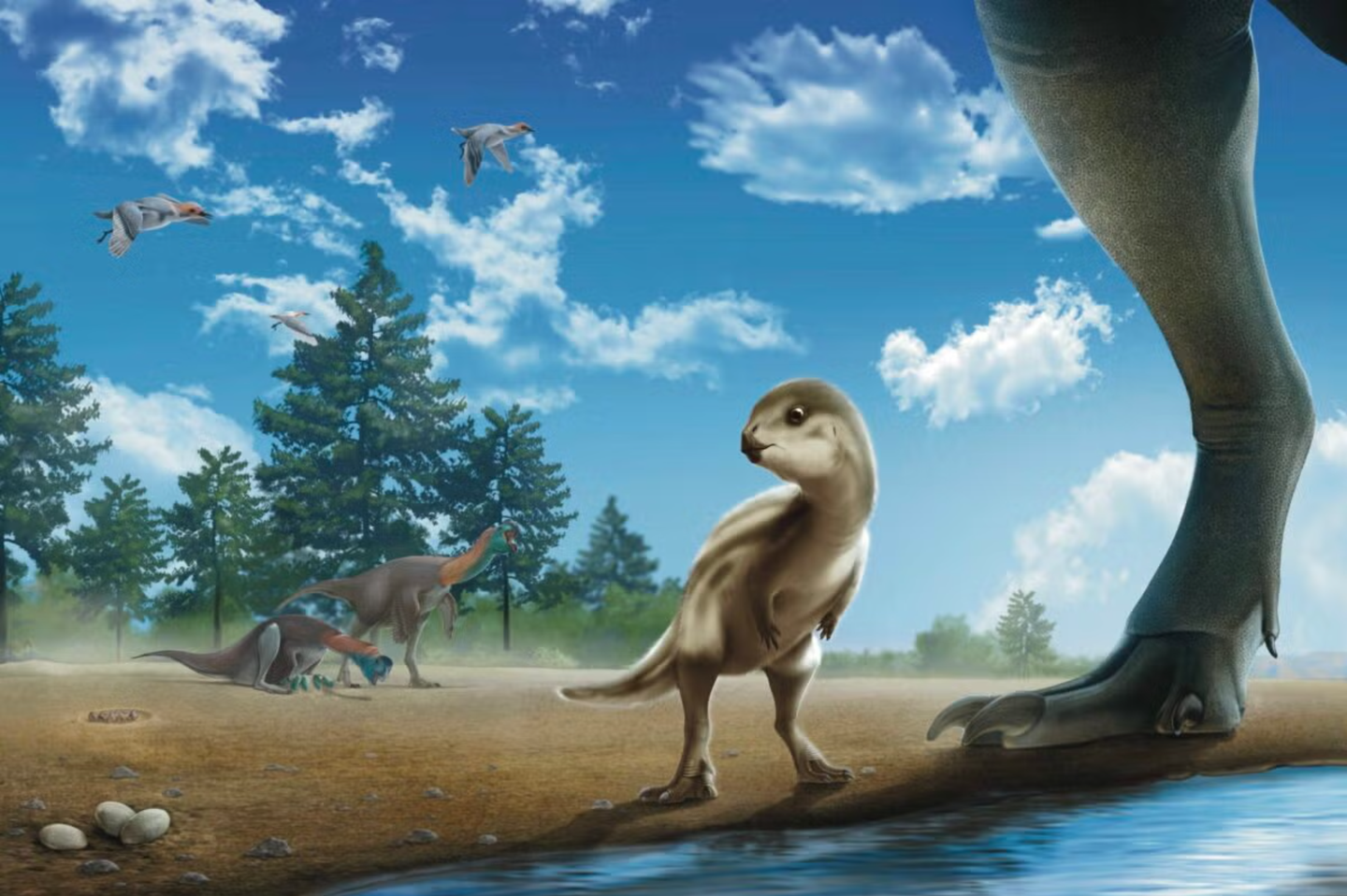
An artist’s interpretation of a juvenile Doolysaurus huhmini. It is depicted alongside birds and other dinosaurs that lived during the Cretaceous in what is now South Korea. (CREDIT: Jun Seong Yi)
The little dinosaur had been dead for roughly 100 million years before anyone thought to scan the rock it was buried in. When researchers finally did, what emerged on their screens stopped them cold. Tucked inside a dense slab of reddish mudstone from a Korean island were bones that no one had expected: leg bones, vertebrae, and scattered pieces of a skull, the first diagnostic cranial material ever found from a dinosaur on the Korean Peninsula.
The specimen is small, the size of a turkey, and was still growing when it died. It belonged to a juvenile, probably about two years old. Its family is a group of lightly built, two-legged dinosaurs called thescelosaurids, relatives of animals known from Asia and North America. Its stomach, preserved by geology's peculiar luck, still held the small pebbles it had swallowed to help grind its food.
Researchers from the University of Texas at Austin and the Korean Dinosaur Research Center named it Doolysaurus huhmini. The first part of that name honors Dooly the Little Dinosaur, a cherubic green cartoon character with two sprigs of hair that has been a fixture of South Korean popular culture since 1983. Every generation in Korea knows Dooly. The researchers thought the name fit.
"Our specimen is also a juvenile or 'baby', so it's perfect for our dinosaur species name to honor Dooly," said Jongyun Jung, a visiting postdoctoral researcher at UT's Jackson School of Geosciences who led the research.
A Discovery That Started With Stomach Stones
The fossil was found in 2023 by co-author Hyemin Jo, a researcher at the Korean Dinosaur Research Center, on the shoreline of Aphae Island off South Korea's southwestern coast. When Jo and Jung first examined what they had, the visible bones were modest: some leg bones protruding from the block, some vertebrae. Nothing suggested a skull was in there.
What prompted a closer look was a small cluster of smooth, polished pebbles sitting between the bones. Gastroliths, stomach stones swallowed deliberately to help with digestion, are lightweight and easily scattered. Their presence in tight formation suggested the animal had not been pulled apart before fossilization, meaning other delicate pieces might still be preserved inside the rock.
"A little cluster of stomach stones, with two leg bones sticking out indicates that the animal was not fully pulled apart before it has hit the fossil record," said co-author Julia Clarke, a professor at the Jackson School. "So, I encouraged them to visit Texas and the UTCT, to try scanning the fossil."
The UTCT, the University of Texas High-Resolution X-ray Computed Tomography facility, scanned the block in three passes, targeting the whole specimen, the cranial region, and the hindlimbs separately. What appeared in the data over the following months was more than anyone had anticipated: skull bones, including jaw elements, the back of the braincase, and pieces that could be assembled into the first dinosaur skull material from Korea.
Manual preparation of a fossil this size and this hard could take close to a decade. The CT analysis produced usable anatomical data in a matter of months.
First Skull From Korea, First New Species in Fifteen Years
Doolysaurus huhmini is the first new dinosaur species discovered in Korea in 15 years, and its skull material makes it scientifically distinctive in a way no previous Korean dinosaur specimen has been. Korea has a rich record of dinosaur footprints, eggs, and nests, but actual bones are rare, and skull bones rarer still. Most of what has been found has been fragmentary enough that identifying species has been difficult or impossible.
The new specimen fills part of that gap. "Our team spent more than a year analyzing its anatomy, comparing it bone by bone to related species from Asia and North America. The animal belongs to the thescelosaurid family, a group that also includes North American animals like Thescelosaurus and Parksosaurus. Phylogenetic analysis placed Doolysaurus within a subdivision of that family called Thescelosaurinae, closer to the North American members than to some of its Asian neighbors," Clarke shared with The Brighter Side of News.
That placement carries implications beyond classification. Thescelosaurids are found in both Asia and North America, and researchers have long debated where the family's major branches first diverged. The discovery of an Asian thescelosaurine from roughly 113 to 94 million years ago suggests the split between the family's two main lineages may have happened in Asia before the animals spread into North America, rather than the other way around.
The species name huhmini honors Professor Min Huh, the Korean paleontologist who founded the dinosaur research center, spent three decades studying Korean fossils, and worked with UNESCO to preserve dinosaur sites in the country.
What the Fossil Tells Us About the Animal
Doolysaurus was a bipedal plant-eater, or more likely an omnivore. Its teeth are triangular and leaf-shaped, typical for the group. But the gastroliths suggest its diet was more varied. Between 40 and 50 pebbles, ranging from 2 to 10 millimeters across, made up a cluster sitting where the stomach would have been. The stones included quartzite and volcanic rock, shaped by their time inside the animal into a mix of rounded and discoid forms that researchers compare to the stomach stones of modern omnivorous birds.
Bone histology, a thin slice of femur examined under polarized light, confirmed the animal was still growing when it died. There was no sign of the slowdown in bone growth that would indicate the animal had reached adult size. Unfused bones throughout the skeleton reinforced the picture of a young individual. The researchers estimate an adult Doolysaurus may have grown to roughly twice the size of the specimen they found.
"I think it would have been pretty cute," Clarke said. "It might have looked a bit like a little lamb."
That description is not purely whimsical. Related thescelosaurids are thought to have carried a coat of fuzzy filaments, a feature known from exceptionally preserved specimens of related dinosaurs. Whether Doolysaurus shared that characteristic can't be confirmed from the available fossil, but the family resemblance makes it plausible.
Why Korean Dinosaur Bones Are So Rare
The scarcity of dinosaur skeletons in Korea has more to do with geology than with biology. Most Mesozoic fossil-bearing rock in Korea is exposed on coasts and small islands where tidal activity and limited access make systematic excavation difficult. Widespread volcanic activity during the late Cretaceous baked many sedimentary layers into a material called hornfels, which destroys fossils and makes preparation of anything that survives extremely difficult.
Aphae Island is an exception. The fine-grained sandy mudstone that entombed Doolysaurus preserved the bones in three dimensions with unusual delicacy. The same site also produced a large nest of giant theropod eggs from a different species. The researchers believe the depositional conditions there, a prehistoric floodplain where sediment settled quickly and steadily, were unusually well suited to preserving fragile remains.
Jung is planning a return trip to collect more material. Kim and Jo, who trained in CT analysis techniques during their work on Doolysaurus, are now applying those skills to other Korean fossils.
"We're expecting some new dinosaur or other egg fossils to come from Aphae and other small islands," Jung said.
Practical Implications
The discovery carries a methodological message as much as a paleontological one. CT scanning is not new, but its application to fossils encased in unusually hard rock has been transformative for exactly the kinds of specimens that tend to accumulate in museum drawers and storage rooms, objects that look too difficult or too risky to prepare by hand. What Doolysaurus demonstrates is that significant finds can be hiding inside rocks that no one has gotten around to opening yet.
South Korea's track record of dinosaur footprints and egg sites suggests the actual diversity of its Cretaceous fauna was much greater than the bone record currently reflects. Some of those missing animals may simply be waiting inside the right kind of rock, on the right kind of island, for someone to bring them to a scanner.
The cartoon Dooly, for his part, is depicted as having been frozen in ice during the Ice Age and thawing out in modern Seoul to considerable bewilderment. His prehistoric namesake had a simpler fate: buried in floodplain mud on what would become a small Korean island, preserved well enough that 100 million years later, a group of researchers could reconstruct what he ate for dinner.
Research findings are available online in the journal Fossil Record.
The original story "CT scans reveal a new species of baby dinosaur hidden in rock for 100 million years" is published in The Brighter Side of News.
Related Stories
- The surprising role of baby dinosaurs within the Jurassic food chain
- Global first: Baby dinosaur found inside 70-million-year-old fossilized egg
- New study confirms Nanotyrannus was a grown dinosaur, not a baby T. rex
Like these kind of feel good stories? Get The Brighter Side of News' newsletter.
Rebecca Shavit
Writer
Based in Los Angeles, Rebecca Shavit is a dedicated science and technology journalist who writes for The Brighter Side of News, an online publication committed to highlighting positive and transformative stories from around the world. Her reporting spans a wide range of topics, from cutting-edge medical breakthroughs to historical discoveries and innovations. With a keen ability to translate complex concepts into engaging and accessible stories, she makes science and innovation relatable to a broad audience.