Entangled photons survive a 38 mile ride through fiber-optic cable strung above Maryland streets
NIST researchers sent entangled photons through 62 kilometers of unstable fiber, advancing real-world quantum networks.
 NIST Writer: Ron Cowen

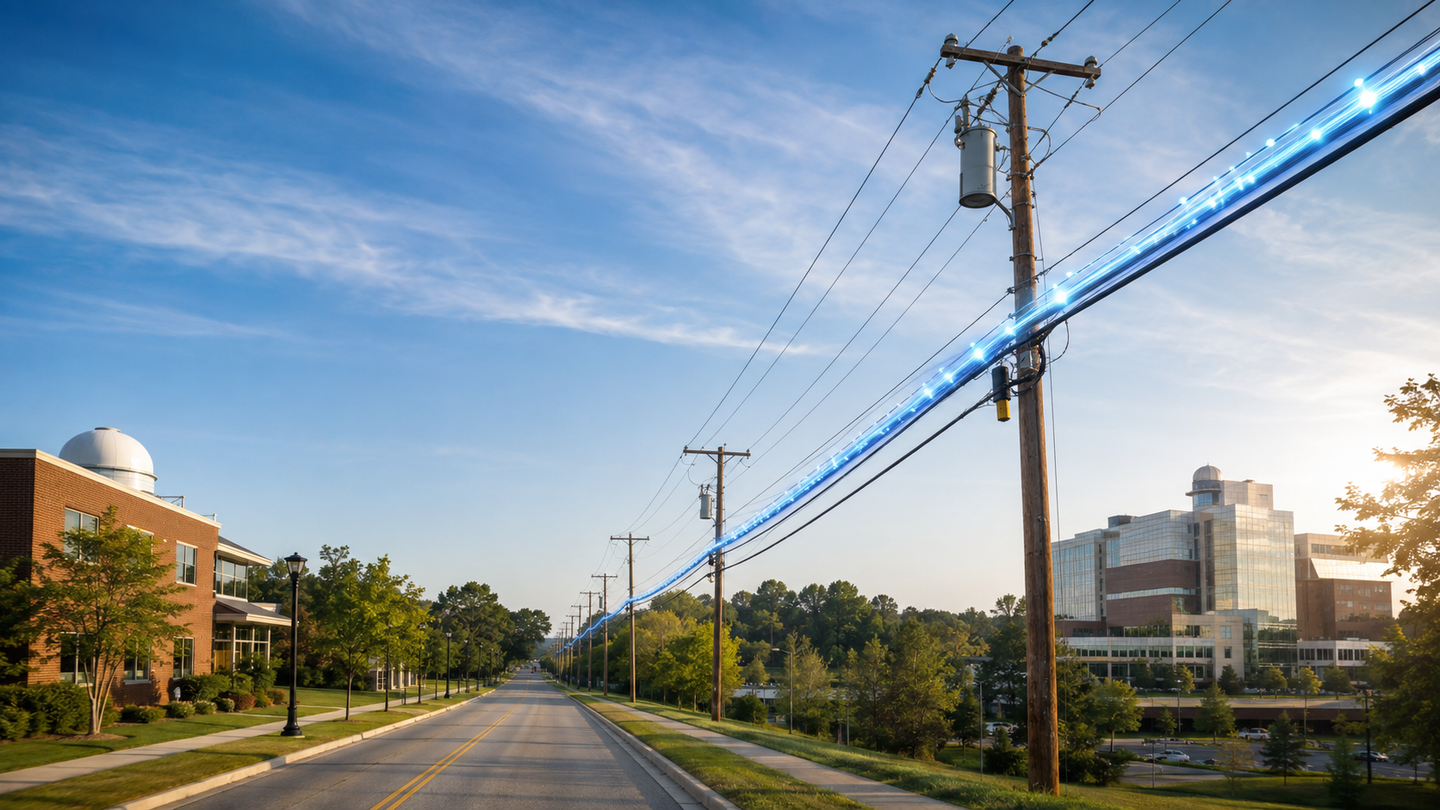
Quantum entanglement fiber test sends linked photons 62 kilometers through unstable Maryland cable while preserving their connection. (CREDIT: Shutterstock)
- Entangled photons stayed connected after traveling 62 kilometers through mostly aboveground fiber between NIST and the University of Maryland.
- A real-time correction system tracked changes in the fiber and reversed distortions before they could overwhelm the quantum signal.
- The test shows existing communications infrastructure may support future quantum networks, although photon loss, speed and faster stabilization remain challenges.
Quantum signals have now survived a rough ride through fiber-optic cable strung above Maryland streets. The achievement marks a serious step toward quantum networks that could someday link computers, sensors and communication systems in powerful new ways.
Researchers at the National Institute of Standards and Technology and partner institutions sent entangled photons across 62 kilometers, about 38.5 miles, of existing fiber between NIST and the University of Maryland. Much of that fiber hangs above ground, where wind, temperature changes and other daily stresses can distort fragile quantum states.
The study shows that quantum networking can work outside quiet laboratory conditions. It does not set a distance record, but it shows how quantum links may survive in real infrastructure.
Why Quantum Networks Matter
Quantum networks rely on entanglement, one of the strangest and most useful features of quantum physics. When two particles become entangled, they share a connected state even when separated by large distances.
A measurement of one particle helps determine the state of the other. Albert Einstein famously described this idea as “spooky action at a distance.”
For future technology, that strange connection could become valuable. Entangled photons could help create ultrasecure communication systems where hacking attempts become visible.
They could also link quantum computers into larger systems. Those connected machines might solve problems too complex for any single device.
Quantum networks may even support new kinds of sensors. Entangled telescopes or seismic detectors could someday measure the world with extraordinary precision.
A Fragile Signal In A Noisy World
To build those networks, researchers must first protect entanglement outside the lab. That is much harder than sending ordinary internet data.
Classical signals, such as emails or video streams, usually encode information by changing light power. That information can tolerate many bumps and shifts.
Quantum signals are more delicate. In this experiment, information was carried in photon polarization, the direction in which light’s electric field vibrates.
Aerial fiber can twist and stretch as temperatures change. Wind can shake it, and birds can land on it. These small movements can scramble polarization.
“It’s about as bad a connection as you can possibly have,” said NIST physicist Oliver Slattery, one of the study’s authors.
Testing Existing Fiber
Building a separate fiber network only for quantum use would cost too much in many places. That is why the team tested existing fiber infrastructure.
Researchers from NIST, the Joint Quantum Institute and Qunnect wanted to know whether quantum networking could share the physical routes used by modern communications.
The fiber link ran from the NIST lab to another lab at the University of Maryland in College Park. About 70% of the route used aerial fiber.
That made the test especially challenging. Underground fibers tend to stay more stable. Aboveground lines face stronger environmental changes.
The team treated the experiment as a real-world stress test, not a protected demonstration.
How The Experiment Worked
The researchers used a commercial device to create pairs of entangled photons. One photon from each pair stayed at NIST, where an analyzer measured its polarization.
The other photon traveled through the 62-kilometer fiber link to the University of Maryland. There, a second analyzer measured its polarization.
If the pair stayed entangled, measurements at both ends would show quantum correlations stronger than classical physics allows.
But the fiber threatened to twist the traveling photon’s polarization. Without correction, that distortion would break the useful link.
To solve the problem, the team used real-time stabilization tools developed by Qunnect.
Correcting The Fiber In Real Time
The stabilization system sent reference light through the same fiber. That light showed how the fiber was changing photon polarization at that moment.
At the receiving end, the system measured how the reference light had been transformed. It then applied the opposite correction to the quantum photons.
This process acted like a constantly updated repair system. It helped undo the fiber’s distortions before they destroyed the entangled state.
Because the reference light and quantum photons used the same wavelength, they experienced similar distortions. That made the correction more accurate.
The system alternated between correction periods and entanglement distribution. During correction, it checked the fiber. During distribution, it sent the quantum signal.
A Full Day Of Operation
The researchers ran the stabilized system for 24 hours. Over that period, it spent only 7.2% of the time correcting polarization.
That left 92.8% of the time available for distributing entangled photons. The team transmitted about 1,500 entangled photons per second.
A statistical test confirmed that photons detected at both ends remained entangled after traveling through the fiber.
The experiment did not beat the longest-distance result. A European group sent entangled photons through 248 kilometers of underground fiber in 2022.
Still, the Maryland test stands out because so much of the fiber was above ground. It faced the kind of instability future city-scale quantum networks must handle.
Daytime Made It Harder
The fiber did not behave the same way all day. At night, polarization drifted more slowly and could remain stable for longer periods.
During the day, temperature swings, traffic and wind likely caused faster shifts. In some periods, the signal quality could drop within seconds.
The stabilization system handled most of these changes. Some correction sessions lasted only fractions of a second. Others took much longer when the fiber changed quickly.
Even with those difficulties, the system kept returning to quantum operation. That resilience is the central success of the work.
“I would call this a stress test of quantum networking systems,” said Yicheng Shi, a physicist at NIST and the study’s lead author. “We put this to an extreme test in an environment that’s really noisy. Amazingly, it turned out it still worked. It’s a demonstration that quantum networking protocols can work in real-world environments.”
What Needs To Improve
The photon transmission rate still needs to rise before practical quantum networks become widespread. More photons per second would allow stronger and faster communication.
The system also needs faster hardware for more volatile fibers. High-speed optical components could help correction systems keep up with rapid changes.
Better algorithms may also help. Current correction methods work, but future systems may need quicker ways to reverse fiber distortions.
Loss remains another challenge. Optical fiber and added equipment absorb or scatter some photons. Fewer losses would make the quantum link stronger.
Still, the experiment shows that existing fiber routes may support quantum networking with the right stabilization tools.
Practical Implications Of The Research
This research could help move quantum networks from laboratories into real cities. By showing that entangled photons can travel through unstable aerial fiber, the study brings practical deployment closer.
Future quantum networks could support ultrasecure communication. Because quantum states change when disturbed, attempts to intercept information could become easier to detect.
The work may also help distributed quantum computing. Linked quantum machines could someday work together on problems involving materials, chemistry, drug discovery and complex systems.
Quantum sensors could benefit too. Networks of entangled devices might improve measurements in astronomy, navigation, geology and disaster warning. The immediate value is proof that real-world fiber does not have to be perfect for quantum links to survive.
Dig deeper into quantum networks and entanglement
These resources explore how entanglement can survive practical fiber networks, how quantum links can scale beyond two points, and what technologies may be needed for a future quantum internet.
Phase-stable optical fiber links for quantum network protocols
Researchers demonstrated exceptionally stable single-photon-level transmission across deployed fiber links, using techniques adapted from precision optical-clock networks to suppress environmental phase noise. The work addresses the same real-world stability problem that limits quantum networking outside controlled laboratories. (Optica Quantum, 2026)
Long-lived remote ion–ion entanglement for scalable quantum repeaters
This experiment created entanglement between quantum-memory nodes connected by 10 kilometers of fiber and kept that entanglement alive longer than the average time needed to establish it. The result tackles a major obstacle to quantum repeaters, which could eventually extend entanglement across much larger networks. (Nature, 2026)
A large-scale reconfigurable multiplexed quantum photonic network
Researchers connected two four-user photonic quantum networks through a programmable device that could route and teleport entanglement between users. The demonstration shows how future quantum networks might move beyond simple point-to-point links toward flexible systems compatible with communications infrastructure. (Nature Photonics, 2025)
Energy-time and time-bin entanglement: past, present and future
This review examines major approaches for sending entangled photons over long distances, including polarization, energy-time and time-bin encoding. It explains why polarization can be vulnerable to environmental changes in fiber and surveys alternative methods designed for more robust long-distance quantum communication. (npj Quantum Information, 2025)
Creation of memory–memory entanglement in a metropolitan quantum network
This metropolitan-scale experiment established entanglement between quantum memories in a multi-node network, moving beyond laboratory-scale two-node demonstrations. It provides an important example of how entanglement distribution, quantum memories and networked nodes could eventually work together across cities. (Nature, 2024)
Research findings are available online in the Journal of Optical Communications and Networking.
The original story "Entangled photons survive a 38 mile ride through fiber-optic cable strung above Maryland streets" is published in The Brighter Side of News.
Related Stories
- Global fiber optic cable network could revolutionize earthquake detection
- Global first: Scientists teleport quantum information through active fiber-optic networks
- Holograms and AI create an uncrackable optical encryption system
Like these kind of feel good stories? Get The Brighter Side of News' newsletter.
Joseph Shavit
Writer, Editor-At-Large and Publisher
Joseph Shavit, based in Los Angeles, is a seasoned science journalist, editor and co-founder of The Brighter Side of News, where he transforms complex discoveries into clear, engaging stories for general readers. With vast experience at major media companies like The Los Angeles Times, Times Mirror and Tribune Publishing, he writes with both authority and curiosity. His writing focuses on space science, planetary science, quantum mechanics, geology. Known for linking breakthroughs to real-world markets, he highlights how research transitions into products and industries that shape daily life.