For the first time ever, researchers made a photon travel back in time
Physicists are learning to rewind tiny particles in time, revealing why the arrow of time is so hard to reverse in the real world.
 Edited By: Joshua Shavit

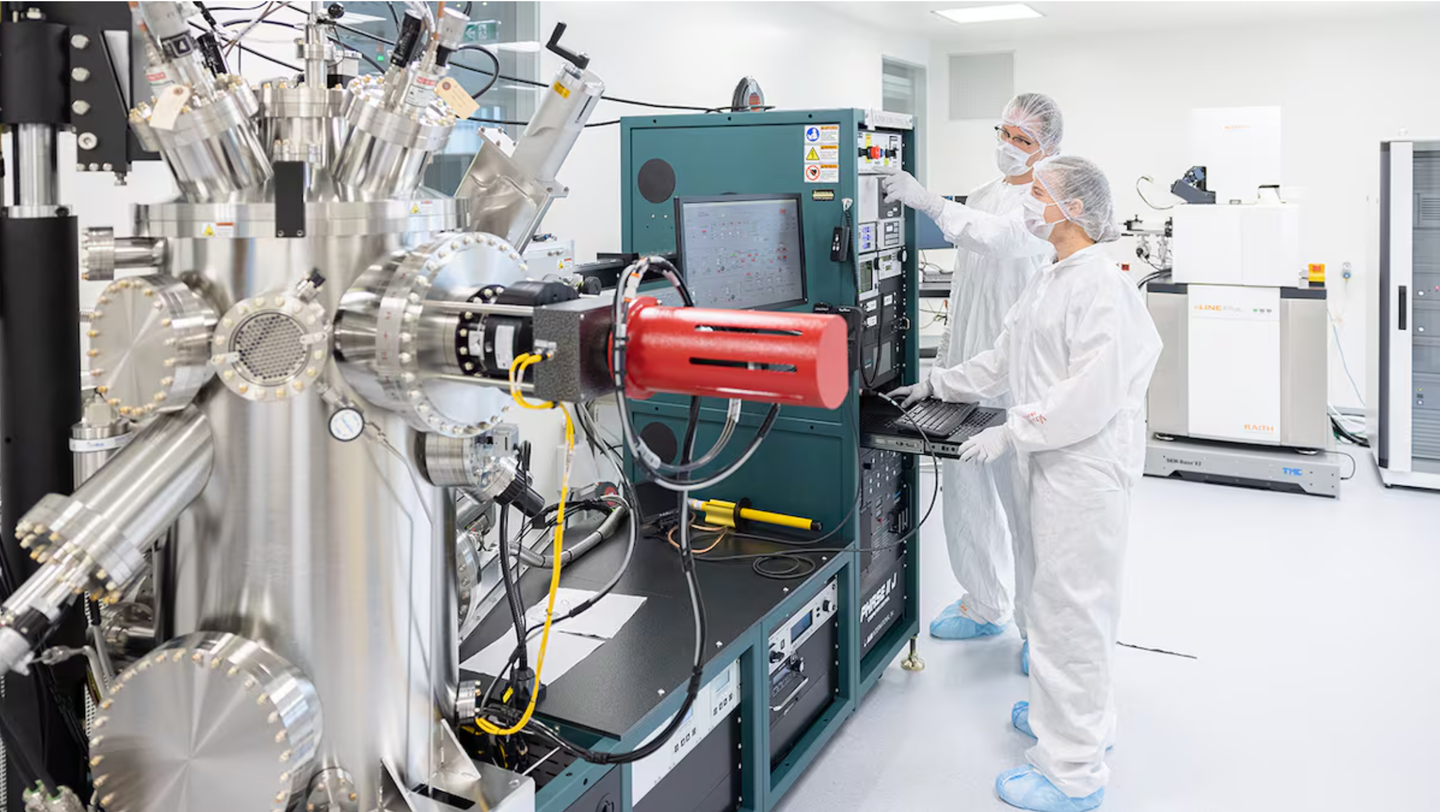
Researchers from the Austrian Academy of Sciences (ÖAW), which houses the laboratories of the Institute for Quantum Optics and Quantum Information (IQOQI). (CREDIT: ÖAW)
Shattered glass does not leap back into your hand. Smoke from a match does not gather itself and crawl back inside. In everyday life, time feels like a one-way street, and you only get one chance to move along it. Yet deep in the quantum world, researchers are learning how to press something that looks a lot like rewind, at least for tiny pieces of matter and light.
The arrow of time meets quantum weirdness
Classical physics explains time’s direction with entropy, the idea that disorder tends to grow. Scrambled eggs do not turn back into a raw egg, and scattered billiard balls do not roll themselves into a perfect triangle again.
Quantum theory adds another twist. In the early 20th century, physicist Eugene Wigner showed that reversing time for a quantum system is not as simple as running a movie backward. The math that describes a quantum state uses complex numbers. To reverse time, you must take a complex conjugate of the wave function, which flips the internal “phase” of the particle everywhere at once. That operation is called anti-unitary, and it does not show up naturally in the world.
A recent theoretical study takes that idea seriously and asks a blunt question: what would it take, in practice, to make a quantum system run backward in time? The answer is not comforting if you like symmetry. The researchers argue that you would need a special “supersystem” that can act on your particles in a very precise, global way. Without that control, the exact sequence of events that would undo time’s flow is so unlikely that you can treat it as impossible.
Rewinding a single particle in theory
To see how this plays out, picture a single quantum particle, such as an electron, spreading out as it moves. Its state is a wave packet that grows wider with time. Inside that packet, the phase, a kind of internal clock for the wave, varies from point to point.
Classical intuition might tell you to reverse the particle’s velocity to run things backward. In quantum mechanics, that is not enough. You would need to flip the phase at every point in space. The team imagines the particle crossing a region filled with a weak electromagnetic field that sometimes spikes. Those fast spikes can change the phase.
Space is divided into many tiny cells. Inside each cell, the phase is almost constant. To reverse time, a single sharp “kick” from the field would have to adjust the phase in every cell, in just the right way, so that the final state becomes the complex conjugate of the original one.
As the wave spreads, the number of cells grows. So does the difficulty of lining them all up. To get a good reversal, you must match the phase in N different cells. The chances that random fluctuations happen to do this scale like 2⁻ᴺ. That number shrinks so fast that, even if the universe tried at gigahertz rates for billions of years, the needed fluctuation would almost never occur.
The punchline is stark. Irreversibility appears even for a single free particle. Time’s arrow does not require a huge gas of molecules. It emerges once a quantum wave has spread out far enough.
From thought experiment to quantum code
Another group pushed the same question in a different way. Their study, published in Scientific Reports, asked whether you could see time reversal built into the behavior of a quantum computer.
They started with a familiar picture from everyday life. A cue hits a triangle of billiard balls. The balls fly out in all directions, a simple image of order turning into chaos. The team asked if some fluctuation in nature could ever make the balls return to their neat triangle. Then they translated that image to an electron whose position is fairly well known at first, then spreads into a blur as time passes.
Using the laws that govern quantum evolution, they calculated the odds that random noise could bring the electron back to its tightly localized state. Even if you watched 10 billion fresh electrons every second for the entire 13.7 billion year age of the universe, you would expect to see a spontaneous “rewind” only once. That rare event would reset the clock by only a tiny slice of time, about one 10 billionth of a second.
In the lab, though, the story is kinder. On a quantum computer, you can program a sequence of operations that imitates time reversal. The team did this using qubits, the basic units of quantum information. In a simple two-qubit setup, their algorithm returned the system to its starting point in about 85% of runs. When they scaled up to three qubits, the success rate dropped close to 50% as noise and hardware errors piled up.
Another group ran a related time-reversal test on IBM’s “ibmqx4” quantum chip. They encoded a simple scattering process: a particle interacting with a tiny two-level system called an impurity. In the two-qubit case, time reversal reduced to complex conjugation. With three qubits, they also had to include an extra rotation linked to swapping the particle qubits.
In each run, the qubits evolved forward in time, were transformed into the time-reversed state, then evolved forward again. In a perfect world, they would land exactly where they started. In reality, gate errors, readout mistakes and the short lifetime of quantum states all cut into the fidelity. The final state did not always match the initial one, and performance got worse as the circuit grew more complex.
The experiments highlight a key message from the theory work. Even on a controllable device, exact reversal becomes harder as more particles interact and get entangled. The size of the quantum state space grows rapidly, and so does the number of operations needed to undo its evolution.
A quantum remote control for time
While these groups probed how hard reversal is, another line of research asked a more hopeful question: can you ever get a clean rewind at all?
To make that idea vivid, Miguel Navascués of the Austrian Academy of Sciences likes a simple picture. “In a theater [classical physics], a movie is projected from beginning to end, regardless of what the audience wants. But at home [the quantum world], we have a remote control to manipulate the movie. We can rewind to a previous scene or skip several scenes ahead.”
Navascués and colleagues, including David Trillo and Philip Walther at the University of Vienna, explored that “remote control” using light. They let a single photon pass through a crystal, which changes the photon’s state. By routing that photon through an experimental device called a quantum switch, they managed to return it to the state it had at the start of its journey.
“It was one of the most difficult experiments we’ve ever built for a single photon,” said Walther. “The fascinating thing is that [the particles] can return to a state you know nothing about.” In their words, “you can run it without knowing about the system, its internal dynamics, or even the details of the interaction between the system and the experimenter.”
On the theory side, the team described a universal “rewind protocol” that can act on a quantum bit, or qubit, and send it back to the state it had before the experiment began. “We present a universal mechanism that, when it acts on any qubit, propagates it to the state it was in before the experiment began.” As they put it, “We answered the question of whether such processes are allowed by the laws of quantum mechanics.”
To explain the deeper idea, Navascués reaches back to a classic thought experiment that grew out of Einstein’s relativity. “A twin travels into space at high speed while his sibling remains on Earth. When the space traveler returns, he or she will have aged less than the one who stayed home. The traveler can claim that the trip into space took less time than the one measured on Earth.” In the relativistic world, you can slow time for one traveler but not reverse it or speed it up without huge energy and extreme conditions. The new quantum protocol shows that, for microscopic systems, those limits melt away.
Why you cannot rewind a person
If you start thinking about rejuvenating yourself, the researchers are way ahead of you. On paper, the same methods that rewind a qubit could apply to more complex systems, even a human body.
There is a catch. The time needed to complete the process depends on how much information the system can store. A person contains an enormous amount of information. “If we could lock a person in a box with zero external influences, it would be theoretically possible. But with our currently available protocols, the probability of success would be very, very low. Also, the time needed to complete the process depends on the amount of information the system can store. A human being is a physical system that contains an enormous amount of information. It would take millions of years to rejuvenate a person for less than a second, so it doesn’t make sense.”
The same realism applies when you try to jump forward. “If you want to revert a particle capable of storing one bit of information to its state five minutes ago, that’s the amount of time needed to complete the process,” said Navascués. Time still passes for the lab and the experimenters. The protocol is not a time machine in the science fiction sense. It only changes the physical state of the system.
To make a system age faster, you have to borrow time from somewhere else. “If you want a system to age 10 years, it will take 10 years. You can’t create time out of nothing. To make a system age 10 years in one year, you must get the other nine years from somewhere.” The team found a quantum trick to do that for small systems. “We discovered that you can transfer evolutionary time between identical physical systems. In a year-long experiment with 10 systems, you can steal one year from each of the first nine systems and give them all to the tenth. At the end of the year, the tenth system will have aged 10 years; the other nine will remain the same as when the experiment began.”
Even with those limits, Navascués cannot hide his sense of wonder. “We have made science fiction come true!”
Practical Implications of the Research
For everyday life, these results will not give you a way to relive your 20s or take back a difficult decision. Their impact shows up most clearly in how you might build and test the next generations of quantum technology.
One direct payoff is quality control for quantum computers. Several teams have shown that you can let a quantum processor run forward from a simple starting state, apply a time-reversal algorithm, then run it forward again. If the device is working well, the final state should match the initial one with high probability. Because the starting state is easy to prepare and measure, this “quantum rewind” offers a powerful way to catch hidden errors, benchmark hardware and check the results of long calculations.
The rewind protocols studied by Navascués, Trillo and Walther also point toward smarter error correction. “We are convinced that it has technological applications. For example, a rewind protocol in quantum processors can be used to reverse unwanted errors or developments.” In practice, that could mean recovering from stray interactions or noise that would otherwise ruin delicate quantum states.
These ideas hint at deeper applications as well. If engineers can control the flow of “evolutionary time” among small systems, they might design sensors that age faster than their surroundings or materials that can be reset to an earlier state during testing. “Further research could include non-optical implementations of the protocol and extensions to higher dimensions,” the team noted, pointing to future platforms beyond photons.
On the scientific side, the work offers a fresh way to probe the arrow of time. By pushing tiny systems toward reversal, or carefully measuring how complexity blocks reversal, researchers can test ideas about entropy, information and the emergence of classical behavior. That, in turn, may sharpen your understanding of why broken glasses do not jump back together, even though the equations on the chalkboard still allow both directions in time.
If humanity ever builds large-scale quantum networks, the ability to check, rewind and fine-tune their evolution will be essential. You may never get a literal time machine, but the tools now being explored could help build faster, more reliable quantum devices that support secure communication, advanced simulations and new forms of computing. In that sense, learning how hard it is to turn back time could help you shape a better future.
Research findings are available online in the journal Scientific Reports.
Related Stories
- The unexpected consequence of time travel: complete memory loss
- New tachyon study could unlock the secrets of time travel and reality
- Astrophysicists discover how wormholes could enable time travel
Like these kind of feel good stories? Get The Brighter Side of News' newsletter.
Joseph Shavit
Writer, Editor-At-Large and Publisher
Joseph Shavit, based in Los Angeles, is a seasoned science journalist, editor and co-founder of The Brighter Side of News, where he transforms complex discoveries into clear, engaging stories for general readers. With vast experience at major media groups like Times Mirror and Tribune, he writes with both authority and curiosity. His writing focuses on space science, planetary science, quantum mechanics, geology. Known for linking breakthroughs to real-world markets, he highlights how research transitions into products and industries that shape daily life.