Fossil discovery solves 500-million-year-old mystery about the dawn of animal life
Tiny colonial fossils from China show bryozoans were already diversifying during the Cambrian explosion.

 Edited By: Joseph Shavit

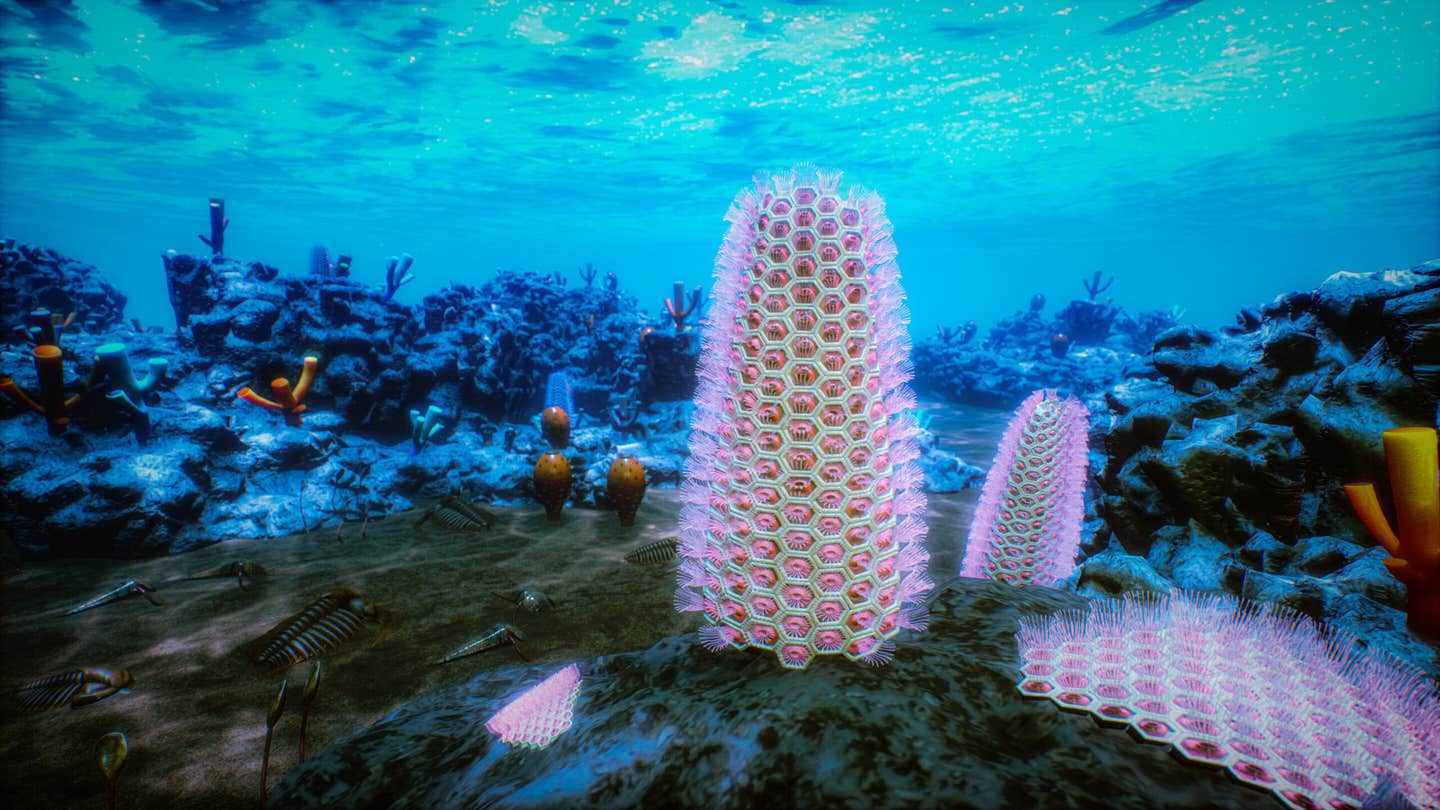
Reconstruction of the early Cambrian seafloor, depicting colonies of Protomelission gatehousei and Dayingomelission hexaclitia living among archaeocyath reefs in shallow seas approximately 520 million years ago. (CREDIT: Zhifei Zhang)
Tiny honeycomb-like colonies from southern China have opened a long-running gap in the story of animal life. For decades, bryozoans seemed oddly absent from the Cambrian explosion, the burst of diversification that filled ancient seas with most major animal groups. These fossils suggest they were there all along.
The new material comes from the early Cambrian Xiannüdong Formation in Shaanxi Province and dates to about 520 million years ago. In Nature, an international team describes new specimens of Protomelission gatehousei and a newly named species, Dayingomelission hexaclitia, preserved in unusual detail.
That matters because bryozoans, tiny filter-feeding invertebrates that live in colonies, have long posed an evolutionary problem. Their fossil record seemed to begin much later, in the Ordovician, even though molecular analyses had pointed to a much earlier origin. Nearly every other major animal phylum had a Cambrian representative. Bryozoans appeared to be the exception.
“Bryozoa has been the elephant in the room of Cambrian palaeontology for a long time.” said co-author Dr Timothy Topper of Northwest University and the Swedish Museum of Natural History. “Every other major animal phylum had a Cambrian representative, except bryozoans. These fossils, finally close that chapter for good.”
Soft tissues inside stone
The fossils are tiny, just a few millimetres across, but they preserve an uncommon mix of features. The colonies retain three-dimensional form, along with internal structures mineralized by phosphate. Using imaging methods including X-ray tomographic microscopy, the team identified membranous sacs inside the zooid chambers, along with circular and longitudinal fibres interpreted as muscles.
The colonies also show the kind of modular architecture expected in bryozoans. In both taxa, the individual zooids are hexagonal in outline and packed into orderly colony walls. P. gatehousei formed an erect bilaminate colony, with zooids arranged back to back in two sheets. D. hexaclitia formed a unilaminate, sheet-like colony with regular hexagonal chambers and occasional styles, structural spines considered important bryozoan features.
Together, that skeletal design and soft-tissue anatomy make the case much stronger than before. Earlier discussions of P. gatehousei had treated it as the first good Cambrian candidate for a bryozoan, but some researchers later argued it might instead be a green alga or even unrelated skeletal pieces from another organism. The new fossils give the team what those earlier finds lacked, anatomy preserved inside the colony itself.
"These specimens are remarkable, to have soft tissues mineralised inside their original skeletal housing, half a billion years later, is nothing short of extraordinary," said Professor Zhifei Zhang of Northwest University, the study's corresponding author. "These bryozoans lived in shallow, clear-water reef environments, which may explain why they have eluded discovery for so long; the Cambrian fossil sites best known for soft-tissue preservation invariably represent deeper-water settings."
A missing phylum reappears
The study describes 38 modular fossils preserved as secondarily phosphatized colonies. In P. gatehousei, colonies measured about 1 to 2 millimetres wide and up to 3 millimetres high, with six to eight rows of autozooids on each side. In D. hexaclitia, the largest fragment exceeded 4 millimetres and had more than ten zooidal rows.
The key soft structures were found inside the chambers of both forms. The membranous sacs had thin walls, smooth outlines, and elongated openings. They were separated by narrow, consistent gaps and carried well-developed circular and longitudinal fibres. In some specimens, the sacs were preserved in place inside the skeletal cystids, confirming that the soft parts and walls belonged together rather than being later mineral infill.
That combination allows the authors to argue that both fossils satisfy the main diagnostic criteria for Paleozoic bryozoans and specifically share important traits with Stenolaemata, one of the three main living bryozoan classes. Their phylogenetic analysis places both Cambrian forms within that crown group.
This changes more than a date on a timeline. If bryozoans from 520 million years ago already belonged to an advanced branch of the group, the common ancestor of bryozoans must be older still, perhaps reaching back into the Terreneuvian Epoch of the early Cambrian or even the Ediacaran.
Colonial life was already taking shape
The findings also add weight to the idea that bryozoans were not rare curiosities in Cambrian seas. Along with earlier material from South Australia and a possible bryomorph from Nevada, the Chinese fossils suggest the group was more widespread than once thought, especially in shallow shelf and reef-associated settings.
The two Chinese taxa also show that bryozoans were already experimenting with different colony designs. One grew as a bilaminate, tapering structure. The other spread as a unilaminate sheet. That diversity hints that colonial body plans had already become well established by this stage of the Cambrian radiation.
Lead author Baopeng Song put the point bluntly. “These aren't just simple precursors; they are complex, modular colonies,” explains Baopeng Song, the study’s lead author. "The combination of skeletal architecture and internal anatomy provides definitive evidence that these are true bryozoans, and that the phylum was already diversifying during the Cambrian radiation."
The paper also pushes back firmly on competing interpretations. The team argues that the fossils differ in basic size, shape and organization from Xiaoshiba material previously compared to algae, and that they do not match the isolated sclerites of Cambroclavus. In their view, both anatomy and preservation now support the bryozoan identity beyond reasonable doubt.
That matters because bryozoans have long sat awkwardly outside the main Cambrian story. With these fossils, that absence looks less like a real evolutionary delay and more like a quirk of preservation.
Practical implications of the research
This work reshapes a basic chapter in early animal history. It brings bryozoans into the Cambrian explosion, aligns the fossil record more closely with molecular estimates, and suggests the group began diversifying earlier than the traditional fossil timeline implied.
It also shows how much can still be hidden in small, poorly sampled reef settings, especially when preservation captures both skeleton and soft tissue.
More broadly, the fossils give researchers rare evidence for how complex colonial organization evolved in early animals, a question tied to the rise of cooperation, body patterning, and biomineralized skeletons in the earliest marine ecosystems.
Research findings are available online in the journal Nature.
The original story "Fossil discovery solves 500-million-year-old mystery about the dawn of animal life" is published in The Brighter Side of News.
Related Stories
- 250-million-year-old Australian ‘sea-salamander’ sheds new light on the dawn of the dinosaurs
- Life may have begun in sticky gels long before the first cells formed
- Ancient Hot Springs Offer Key Insights to Earth's Origin of Life
Like these kind of feel good stories? Get The Brighter Side of News' newsletter.
Rebecca Shavit
Writer
Based in Los Angeles, Rebecca Shavit is a dedicated science and technology journalist who writes for The Brighter Side of News, an online publication committed to highlighting positive and transformative stories from around the world. Having published articles on MSN, AOL News, and Yahoo News, Rebecca's reporting spans a wide range of topics, from cutting-edge medical breakthroughs to historical discoveries and innovations. With a keen ability to translate complex concepts into engaging and accessible stories, she makes science and innovation relatable to a broad audience.