Future quantum computers may be built like modular data centers
Researchers show modular quantum computers can remain fault tolerant even with noisy chip-to-chip connections.
 UC Riverside Writer: Iqbal Pittalwala

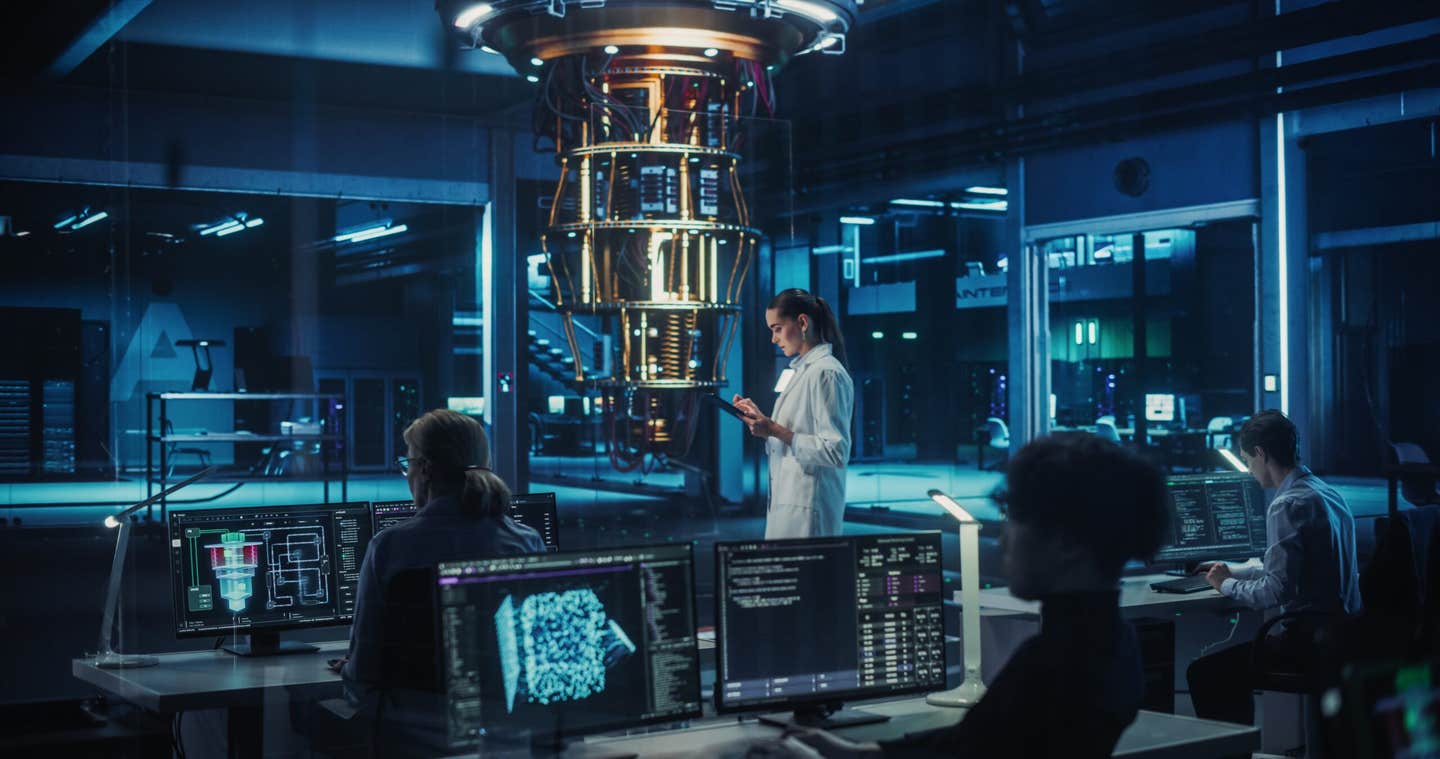
Scientists at UC Riverside found that quantum chips can be linked into larger fault-tolerant systems even when connections are significantly noisier than the chips themselves, bringing scalable quantum computing closer to reality. (CREDIT: Shutterstock)
- Simulations show that separate quantum chips can remain fault tolerant even when the connections between them are substantially noisier than operations inside each processor.
- Researchers tested direct links, gate teleportation and CAT-state connections across six surface-code configurations, finding that careful interface design preserved quantum error correction.
- The results suggest future large quantum computers may be assembled from smaller high-quality modules instead of requiring one enormous, nearly flawless processor.
Quantum computers have long promised to transform fields ranging from chemistry and materials science to cybersecurity. Yet one major obstacle has stood in the way: size. Most quantum machines today remain too small and fragile to tackle the complex problems researchers hope they will eventually solve.
A new study led by scientists at the University of California, Riverside suggests that hurdle may be easier to overcome than many believed. The research shows that future quantum computers could be built by linking many smaller quantum chips together, even when the connections between those chips are far from perfect.
The study found that modular quantum systems can still detect and correct errors even when the links connecting individual chips are up to ten times noisier than operations occurring inside each chip. The finding offers a practical path toward building larger, more powerful quantum computers using technology that already exists.
“Our work isn’t about inventing a new chip,” said Mohamed A. Shalby, first author of the study and a doctoral candidate in the Department of Physics and Astronomy at the University of California, Riverside. “It’s about showing that the chips we already have can be connected to create something much larger and still work. That’s a foundational shift in how we build quantum systems.”
Why Bigger Quantum Computers Are So Difficult To Build
Unlike conventional computers, which use bits that store either a 0 or a 1, quantum computers use quantum bits, or qubits. These qubits can exist in multiple states simultaneously, allowing quantum machines to process certain calculations far more efficiently than classical computers.
The challenge is that qubits are extremely delicate. Tiny disturbances from their environment can introduce errors and destroy valuable information. Building larger systems often means creating more opportunities for those errors to occur.
To address this problem, researchers use quantum error correction. Rather than relying on a single qubit, they combine many physical qubits to create one highly reliable logical qubit.
“Today, individual ‘logical’ qubits must be built out of clusters of many physical qubits, often hundreds or thousands,” Shalby explained.
One of the most widely used error-correction methods is known as the surface code. In this approach, qubits are arranged on a grid and continuously monitored for errors. If a mistake occurs, the system identifies and corrects it before it spreads.
Surface codes have become a leading strategy because they offer relatively high tolerance for errors while requiring only local interactions between neighboring qubits.
A Different Way To Build Quantum Machines
As quantum processors grow larger, engineers face practical limits. Manufacturing massive chips becomes increasingly difficult. Cooling systems become more complex. Controlling thousands or millions of qubits on a single processor presents enormous technical challenges.
Many researchers now believe the future lies in modular quantum computing. Instead of constructing one giant chip, engineers could connect many smaller chips together and make them operate as a unified machine.
The concept resembles modern data centers. Rather than relying on one enormous computer, data centers distribute tasks across many connected processors.
However, quantum systems face a unique problem. The links connecting separate modules often introduce much more noise than operations performed within a chip.
“In practice, connecting multiple smaller chips has been difficult,” Shalby said. “Connections between separate chips, especially those housed in separate cryogenic refrigerators, are much noisier than operations within a single chip. This increased noise can overwhelm the system and prevent error correction from working properly.”
Testing Whether Noisy Connections Can Work
To investigate the problem, the research team conducted thousands of simulations using realistic quantum architectures inspired by existing infrastructure developed by Google Quantum AI.
The researchers examined six different modular designs and tested three strategies for linking quantum chips. These included direct noisy links, gate teleportation methods, and CAT-state gadgets.
Each design relied on surface-code error correction. The simulations evaluated how well the systems performed under varying levels of noise and operational errors.
The researchers focused on an especially challenging scenario. They assumed the connections between modules were ten times noisier than operations occurring inside each quantum chip.
Under conventional thinking, such noisy boundaries could potentially cripple a quantum computer’s ability to correct errors. Instead, the simulations revealed something surprising.
Even under those conditions, the systems continued functioning and maintained fault tolerance.
Fault tolerance refers to a system’s ability to automatically detect and correct errors while continuing to produce reliable results.
“This means we don’t have to wait for perfect hardware to scale quantum computers,” Shalby said. “We now know that as long as each chip is operating with high fidelity, the links between them can be ‘good enough’, not perfect, and we can still build a fault-tolerant system.”
Solving The Problem Of Error-Prone Boundaries
One of the most important challenges involved controlling what physicists call hook errors. These errors can spread through a quantum system and reduce the effectiveness of error correction.
The team developed specialized boundary designs that preserved the full protective power of the surface code.
For rotated surface-code architectures, researchers used a zigzag-shaped boundary rather than a straight-line interface. This design prevented dangerous error patterns from forming across connected modules.
The simulations showed that carefully engineered boundaries allowed the systems to maintain their full code distance, a key measure of how effectively a quantum computer suppresses errors.
Researchers ran simulations on code distances ranging from 3 to 11. Some data points involved as many as 10 million samples. The team used the Stim stabilizer simulator and Pymatching decoder to evaluate performance under realistic conditions.
Across all tested configurations, the systems remained fault tolerant despite elevated interface noise.
Moving Beyond The Qubit Race
For years, many quantum computing milestones focused on increasing the number of qubits in a machine. While larger qubit counts often attract attention, experts increasingly recognize that raw numbers alone are not enough.
Without robust error correction, additional qubits offer little practical value.
“Until now, most quantum milestones focused on increasing the sheer number of qubits,” Shalby said. “But without fault tolerance, those qubits aren’t useful. Our work shows we can build systems that are both scalable and reliable, now, not years from now.”
The study suggests that researchers may no longer need to wait for flawless interconnects before building larger systems. Instead, engineers can focus on ensuring that individual chips operate with high accuracy while accepting some imperfections in the links connecting them.
A New Direction For Quantum Computing
The findings also help explain how future quantum networks may evolve. Modular systems could support advanced techniques such as lattice surgery, a method that allows quantum information to move between separate regions of a processor.
The researchers note that each connection strategy comes with tradeoffs. Direct links require fewer resources and produced the strongest performance. CAT-state and gate-teleportation approaches required additional qubits and deeper circuits, but still maintained fault tolerance with only modest reductions in performance.
Perhaps most importantly, the work demonstrates that large-scale quantum systems may be achievable using hardware already under development.
The study was motivated by earlier research from the Massachusetts Institute of Technology, supported by the National Science Foundation, and relied on simulation tools developed by Google Quantum AI.
Dig deeper into modular quantum computing and error correction
These resources provide broader context on surface codes, fault tolerance, decoding and the simulation tools used to study scalable quantum computers.
Surface codes: Towards practical large-scale quantum computation: This influential paper explains the surface-code architecture, logical qubits and the error thresholds that make the approach attractive for large quantum computers. (Physical Review A, 2012)
High-threshold universal quantum computation on the surface code: This work describes how surface codes can support universal fault-tolerant computation using local interactions and comparatively high error thresholds. (Physical Review A, 2009)
Fault-tolerant quantum computation by anyons: This foundational work introduced key ideas behind topological quantum error correction that later became central to surface-code architectures. (Annals of Physics, 2003)
Stim: a fast stabilizer circuit simulator: The paper describes the high-speed simulator used to model large stabilizer circuits and quantum error-correction experiments. (Quantum, 2021)
PyMatching: A Python Package for Decoding Quantum Codes with Minimum-Weight Perfect Matching: This resource explains the decoder used to translate error-syndrome measurements into likely corrections during surface-code simulations. (ACM Transactions on Quantum Computing, 2022)
Research findings are available online in the journal Physical Review A.
The original story "Future quantum computers may be built like modular data centers" is published in The Brighter Side of News.
Related Stories
- Scientists unlock scalable entanglement for next-generation quantum computing
- MIT scientists built photonic 'ski jumps' that beam light off chips for faster quantum computing
- Researchers may have observed triplet superconductivity
Like these kind of feel good stories? Get The Brighter Side of News' newsletter.
Joshua Shavit
Writer and Editor
Joshua Shavit is a NorCal-based science and technology writer with a passion for exploring the breakthroughs shaping the future. As a co-founder of The Brighter Side of News, he focuses on positive and transformative advancements in technology, physics, engineering, robotics, and astronomy. Having published articles on AOL.com, MSN, Yahoo News, and Ground News, Joshua's work highlights the innovators behind the ideas, bringing readers closer to the people driving progress.