Global first: Scientists teleport quantum information through active fiber-optic networks
Researchers showed quantum teleportation can work inside fiber already carrying internet traffic, without building new infrastructure.

 Edited By: Joseph Shavit

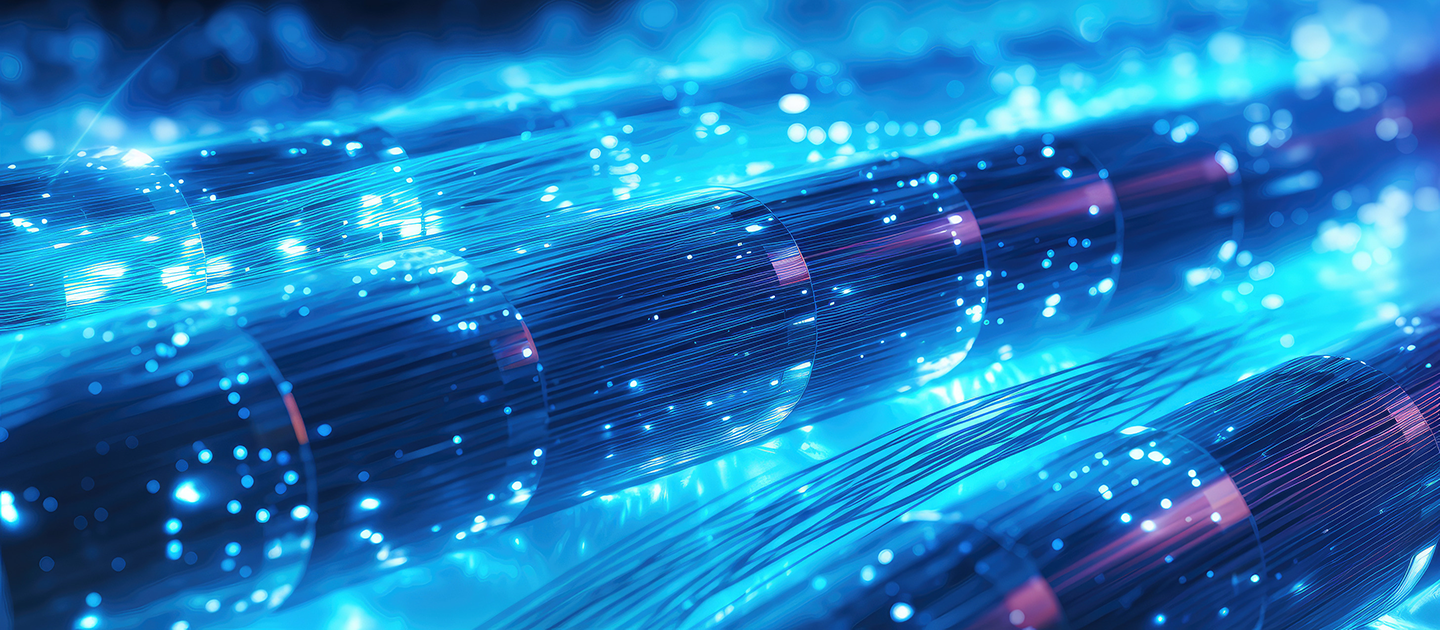
Scientists demonstrated quantum teleportation over fiber-optic cables carrying live internet data, opening a path to real-world quantum networks. (CREDIT: Wikimedia / CC BY-SA 4.0)
You are watching a long-standing assumption in physics and engineering quietly fall apart. Researchers at Northwestern University have shown that quantum teleportation can work inside fiber-optic cables already carrying real internet traffic. The team demonstrated the feat over more than 30 kilometers of standard telecom fiber, while high-power data streams raced through the same glass strand.
The work was led by Prem Kumar, a professor of electrical and computer engineering at Northwestern’s McCormick School of Engineering and director of the Center for Photonic Communication and Computing. The results appeared in Optica and point toward a future where quantum networks ride on existing internet infrastructure.
“This is incredibly exciting because nobody thought it was possible,” Kumar said. “Our work shows a path towards next-generation quantum and classical networks sharing a unified fiberoptic infrastructure. Basically, it opens the door to pushing quantum communications to the next level.”
The study brings quantum teleportation out of carefully isolated lab setups and into conditions that resemble the real world. Instead of pristine, empty fibers, the experiment used cables similar to those that already move global internet traffic.
What Quantum Teleportation Really Means
Quantum teleportation does not move matter from one place to another. It transfers information about a quantum state using entanglement. Two particles are prepared so their properties remain linked, no matter how far apart they are.
“In optical communications, all signals are converted to light,” Kumar said. “While conventional signals for classical communications typically comprise millions of particles of light, quantum information uses single photons.”
Jordan Thomas, a Ph.D. candidate in Kumar’s lab and the paper’s first author, explained the core idea. “By performing a destructive measurement on two photons, one carrying a quantum state and one entangled with another photon, the quantum state is transferred onto the remaining photon,” Thomas said. “The photon itself does not have to be sent over long distances, but its state still ends up encoded onto the distant photon.”
This method allows information to be shared without physically sending the particle that holds it. That feature makes teleportation attractive for secure communication and future quantum computing networks.
Solving the Traffic Problem Inside Fiber
For years, many scientists believed quantum teleportation could not survive in fibers full of classical signals. The concern was noise. Bright classical light scatters inside glass and creates stray photons that overwhelm faint quantum signals.
Kumar’s team tackled this problem by studying how light scatters at different wavelengths. They placed quantum signals in a quieter part of the spectrum and added specialized filters to block noise from internet traffic.
“We carefully studied how light is scattered and placed our photons at a judicious point where that scattering mechanism is minimized,” Kumar said. “We found we could perform quantum communication without interference from the classical channels that are simultaneously present.”
The experiment used a 30.2-kilometer fiber link carrying a commercial 400-gigabit-per-second data signal. Quantum information traveled alongside it without disrupting the data, and without being destroyed by it.
Inside the Three-Node Teleportation Test
You can picture the setup as three stations. Alice prepares the quantum state. Bob receives it. Charlie sits in the middle, where the crucial teleportation measurement happens.
Alice created single photons carrying quantum information and sent them 15.2 kilometers to Charlie. Bob produced pairs of entangled photons. One stayed with Bob. The other traveled 15 kilometers to Charlie in the opposite direction.
At Charlie’s station, two photons met and were measured together. That measurement destroyed them, but it forced Bob’s remaining photon into the same state Alice had prepared. The quantum state moved from Alice to Bob, even though Alice’s photon never reached Bob.
All of this occurred while intense classical data streams shared much of the same fiber path.
Choosing the Right Colors of Light
"A key engineering decision involved wavelength choice. Classical internet traffic stayed in the C-band, near 1550 nanometers. Quantum signals operated in the O-band, around 1290 nanometers," Kumar told The Brighter Side of News.
"This separation matters. Bright C-band light creates fewer stray photons at 1290 nanometers than at other nearby wavelengths. That choice cut noise by roughly an order of magnitude," he continued.
The researchers generated their photons using nonlinear optical waveguides made of lithium niobate. Lasers produced short pulses that were converted into pairs of correlated photons. Careful filtering ensured the photons had nearly identical timing, color, and polarization.
Those details were critical. For teleportation to work, photons must be almost indistinguishable when they meet at the beam splitter in Charlie’s station.
Proving Teleportation Survived the Noise
The team tested how noise increased as classical power rose. Detector noise increased linearly, but the classical channel required little power to operate. That kept added noise low under realistic conditions.
They also checked whether quantum interference and entanglement survived alongside strong data traffic. Measurements showed that both effects remained intact, even at power levels far higher than needed for normal internet operation.
Finally, the researchers ran full teleportation tests. They prepared different quantum states at Alice’s station and measured the results at Bob’s end. The outcomes showed clear quantum patterns that no classical system could reproduce.
Teleportation fidelity stayed high across many states. Importantly, the results with heavy internet traffic closely matched tests run without long fiber links at all.
A Step Toward Real Quantum Networks
The study suggests that advanced quantum operations do not need their own dedicated cables. They can coexist with today’s networks, if engineers choose wavelengths wisely and manage noise carefully.
“Quantum teleportation can provide quantum connectivity securely between geographically distant nodes,” Kumar said. “If we choose the wavelengths properly, we won’t have to build new infrastructure. Classical communications and quantum communications can coexist.”
Future experiments will push the distances farther and test more complex protocols, such as entanglement swapping. The team also plans to work with deployed underground cables instead of lab spools.
Practical Implications of the Research
This research shows that quantum communication can move from theory and lab tests into real network environments. By sharing existing fiber infrastructure, future quantum networks could expand faster and at lower cost.
That shift may speed progress in secure communications, distributed quantum computing, and advanced sensing.
For society, the work suggests that a quantum internet could grow alongside today’s digital backbone, rather than replacing it, making powerful new technologies more accessible and practical.
Research findings are available online in the journal Optica.
Related Stories
- Quantum teleportation is unlocking a new age of innovation
- Scientists achieve first-ever quantum teleportation between separate semiconductor chips
- For the first time ever, scientists 'teleport' images using light
Like these kind of feel good stories? Get The Brighter Side of News' newsletter.
Shy Cohen
Writer