JWST finds rare planet with different atmospheric conditions at dawn and dusk
JWST shows WASP-121 b has different atmospheric conditions at dawn and dusk, exposing heat transport on an extreme world.

 Edited By: Joshua Shavit

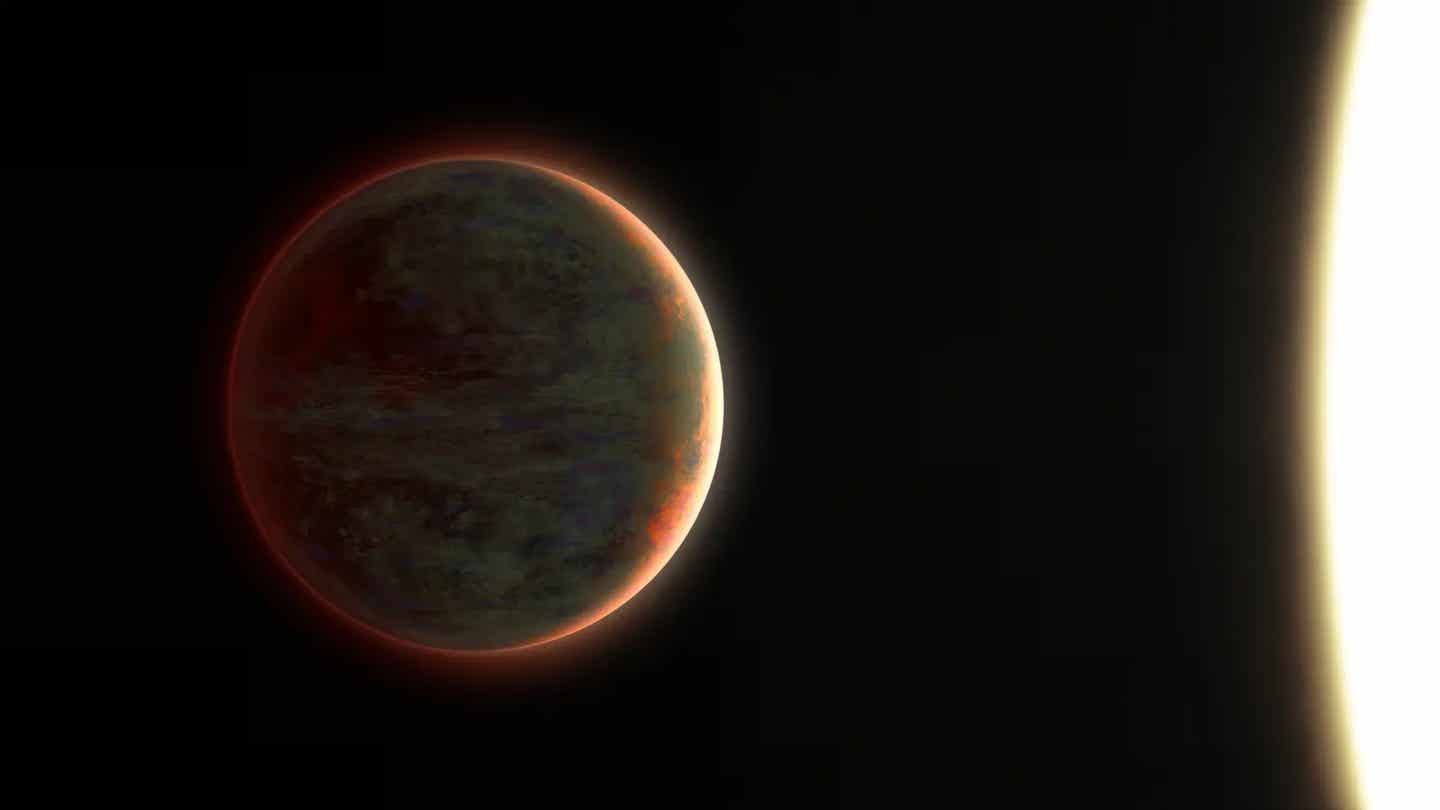
Artist’s impression of the exoplanet WASP-121 b. It belongs to the class of hot Jupiters. Due to its proximity to the central star, the planet’s rotation is tidally locked to its orbit around it. (CREDIT: Patricia Klein and MPIA)
WASP-121 b is split between extremes. One side faces its star nonstop and burns at about 2,770 Kelvin. The other stays in darkness and cools to roughly 1,000 Kelvin. Now astronomers have found that even the narrow boundary zones between those halves are not alike.
Using the James Webb Space Telescope, a team led by Cyril Gapp of the Max Planck Institute for Astronomy detected clear differences between the planet’s morning and evening terminators, the regions where day turns to night. The result gives researchers one of their sharpest looks yet at how temperature and chemistry shift across an exoplanet’s atmosphere.
The signal appeared during transit, when WASP-121 b crossed in front of its host star. As starlight passed through the planet’s atmosphere, the gases there filtered specific infrared wavelengths. By tracking how that filtering changed over the course of the transit, the team could watch different longitudes rotate into view.
“With its unprecedented observational quality, JWST gives us the most detailed glimpses into distant planets to date: By measuring how star light absorption changes as WASP-121 b rotates, we probe its atmosphere longitude by longitude,” Gapp said.
Because the planet is so close to its star, tidal forces have locked its rotation. One spin takes as long as one orbit, leaving the same hemisphere always facing the star. During a transit, though, the planet turns enough for astronomers to sample different slices of its atmosphere, including the dawn side leading its orbit and the dusk side trailing behind.
A planet that grows larger at dusk
What the team saw was not symmetrical. The evening terminator absorbed more light than the morning side, especially later in the transit. That points to an atmosphere that is hotter and more expanded at dusk.
The interpretation fits a long-standing picture of fierce eastward winds sweeping heat from the blazing dayside toward the cooler nightside. Those winds would warm the evening terminator, puffing up the atmosphere there and making the planet appear slightly larger in cross-section. A bigger cross-section blocks and absorbs more of the star’s light.
WASP-121 b is an ideal place to look for this effect because it rotates by about 30 degrees during a full transit. That is enough to separate the atmospheric signal from the two terminators with unusual precision.
Astronomers usually average transit data across the full event to strengthen the signal. Here, the team did the opposite. They let the signal vary over time and used statistical tests to see whether that changing model fit the observations better than a standard, time-invariant one. It did.
The measurements came from JWST’s NIRSpec instrument, with supporting evidence from NIRISS. In the NIRSpec data, the overall brightness dropped slightly more toward the end of the transit, matching the idea that the planet’s absorbing area was increasing as hotter regions rotated into view.
Molecules tell a different part of the story
The pattern was not just about size. It also appeared in the spectrum itself.
A carbon monoxide feature between 4.3 and 5.2 micrometers grew stronger as the transit progressed. The researchers do not think that means carbon monoxide suddenly becomes more abundant on the evening side. Instead, they argue it is mainly a temperature effect. Carbon monoxide remains stable across the atmosphere, so hotter, more expanded gas can strengthen its signal even without adding more molecules.
Water behaved differently. Its signal stayed flat or shrank slightly, which the team interprets as a genuine drop in water molecules on the hotter side. In the upper atmosphere of such an extreme planet, temperatures can become high enough to tear water apart into its constituent parts. As hotter gas rotates into view on the trailing limb, the amount of intact water drops.
That contrast matters because it turns the transmission spectrum into more than a heat map. It becomes a way to watch chemistry change from one longitude to another.
The data also hinted at a slight rise in silicon monoxide absorption, though the evidence there is weaker. The spectral feature is narrow, leaving less room for a confident interpretation.
A better view, but not a complete one
The team compared the observations with atmospheric models designed to simulate how heat spreads through a gas giant’s upper layers. Those models did predict an asymmetry between the two terminators, supporting the broad explanation. But the observed signal was stronger than expected.
That mismatch suggests something may be missing from the standard picture. One likely candidate is clouds.
Not water clouds, but mineral clouds made of materials such as silicates. Earlier work has suggested such clouds may form in these harsh atmospheres. If clouds are more important near the morning terminator, they could block infrared light from hotter layers below and make that region look cooler than simple models predict.
Cloud physics is notoriously difficult to simulate in a changing atmosphere. Condensation, evaporation, and transport all matter, and many exoplanet models still treat those effects only crudely or ignore them. When the researchers adjusted their simulations to approximate cloud effects, the results moved closer to the observations. Even so, they stopped short of claiming cloud detection. More sophisticated modeling will be needed.
The new measurements also fit with earlier ground-based work. Previous observations had traced phase-dependent behavior in atoms and ions at optical wavelengths, and infrared data from Gemini-South had suggested that carbon monoxide and water trace different parts of the atmosphere during transit. The new JWST results support that picture while extending it into molecular measurements from space.
A method that could spread beyond one world
WASP-121 b is among the most extreme known ultrahot Jupiters, but it may not be unique in offering this kind of atmospheric view. The researchers say other planets with the right temperatures and rotation geometry could also reveal phase-dependent signals during transit.
That matters because transmission spectroscopy has long treated an exoplanet’s limb as if it were mostly uniform. This work shows that assumption can miss important structure. Dawn and dusk on a distant planet may tell different stories.
Instead of one blended atmospheric ring, astronomers may now be able to separate pieces of that ring and compare them directly. In worlds where dayside heat, nightside cooling, fast winds, molecular breakup, and cloud formation all compete, that added detail could reshape how these atmospheres are understood.
For WASP-121 b, the message is already clear. The boundary between day and night is not a simple dividing line. It is a place where motion, heat, and chemistry pull the atmosphere in different directions, and JWST is finally sensitive enough to watch it happen.
Practical implications of the research
This study gives astronomers a new way to examine exoplanet atmospheres in three dimensions, not just as averaged shells of gas. By measuring how atmospheric absorption changes from the start of a transit to the end, researchers can test where heat is moving, which molecules survive in hotter regions, and whether clouds are masking deeper layers.
That should improve atmospheric models for ultrahot Jupiters and help scientists pick the best future targets for JWST and other observatories.
It also strengthens the case for combining space-based infrared observations with ground-based high-resolution spectroscopy, since the two approaches can track different parts of the same atmospheric circulation.
Research findings are available online in the journal Nature Astronomy.
The original story "JWST finds rare planet with different atmospheric conditions at dawn and dusk" is published in The Brighter Side of News.
Related Stories
- JWST reveals surprising origin of fiery giant planet reaching 3000°C
- Astronomers capture first 3D view of an exoplanet’s atmosphere and climate
- JWST finds methane in the atmosphere of a rare temperate Saturn-sized planet
Like these kind of feel good stories? Get The Brighter Side of News' newsletter.
Joseph Shavit
Writer, Editor-At-Large and Publisher
Joseph Shavit, based in Los Angeles, is a seasoned science journalist, editor and co-founder of The Brighter Side of News, where he transforms complex discoveries into clear, engaging stories for general readers. With vast experience at major media companies like The Los Angeles Times, Times Mirror and Tribune Publishing, he writes with both authority and curiosity. His writing focuses on space science, planetary science, quantum mechanics, geology. Known for linking breakthroughs to real-world markets, he highlights how research transitions into products and industries that shape daily life.