JWST solves a longstanding cosmic mystery about comet crystals
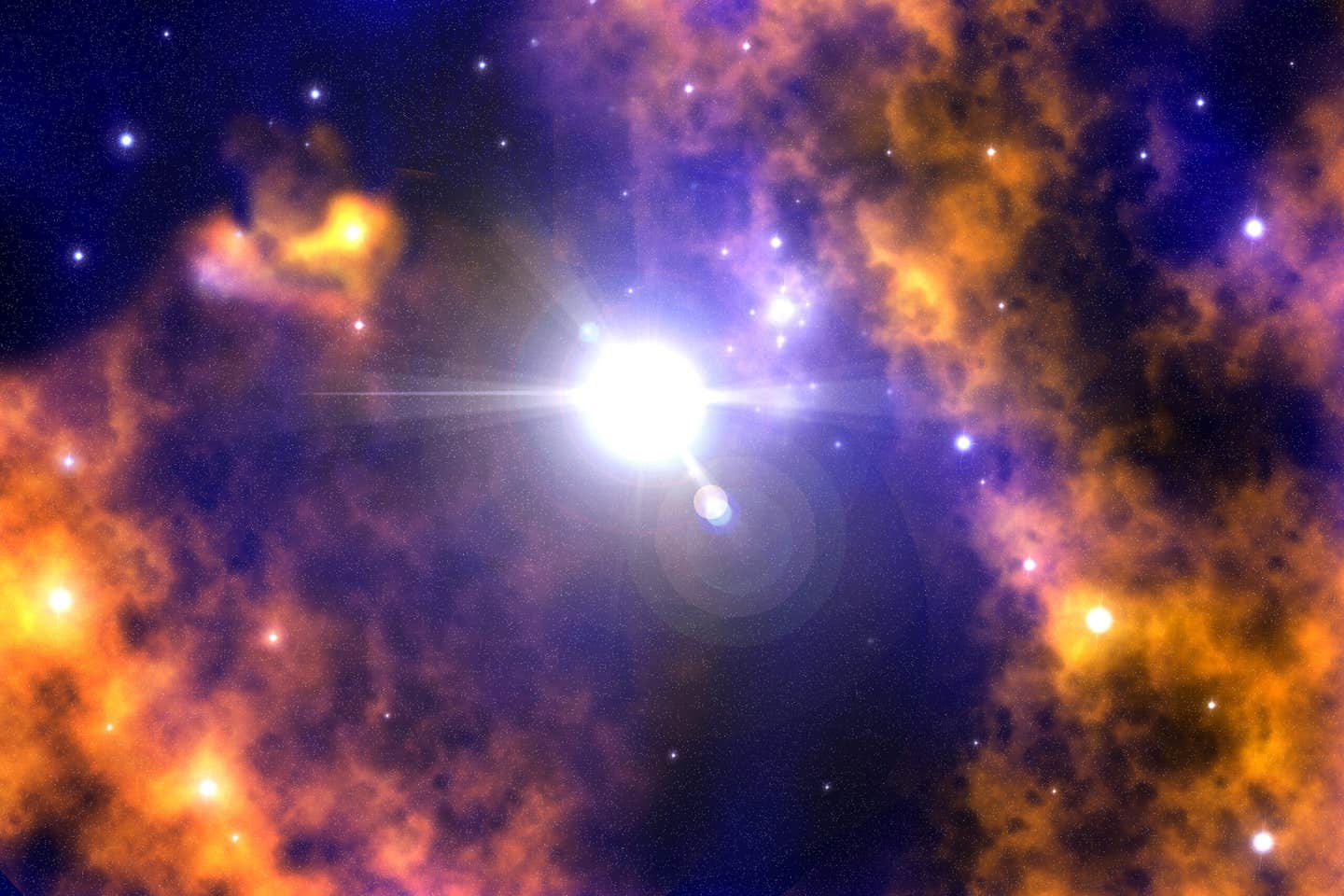
New Webb data reveal how explosive bursts in a young star create and distribute crystals later found in comets and planets.


NASA’s James Webb Space Telescope’s 2024 NIRCam image shows protostar EC 53 circled. (CREDIT: NASA, ESA, CSA, STScI, Klaus Pontoppidan (NASA-JPL), Joel Green (STScI); Image Processing: Alyssa Pagan (STScI))
Using NASA's James Webb Space Telescope, astronomers from Seoul National University and other international institutions have been able to answer a question that has puzzled scientists for years about how rocky materials formed in planetary systems. By studying the young star EC 53, the astronomers present evidence that crystallized minerals form near a newly created star and move outward into cooler regions where comets and planets develop.
The research team, led by Jeong-Eun Lee at Seoul National University, studied EC 53, a Sun-like protostar located deep in the Serpens Nebula about 1,300 light years from Earth, which is filled with stars still forming. The team's results were published in Nature.
Crystalline silicates are regularly found in comets that have formed in our Solar System. These materials require very high levels of heat, greater than 900 Kelvin, to form, which is a significant mystery since comets spend the bulk of their lives far away from the Sun and frozen solid. Scientists have long thought that crystallized materials formed near a newly formed star and travelled outward, but there was no direct evidence to support these beliefs until the discovery made with Webb.
Webb’s mid-infrared imaging has provided clear proof of this phenomenon.
A Predicted Star With Outbursts Of Activity
EC 53 is an unusual star due to the orderly way in which it behaves. Most young stars that become brighter will do so without warning, while EC 53 erupts and has an organized timetable of outbursts. EC 53 experiences a series of bursts every 18 months, each of which lasts approximately 100 days. At these times, when material from the disk around the star collapses onto the growing star, the brightness of the star increases significantly, and the dust surrounding the star becomes very heated.
The predictability of the bursts allowed astronomers to prepare to look at both quiet and burst periods of activity. Spectral data of the dust surrounding the star EC 53 were collected during both of these phases using Webb’s Mid-Infrared Instrument (MIRI).
Lee told The Brighter Side of News, "Webb allowed us to see precisely which types of silicate minerals surround the star, and where they are located in relation to the star during both calm and burst activity. As such, the outflows from EC 53 are layered, and as they move outward, these layers are likely lifting the crystalline silicate minerals and taking them to other locations in the universe, kind of like a cosmic freeway."
Dust surrounding EC 53 had mostly an amorphous appearance, with randomly arranged atoms, during the quiet phases. The emergence of a distinct feature at approximately 10 micrometers near the burst phase indicates that newly formed crystalline silicates were glowing in the hot inner disk.
Minerals Made Near the Star
The researchers found evidence of specific crystalline silicate minerals, forsterite and enstatite, that are abundant on Earth, with a small presence of quartz. Forsterite made up roughly 33 percent of the crystalline material found in the vicinity of EC 53, while enstatite accounted for a much smaller percentage.
As a co-author and principal research officer for the National Research Council of Canada, Doug Johnstone said, "As a scientist, it is astonishing to me to discover that we are discovering certain types of silicates in space that are common on Earth."
Crystals appeared at wavelengths associated with the hot dust in the vicinity of the star. In contrast, at greater distances with cooler, more distant dust, there was no crystalline form present, and all forms near the star were amorphous. This indicates that these crystals were formed after the outburst event and not previously.
Temperatures near the star can exceed 1,200 Kelvin during the event. This temperature range is hot enough to destroy any pre-existing dust grains, effectively erasing any previous dust. In this small area with specific conditions for the formation of new crystals, laboratory results show that it could take just minutes to hours for them to form, which is considerably less time than the duration of an outburst.
Winds That Carry Crystals Outward
The formation of new crystals near the star is only part of their journey. To understand how they are transported to colder regions where they become part of comet material, the researchers sought to understand how material within a disk travels.
The Webb Space Telescope has also revealed a network of highly dynamic, fast-moving outflows of gas surrounding EC 53. Close to the poles of the star, narrow, fast jet streams of hot gas flow out into space, while slower, wider outflowing wind streams move away from the inner region of the disk. The layered wind patterns produced by the outflows from this system are consistent with results from computer simulations of magnetically driven outflows from disks.
"The Webb Telescope is doing an incredible job of providing amply detailed views of this event and is also producing data that accurately represent how everything in the disk is located," stated Joel Green, an instrument scientist at the Space Telescope Science Institute in Baltimore, Maryland.
The researchers studied how the crystalline material moves within the disk surrounding the young star EC 53. Dust grains floating in the disk’s atmosphere are subject to wind forces, which can carry these grains away from their source and transport them away from the star and out into space. The authors’ study did not detect the crystals directly; however, the wind evidence provides a path for travel across distances of thousands of astronomical units from the star.
Vertical mixing in the disk can also transport crystalline particles into the interior of the disk through turbulence. The hot regions on the surface of the disk do not have many crystals, but the temperature of these hot regions will eventually cause increased crystalline material to develop within the planet-forming regions of the disk.
Clues to the Solar System’s Past
The observations of EC 53 allow scientists to better understand how the Sun may have formed through an episodic and erratic process of brightness changes. The results of the study confirm that most young stars go through cycles of increasing and decreasing brightness. Therefore, it is reasonable to conclude that the early development of the Sun likely followed similar eruption patterns.
Older stars that are less active do not have the same pronounced crystalline features as younger stars with more frequent eruptions, while young stars that experience explosive events show fewer crystals due to the destructive effects of heat.
Thus, it is highly probable that the Sun was subjected to similar eruption events as it formed, building up crystalline materials near its surface and expelling them into the debris cloud surrounding the Sun, contributing these minerals to the planets in the Solar System.
Presently, EC 53 is completely obscured by dust and will likely remain so for 100,000 years or longer. Dust particles colliding and combining into larger aggregates over millions of years will eventually result in the formation of terrestrial planets and gas giants, leaving behind a less turbulent and more organized planetary system.
Practical Implications of the Research
This work alters how planet formation is viewed by examining the explosive events associated with stars. Moreover, by examining the mechanisms behind the formation and transport of crystalline minerals, additional information is provided that explains the presence of crystals in cold areas of planetary systems.
Future studies will refine models of how disks evolve to form planets and assist in identifying potential locations where similar processes occur around other young stars.
In the long term, understanding how much influence these explosive events have had in creating similar chemical compositions between the Solar System and planets orbiting other stars will enhance knowledge of Earth-like planet formation across the universe.
Research findings are available online in the journal Nature.
Related Stories
- JWST found a 'dead' galaxy that quit making stars billions of years ago
- Astronomers spot an 'impossible' shock wave around a dead star system
- Runaway stars within the Milky Way may reveal dark matter’s hidden structure
Like these kind of feel good stories? Get The Brighter Side of News' newsletter.

Joshua Shavit
Writer and Editor
Joshua Shavit is a NorCal-based science and technology writer with a passion for exploring the breakthroughs shaping the future. As a co-founder of The Brighter Side of News, he focuses on positive and transformative advancements in technology, physics, engineering, robotics, and astronomy. Joshua's work highlights the innovators behind the ideas, bringing readers closer to the people driving progress.