Martian dust storms crackle with ‘mini lightning,’ revealing a hidden electric Mars
Perseverance’s microphone has heard tiny lightning in Martian dust storms, reshaping ideas about Mars’ climate, chemistry and future missions.

 Edited By: Joshua Shavit

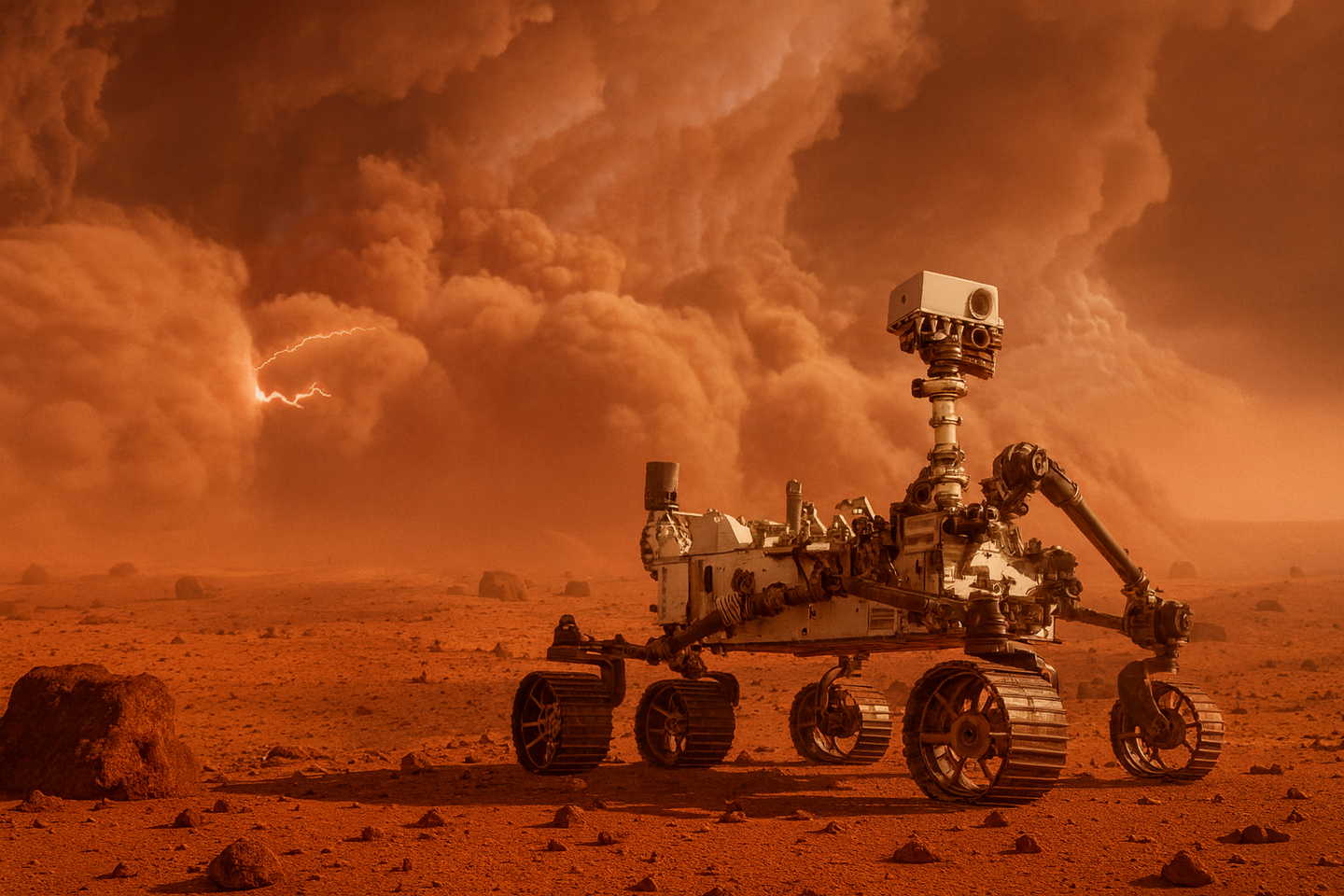
By listening with Perseverance’s microphone, scientists uncovered “mini lightning” that shifts how you see Mars’ weather, chemistry and the risks that dust may pose to future explorers. (CREDIT: AI-generated image / The Brighter Side of News)
Dust on Mars has a new voice. What once looked like silent red storms now crackles with tiny sparks, as if the planet were whispering with electricity right under your feet.
For the first time, scientists have heard miniature lightning on a rocky world other than Earth. Using a simple microphone on NASA’s Perseverance rover, a French-led team has recorded dozens of faint, static-like zaps from dust devils and storm fronts in Jezero crater. The work, led by Baptiste Chide of the Institut de Recherche en Astrophysique et Planétologie in Toulouse, appears in the journal Nature and reveals an invisible electrical side to Martian weather that you were never able to sense before.
“It opens a completely new field of investigation for Mars science,” Chide said, citing the possible chemical effects from electrical discharges. “It’s like finding a missing piece of the puzzle.”
A microphone that heard more than wind
Perseverance’s SuperCam instrument carries a small microphone high on the rover’s mast. It was meant to listen to wind and to the sharp pops from the rover’s rock-vaporizing laser. Instead, it stumbled onto something more surprising.
Chide’s team sifted through 28 hours of audio collected over two Martian years. You can think of that as eavesdropping on the planet for a full day, spread out over hundreds of sols. They were not just hunting for random pops. They searched for a precise three-part pattern that revealed both electricity and sound.
Each event began with an extremely fast spike in the signal, rising in under 40 microseconds, followed by a smooth drop that faded over about 8 milliseconds. That pair of features was not a real noise in the thin air. Electrical models showed it came from electromagnetic interference as a magnetic pulse from a discharge ran through a ground loop in the microphone wiring and briefly disturbed its electronics.
The third feature was different and very real. A sharp N-shaped pulse arrived slightly later, matching the shock wave from a tiny explosion or spark. In the frequency spectrum, the team also saw a dip around 6 kilohertz, created when sound waves bounced off the microphone base and interfered with the direct signal. The same pattern shows up when the microphone listens to the shock waves from SuperCam’s own laser-made plasma.
That combination, an electrical “overshoot” followed by an acoustic shock, let the team separate true discharges from simple dust hits, wind gusts or rover vibrations. In total, they found 55 electrical events, many surrounded by smaller spikes that spread energy across all frequencies. Those spikes matched low-energy triboelectric discharges between colliding dust grains that were too far away, or too weak, for their sound to stand out.
Why Mars is easy to spark
On Earth, you see similar electrical charging in dust storms, sandstorms and volcanic ash clouds. When grains rub together, they trade charge, build up electric fields and sometimes release energy as lightning. Fields in terrestrial storms can reach 10,000 to 160,000 volts per meter.
Mars is even more ready to spark. Its air is about one hundredth the pressure of Earth’s and made mostly of carbon dioxide. That thin atmosphere is a poor electrical shield. The breakdown threshold, the electric field needed to trigger a discharge, is only about 15,000 volts per meter near the surface. On Earth, you need roughly 3 million volts per meter.
That lower threshold means fields that would be harmless here can cause sparks there. For decades, models and lab experiments suggested that Martian dust devils and storms should be electrified. Until now, though, no one had actually measured an electric field or heard a discharge on the ground.
Perseverance changed that picture. By timing the gap between the electromagnetic spike and the arrival of the shock wave, the team could estimate how far each discharge was from the microphone. Some happened within a few centimeters. Others struck nearly 2 meters away, probably as arcs from the rover into the ground.
Most of the discharges were tiny. Using blast wave theory, the researchers calculated that several sparks carried only 0.1 to 150 nanojoules of energy. Those could come from hundreds to 100 million dust grains, about 10 to 100 micrometers across, releasing their charge over gaps shorter than a centimeter.
One event on Sol 1,296 stood out. Its sound pointed to about 40 millijoules of energy, thousands of times more than most others, with a path less than about 40 to 46 centimeters long. That fits a simple but dramatic picture: the rover itself had built up several thousand volts of charge during a dust event and then suddenly discharged to the ground in one bright spark.
Dust devils, storm fronts and crackling air
The electrical events did not happen at random. When Chide’s group lined up the timing of each discharge with weather data from the Mars Environmental Dynamics Analyzer, a pattern jumped out. Fifty-four of the 55 events occurred during the top 30 percent of the windiest recordings.
Sixteen of the discharges coincided with two dust devils that passed right over Perseverance while the microphone was on, during Sols 215 and 1,296. The first vortex, on Sol 215, was fairly average. It caused a pressure drop of about 2 pascals and only a small dip in sunlight, a sign of modest dust. Grains were still lofted up to the microphone height of about 2 meters, and the discharges happened inside the core of the vortex, where electric fields are strongest.
The Sol 1,296 dust devil was much stronger. It produced a pressure drop of 5.5 pascals and a more than 1.4 percent change in solar energy reaching the ground. The microphone heard many more grain impacts and more electrical events. That pattern supports the idea you might expect from intuition: stronger vortices create more charge and more discharges.
Thirty-five additional events lined up with the leading edges of dust storms on Sols 317 and 1,245. In one case, a regional storm passed directly over Jezero crater, whipping up low-altitude dust, strong winds and intense sand motion between Sols 313 and 319. In the other, the core of a storm front passed a few kilometers east of the rover but still injected dust into the crater.
At those moving fronts, sharp changes in pressure and temperature stir up turbulence. Grain collisions increase, triboelectric charging ramps up and positive and negative charges separate. That cocktail creates ideal conditions for sparks.
Curiously, the team did not see more discharges during the dustiest season overall, when a veil of fine particles from distant storms hangs high in the Martian atmosphere. In that season, the blanket of dust cuts surface heating, softens convection and reduces local dust lifting. The result suggests that what really matters for electrical activity is not just a hazy sky, but fresh dust being kicked up near the ground.
How much electricity a dusty planet can make
With only 55 events, you might think it is hard to estimate the planet’s total electrical budget. Still, the team combined the recorded energies with known rates of dust devils and storms to get rough numbers.
In Jezero crater, typical dust devils with 2 pascal pressure drops occur about 2.5 times per square kilometer per sol. Stronger vortices with drops over 5 pascals are rarer, about 0.1 per square kilometer per sol. If you assume a typical discharge rate of about 0.1 events per second during a six minute dust devil, you get a daily energy range of at least 1 to 100,000 microjoules per square kilometer.
Orbital images show that local and regional storms cover roughly 9 billion square kilometers per Martian year. Only some of that area actively lifts dust. Portions of storm fronts with textured cloud tops, which indicate strong turbulence, are used as a stand in for these active regions. They cover about 3.3 × 10^8 square kilometers each Martian year.
If you treat those active storm cells like large dust devils, with similar discharge rates and energies, their fronts produce about a thousand times more electrical energy on average than dust devils alone. In simple terms, storm fronts likely dominate Mars’ global electrical budget.
Experiments on Earth suggest that every joule of electrical energy in these sparks can generate several 10^16 oxidant molecules under Mars-like conditions. Scaled up, dust devils in Jezero could create about 10^10 to 10^15 oxidant molecules per square kilometer per sol, with storm fronts adding roughly a factor of a thousand.
“It really is a chance discovery to hear something else going on nearby, and everything points to this being Martian lightning,” said Daniel Mitchard of Cardiff University, who wrote a companion article in Nature and was not part of the rover team. But, he added, until new instruments fly, “I think there will still be a debate from some scientists as to whether this really was lightning.”
Practical Implications of the Research
For you and for future explorers, these tiny sparks carry big meaning.
First, electrical forces change how dust behaves. When you add charge to the usual push from wind, grains lift off the ground more easily. That feedback loop helps storms grow, keeps dust aloft longer and shapes the climate of Mars. Better models of that process will help you understand how often global storms form and how they might affect robotic missions or human bases.
Second, the discharges help build reactive chemicals. Sparks can make oxidants such as hydrogen peroxide and drive chlorine chemistry that forms perchlorates, which have already been found in Martian soil. Those oxidants can break apart organic molecules and blur the chemical traces of life.
If you hope to find biosignatures on Mars, you now have a new clue. Regions with fewer dust devils and storms may preserve organic material better, while very active regions could be harsher and more chemically aggressive. Chide called the next step “the quantification of the amount of oxidants produced by this new phenomenon,” which will need lab work and new models.
Third, the results give engineers real numbers to design against. Some of the discharges came from the rover itself charging to several thousand volts, then dumping that energy into the ground. So far there have been no reported electrical failures from this effect on modern landers or rovers, which shows that careful grounding and shielding work. Still, Mitchard warned that the “small and frequent static-like discharges could prove problematic for sensitive equipment.” Knowing the typical voltages and energies will help you build safer electronics, more robust power systems and eventually protective space suits for astronauts.
The findings may also rewrite an old mystery. The Soviet Mars 3 lander set down during a dust storm in 1971 and fell silent after about 20 seconds. Chide and others note that electrical discharges could have played a role in that failure. With better data, future missions can avoid similar risks.
Finally, this work reaches beyond Mars. Similar triboelectric discharges may occur wherever wind-blown grains move through an atmosphere, from the hot clouds of Venus to the hazy skies of Saturn’s moon Titan. Understanding these sparks can help you interpret strange weather on other worlds, guide future landing sites and refine your search for life.
“The current evidence suggests it is extremely unlikely that the first person to walk on Mars could, as they plant a flag on the surface, be struck down by a bolt of lightning,” Mitchard said. But the same study that reassures you about giant bolts also tells you to respect the many small zaps that flicker through Martian dust. Those faint crackles are now part of how you will plan to live and work on the Red Planet.
Research findings are available online in the journal Nature.
Related Stories
- NASA orbiter data challenges the idea that liquid water exists on Mars
- UC Berkeley and NASA prepare twin satellites — could rewrite what we know about Mars
- Strange new mineral found on Mars points to past potential for life
Like these kind of feel good stories? Get The Brighter Side of News' newsletter.
Joseph Shavit
Writer, Editor-At-Large and Publisher
Joseph Shavit, based in Los Angeles, is a seasoned science journalist, editor and co-founder of The Brighter Side of News, where he transforms complex discoveries into clear, engaging stories for general readers. With vast experience at major media groups like Times Mirror and Tribune, he writes with both authority and curiosity. His writing focuses on space science, planetary science, quantum mechanics, geology. Known for linking breakthroughs to real-world markets, he highlights how research transitions into products and industries that shape daily life.