MIT scientists create pill capsule sensor to help doctors track missed doses
MIT engineers built a pill capsule that confirms swallowing by RF signal, then most parts dissolve in the stomach.

 Edited By: Joseph Shavit

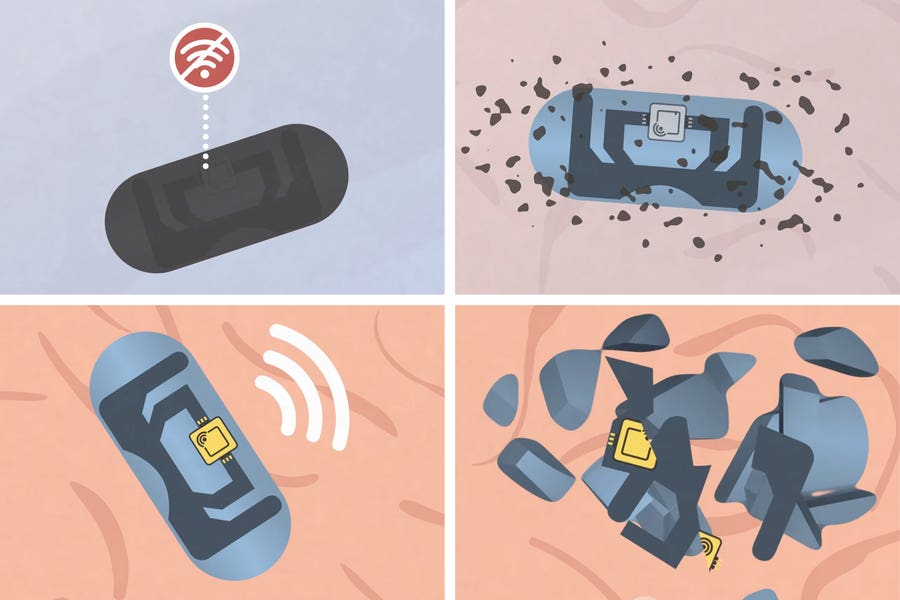
A new MIT capsule can ping a confirmation signal within 10 minutes of swallowing, then largely breaks down, aiming to improve medication adherence. (CREDIT: Nature Communications)
Missing a dose can feel small in the moment. But in transplant care, HIV, tuberculosis, and many heart conditions, a skipped pill can carry a heavy price. That gap between what a doctor prescribes and what a patient actually takes has long frustrated clinicians and families. Now MIT engineers say they have built a pill that can confirm, within minutes, that it was swallowed, then largely dissolves in the stomach.
The new system is designed to fit inside existing pill capsules. It relies on radio frequency, a signal type that can be detected from outside the body and is considered safe for humans. The capsule stays quiet before you swallow it. After ingestion, it sends a confirmation signal. Most of its parts then break down in the stomach, while a tiny radio frequency chip passes through the digestive tract and exits the body.
“The goal is to make sure that this helps people receive the therapy they need to help maximize their health,” said Giovanni Traverso, an associate professor of mechanical engineering at MIT, a gastroenterologist at Brigham and Women’s Hospital, and an associate member of the Broad Institute of MIT and Harvard.
The Real Problem is Not Always the Medicine
Medication nonadherence remains a stubborn public health problem. People miss doses for many reasons. Some forget. Some struggle with side effects. Others face cost, stigma, or mental health barriers. In many settings, clinicians can only guess what happened between visits. Self-reports can be unreliable. Pill counts can mislead. Refill histories show what was picked up, not what was swallowed.
Traverso’s group has worked on long-lasting delivery capsules that release drugs over days or weeks. Those devices can improve adherence by reducing how often you need to remember a pill. But that approach cannot work for every medication. Some drugs cannot be reformulated. Others must stay in their original capsule or tablet form.
“We’ve developed systems that can stay in the body for a long time, and we know that those systems can improve adherence, but we also recognize that for certain medications, we can’t change the pill,” Traverso said. “The question becomes: What else can we do to help the person and help their health care providers ensure that they’re receiving the medication?”
That question pushed the team toward a different goal: confirm ingestion without changing the drug itself.
A Capsule That Stays Silent Until it Reaches the Stomach
The MIT device is built around a biodegradable radio frequency antenna. The antenna is made from zinc and embedded into a cellulose particle. The antenna is rolled up and placed inside a capsule along with the drug. The capsule’s outer layer uses gelatin coated with cellulose and either molybdenum or tungsten. That coating blocks any radio signal from getting out.
The result is a pill with a built-in “quiet mode.” Before swallowing, it does not broadcast. Once it reaches the stomach, the coating breaks down. That breakdown releases the drug and exposes the antenna.
At that point, the system comes to life. The antenna can pick up an RF signal sent from an external receiver. Working with a small RF chip, it sends back a signal confirming the capsule has been swallowed. The researchers report that this exchange happens within 10 minutes of ingestion.
There have been other efforts to use radio frequency to confirm pill swallowing. But earlier designs relied on components that do not break down easily in the body. That raised concerns about safety and long-term exposure as materials pass through the gut. The MIT team aimed to reduce any risk of blockage by making the system bioresorbable, meaning the body can break down and absorb most of it.
“We chose these materials recognizing their very favorable safety profiles and also environmental compatibility,” Traverso said.
What Breaks Down, What Does Not
The capsule’s key pieces do not all behave the same way after ingestion. Most components are designed to break down in the stomach within about a week. The antenna materials, built from zinc and cellulose, are intended to dissolve and disperse.
One small part is different. The RF chip is about 400 by 400 micrometers. It is an off-the-shelf chip, and it is not biodegradable. The design assumes it will pass through the digestive tract and exit the body.
“The components are designed to break down over days using materials with well-established safety profiles, such as zinc and cellulose, which are already widely used in medicine,” said Mehmet Girayhan Say, an MIT research scientist and a lead author of the paper. “Our goal is to avoid long-term accumulation while enabling reliable confirmation that a pill was taken, and longer-term safety will continue to be evaluated as the technology moves toward clinical use.”
The study’s other lead author is Sean You, a former MIT postdoc.
Early Tests Show the Signal Can Be Read Outside the Body
To see whether the capsule could communicate from inside a stomach, the researchers tested it in an animal model. They found that the signal could be detected by an external receiver from as far as 2 feet away. That distance matters because any real-world system must work through tissue, clothing, and daily movement.
If adapted for people, the team envisions a wearable receiver. It could pick up the pill’s confirmation ping, then relay it to a patient’s care team. The wearable could also support reminders or follow-up prompts, especially if a dose does not register.
The idea is not only to watch, but to help. Monitoring may give clinicians a clearer picture of why a treatment is failing. It could also allow earlier intervention when missed doses create danger.
Who Might Benefit Most
The researchers point to transplant care as one of the most urgent use cases. After an organ transplant, patients often take immunosuppressive drugs on strict schedules to prevent rejection. Nonadherence can lead to severe complications and organ loss.
“We want to prioritize medications that, when non-adherence is present, could have a really detrimental effect for the individual,” Traverso said.
The team also sees potential in other settings where long treatment courses and strict timing matter. They include people with tuberculosis, individuals living with HIV, and patients who recently received stents and need drugs that help prevent blockage. The researchers also mention neuropsychiatric disorders, where symptoms may interfere with consistent daily routines.
Practical Implications of the Research
If this approach proves safe and reliable in human studies, it could change how medicine is supported outside the clinic. A swallow-confirmation signal could help clinicians separate treatment failure from nonadherence, which often looks the same in lab results. That clarity could reduce unnecessary dose increases, extra testing, and avoidable hospital visits.
For patients, the biggest benefit may be earlier, kinder support. A missed dose could trigger a reminder, a check-in, or a quick care adjustment before the situation becomes dangerous. In high-stakes therapies, that timing can protect transplanted organs, limit drug resistance in infectious disease, and prevent complications after cardiac procedures.
For researchers, a system that verifies ingestion could strengthen clinical trials. It could improve confidence that results reflect the drug, not gaps in dosing. It could also support new study designs focused on real-world use.
The work may also accelerate interest in biodegradable electronics, where devices perform a task, then largely disappear instead of accumulating in the body or creating waste.
Research findings are available online in the journal Nature Communications.
The original story "MIT scientists create pill capsule sensor to help doctors track missed doses" is published in The Brighter Side of News.
Related Stories
- Low-dose aspirin can reduce risk for heart attacks and strokes in adults with Type 2 diabetes
- Small doses of exercise can reduce the risk of dementia by up to 40%, study finds
- One dose of ketamine could treat depression for months, study finds
Like these kind of feel good stories? Get The Brighter Side of News' newsletter.
Mac Oliveau
Writer
Mac Oliveau is a Los Angeles–based science and technology journalist for The Brighter Side of News, an online publication focused on uplifting, transformative stories from around the globe. Passionate about spotlighting groundbreaking discoveries and innovations, Mac covers a broad spectrum of topics including medical breakthroughs, health and green tech. With a talent for making complex science clear and compelling, they connect readers to the advancements shaping a brighter, more hopeful future.