NASA’s Curiosity rover detects never-before-seen organic compounds on Mars
Curiosity uncovered complex organics on Mars, including molecules tied to life’s chemistry and ancient habitability.

 Edited By: Joseph Shavit

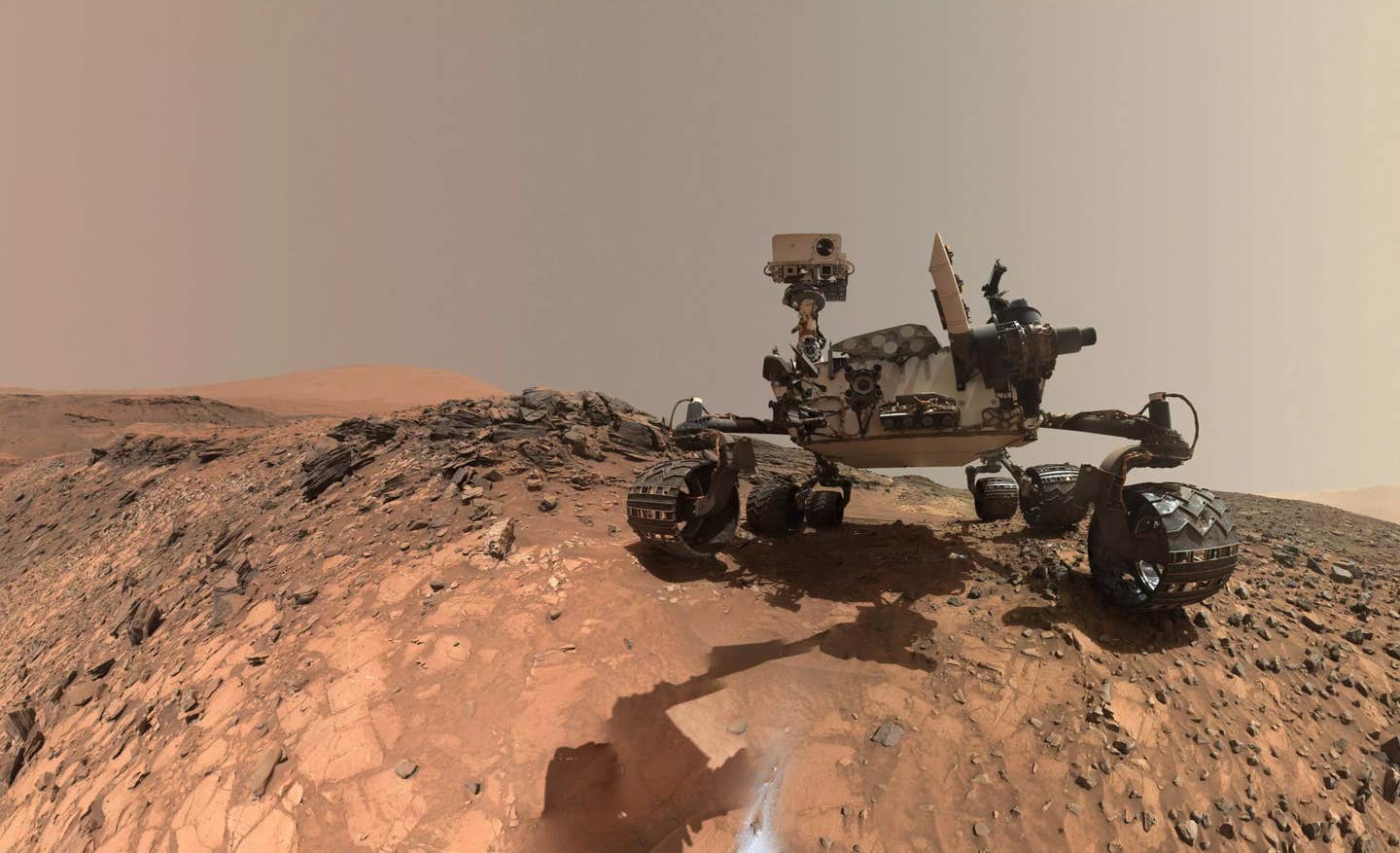
On Oct. 25, 2020, NASA’s Curiosity rover snapped a selfie after drilling into a rock called “Mary Anning.” Years later, that sample has delivered the richest mix of organic molecules ever detected on Mars.
(CREDIT: NASA/JPL-Caltech/MSSS)
A drill hole in an ancient Martian rock has yielded something more complicated than a simple yes-or-no answer about life.
NASA’s Curiosity rover has identified a broad mix of organic molecules on Mars, including compounds tied to sulfur, oxygen and nitrogen, along with chemicals that scientists see as important to life’s chemistry on Earth. One of the most intriguing signals came from a nitrogen-bearing molecule with a structure similar to compounds used to build DNA. Another was benzothiophene, a sulfur-containing molecule that had not been firmly confirmed on Mars before.
That does not mean life once existed there. It does mean Mars can preserve fragile chemical clues for a very long time.
“We think we're looking at organic matter that's been preserved on Mars for 3.5 billion years,” said Amy Williams, a geological sciences professor at the University of Florida who led the study and works on both the Curiosity and Perseverance rover missions. “It's really useful to have evidence that ancient organic matter is preserved, because that is a way to assess the habitability of an environment. And if we want to search for evidence of life in the form of preserved organic carbon, this demonstrates it's possible.”
Curiosity landed in Gale crater in 2012 to investigate whether ancient Mars once had conditions suitable for microbial life. The rover later explored Glen Torridon, a clay-rich part of the crater where minerals point to a watery past. That mattered, because clays are especially good at trapping and protecting organic material.
A first for chemistry on another world
The new work centers on a chemical test never before carried out on another planet.
Curiosity performed it in 2020 on a drilled rock target called Mary Anning 3. The rover used its Sample Analysis at Mars instrument suite, known as SAM, which has played a major role in detecting organics and studying the Martian atmosphere. For this experiment, SAM used tetramethylammonium hydroxide, or TMAH, a chemical reagent designed to break apart larger organic material into smaller pieces that can be identified.
That matters because some of the most interesting carbon-based material may not sit in rocks as neat, easily detectable molecules. It may be locked inside larger macromolecular structures. By breaking those apart, the rover can expose fragments that would otherwise stay hidden.
Only a small amount of the reagent was available onboard, roughly two cups, so researchers had to be selective. They chose a promising spot in Glen Torridon, where water-rich environments from billions of years ago may have helped preserve ancient chemistry.
The results were messy in the way real science often is. Some expected internal standards were lost because of the instrument’s sampling design. Several chemical peaks remain unidentified. Others can only be described as plausible matches rather than confirmed detections. Even so, the test worked well enough to recover a surprisingly varied set of organics.
Rings, sulfur and a hint of nitrogen
Researchers confirmed seven molecules in the data, including trimethylbenzene, tetramethylbenzene, methyl benzoate, dihydronaphthalene, naphthalene, benzothiophene and methylnaphthalene. Beyond those, the experiment pointed to more than 20 compounds overall, many aromatic or cyclic in structure.
Some of these chemicals are especially important because they suggest the original Martian material was complex.
The methylated benzene and naphthalene compounds likely formed when TMAH broke down larger carbon-rich matter. That suggests the source was not just a few stray small molecules, but a more substantial macromolecular material preserved in the rock.
Benzothiophene stands out for another reason. It is common in carbon-rich meteorites, and its detection adds to growing evidence that sulfur-bearing organics can survive in Martian sediments. Researchers said sulfurization may help preserve this kind of material over deep time.
Then there is the nitrogen story. One signal, called peak 22 in the analysis, most closely matched a methylated double-ring aromatic molecule containing a nitrogen heterocycle, possibly something similar to dimethyl-indole. The team stopped short of making a firm identification because the retention time did not line up perfectly in lab comparisons. Still, it is a tantalizing result.
Nitrogen-containing ring structures matter in astrobiology because they are central to molecules such as nucleic acids. That does not make this a sign of life, but it does show that the kinds of chemical pieces relevant to biology can either form or survive on Mars.
“The same stuff that rained down on Mars from meteorites is what rained down on Earth, and it probably provided the building blocks for life as we know it on our planet,” Williams said.
What the experiment can, and cannot, settle
The finding adds weight to an idea that has been building for years: Mars preserved indigenous organic material in ancient rocks, even after billions of years of radiation exposure and chemical alteration near the surface.
But there is a hard limit here. This experiment cannot tell researchers whether these organics came from biology, from nonliving Martian chemistry, or from meteorites that fell onto the planet long ago. The source remains unresolved.
The team noted several possibilities. The material could be exogenous, delivered from space. It could be endogenous, formed through abiotic processes such as water-rock reactions. Or, in principle, some of it could reflect ancient biology. The rover cannot sort those possibilities by itself.
There are also technical limits. No aliphatic carboxylic acid methyl esters were detected, which may reflect low abundance or flight conditions that still need improvement. Some molecules may have been altered or lost during analysis. And several peaks remain unidentified.
Even so, the broader pattern is striking. The experiment found one- and two-ring aromatic compounds, oxygen-bearing organics, sulfur-bearing molecules, and several possible nitrogen-bearing compounds, all in shallow subsurface rock from an ancient lake environment.
That diversity suggests Mars has done more than merely hang onto a few simple carbon traces. It has preserved a richer chemical archive than many scientists could once test directly on the planet’s surface.
Why this matters for the next missions
The timing of the result matters beyond Curiosity itself.
Future missions are already planning to use the same kind of chemistry. The Rosalind Franklin rover, which is headed for Mars, and Dragonfly, the mission bound for Saturn’s moon Titan, are both expected to carry instruments that can use TMAH-based tests to hunt for organics.
This latest Martian trial offers a preview of what those missions may be able to do with improved methods.
“We now know that there are big complex organics preserved in the shallow subsurface of Mars, and that holds a lot of promise for preserving large complex organics that might be diagnostic of life,” Williams said.
For now, Curiosity’s result sharpens the case for sample return. A rover can spot chemical hints, break apart ancient material and expand the catalog of Martian organics. What it cannot do is provide the final verdict. That will likely require bringing carefully chosen rock samples back to Earth, where larger instruments can test whether Mars once hosted life or simply preserved the raw ingredients.
Practical implications of the research
This work strengthens the case that ancient Martian rocks can preserve complex organic matter over billions of years. That is important for planning future missions, because it helps scientists target the kinds of environments most likely to hold useful chemical records. Clay-rich sediments now look even more valuable.
The findings also help engineers refine how wet-chemistry experiments should run on other worlds. Researchers can use what worked, and what failed, in Curiosity’s test to improve later searches on Mars and Titan.
Most of all, the study narrows the gap between detecting organics and understanding where they came from. Mars has preserved the chemistry. The next challenge is figuring out whether that chemistry points only to geology and meteorites, or to something once alive.
Research findings are available online in the journal Nature Communications.
The original story "NASA’s Curiosity rover detects never-before-seen organic compounds on Mars" is published in The Brighter Side of News.
Related Stories
- 'Bathtub Ring' points to vast ancient ocean on Mars
- Tardigrades and water reveal potential for food growth on Mars
- Hidden Martian deltas point to an ancient ocean covering half of Mars
Like these kind of feel good stories? Get The Brighter Side of News' newsletter.
Joshua Shavit
Writer and Editor
Joshua Shavit is a NorCal-based science and technology writer with a passion for exploring the breakthroughs shaping the future. As a co-founder of The Brighter Side of News, he focuses on positive and transformative advancements in technology, physics, engineering, robotics, and astronomy. Having published articles on AOL.com, MSN, Yahoo News, and Ground News, Joshua's work highlights the innovators behind the ideas, bringing readers closer to the people driving progress.