New coating helps solar panels generate electricity from raindrops and sunlight
A new coating lets solar cells generate power from rainfall while improving durability in harsh weather conditions.

 Edited By: Joseph Shavit

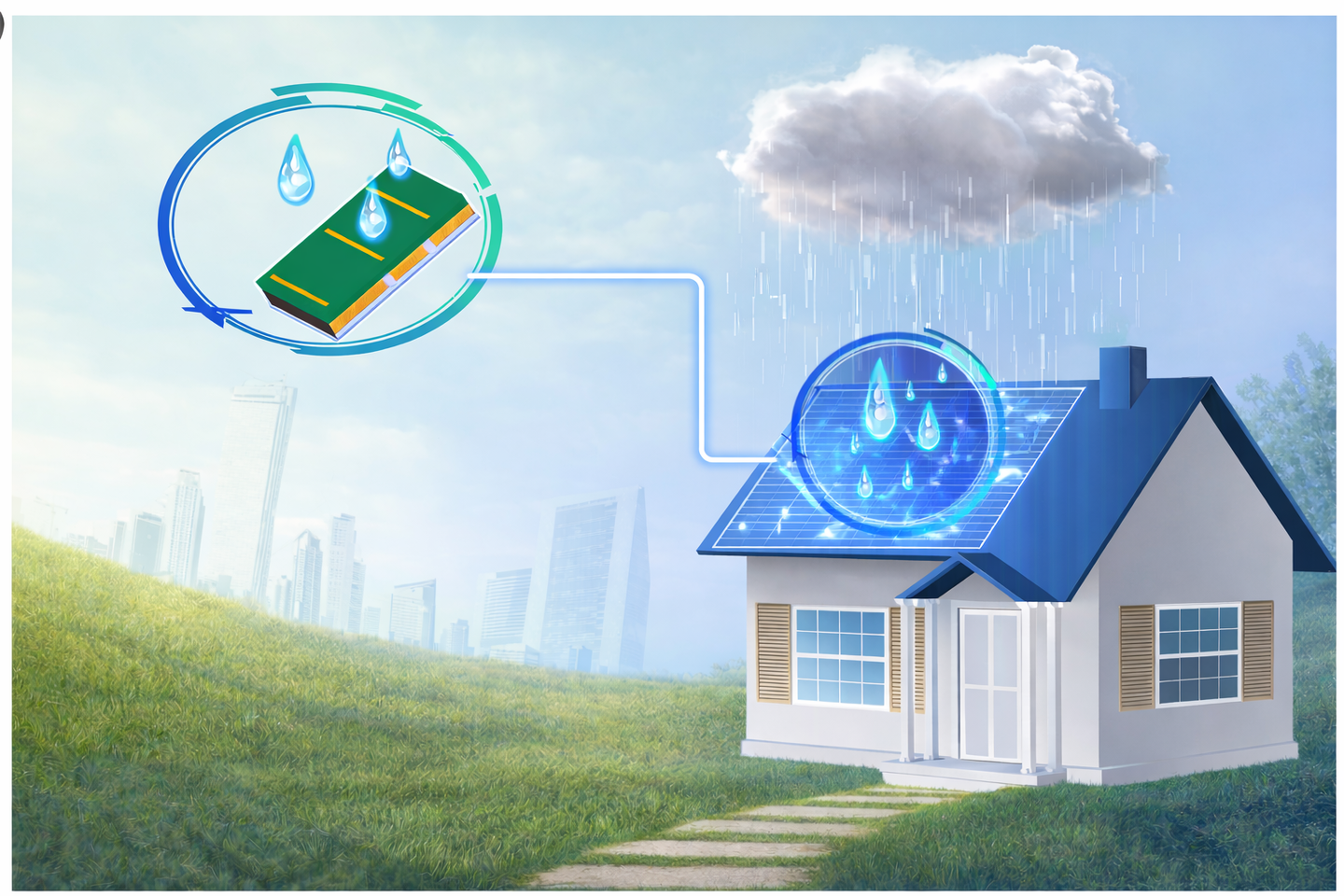
New hybrid solar device captures energy from both sunlight and raindrops using a protective thin film coating. (CREDIT: AI-generated image / The Brighter Side of News)
While they may appear to be insignificant, raindrops’ impact on surfaces can create measurable electrical signals when specific conditions exist. Scientists from Spain have now demonstrated that the impact of a drop can create over 100 volts of electricity and support the operation of a photovoltaic solar cell by producing additional current through rainfall under adverse weather conditions.
This work was conducted at the Materials Science Institute in Seville, a collaboration between the Spanish National Research Council (CSIC) and the University of Seville. The researchers created a dual energy harvesting device that had never before been combined. The device uses a thin coating to protect the fragile solar cell materials and, at the same time, captures mechanical energy created by the fall of water.
"The work we have conducted is an innovative method to integrate perovskite-type solar cells and triboelectric nanogenerators into a thin film configuration, which establishes the potential for combining these two energy harvesting techniques in one device," stated researcher Carmen Lopez.
Why Sunlight and Rain Seldom Work Together
Perovskite-type solar cells have drawn much attention because they can be manufactured at a lower cost and have the potential to be more efficient compared to traditional silicon photovoltaic panels. While single-junction certified efficiencies approached approximately 27 percent in 2025, tandem devices with silicon panels have approached nearly upwards of 35 percent.
Despite these advances, the materials are susceptible to degradation from moisture, oxygen, ultraviolet radiation, and fluctuating temperatures. As a result, it can be difficult to pair perovskite solar cells with devices that purposely place water on their surfaces for harvesting energy.
The team in Seville utilized plasma technology to solve this challenge. A new technology developed a fluorinated coating that is around 100 nm thick and is applied to a surface at room temperature under low vacuum conditions. This coating serves as a chemical barrier while still allowing for the transmission of light through the film. Additionally, the coating reduces the amount of reflected light, allowing for an increase in the amount of light absorbed by the coated surface.
The coating also acts as a triboelectric material. When water droplets hit the coating and move on it, a charge builds up that generates voltage.
Durability and Protection
They were able to demonstrate that a single drop of rain can generate electrical voltage peaks ranging up to 110 volts. At particular conditions, the power densities measured were approximately 4 milliwatts per square centimeter. Therefore, a single drop could generate enough power to operate small electronic devices or to charge batteries when combined with a solar panel.
The coating also increases the durability of solar cells. The use of encapsulated solar cells resulted in over 65 hours of operation at full performance when continuously illuminated in dry conditions, versus just under eight hours for unencapsulated solar cells (those which had lost more than 80% of their initial performance). The improvement in stability also held when the solar cells were exposed to humidity in a nitrogen atmosphere.
The coating can be further supplemented by adding an epoxy or similar commercial product over the coating to enhance durability. In the example where both the coating and the epoxy were used in conjunction with devices, the devices were able to maintain their full performance for over 300 hours of testing at room temperature and 50% relative humidity to flowing nitrogen gas. The epoxy alone would have caused damage to the solar cells as a result of chemical interactions with the internal components if placed over the unprotected solar cell.
Unprotected solar cells failed after only a few minutes in water immersion tests. Coated devices outlasted uncoated ones, and systems that consisted of both the coating as well as an epoxy covering maintained operational capability over fifteen minutes while immersed in both water and light.
Creating a Hybrid Energy Harvester
In an investigation, the researchers combined coated solar cells with an alternative energy source, a drop-based triboelectric nanogenerator. The connection between the solar cell and the triboelectric generator was facilitated by shared electrodes, which allowed the simultaneous capture of energy produced by rainfall and light.
Through laboratory experimentation, the hybrid energy harvester operated continuously for greater than five hours in the presence of constant light and periodic dripping water. It was capable of charging capacitors and powering LED lights with the aid of a "Boost" converter circuit. The circuit allowed an LED with a red light to operate off the roof, while the green LED could be turned on and off with the energy produced from raindrops.
Dr. Fernando Núñez, an investigator with ICMS, indicated that this technology may be viable for powering self-sustained devices used in outdoor areas. For example, it may be suitable for signage or self-powered emergency lights and monitoring. In addition, it would stand up to extreme weather and environmental conditions such as rain, moisture, and thermal cycling. He added that it also has potential uses in remote environments, such as marine monitoring stations.
Limitations and Future Work
This study represents proof of concept. Thus, the durability of hybrid solar energy cells over time will depend heavily on additional improvements being made to the hybrid perovskite material system itself, since perovskites have an inherent susceptibility to environmental stress. Additionally, the triboelectric component faces several critical challenges regarding the saturation of electrically charged contact surfaces after repeated impacts, and the longevity of exposed electrodes.
A third critical factor in the production and management of the energy produced from these systems is the energy produced from triboelectric generators, in contrast to solar cells, which produce steady lower voltages over the course of a complete cycle. To effectively combine both hybrids, specific circuit characteristics must be employed.
Nevertheless, this research demonstrates the potential of rain as an important new source of renewable energy for solar technologies under the right configurations.
Practical Implications of the Research
Hybrid solar and rain energy harvesters could provide continuous power for sensors, monitoring equipment, and portable electronics in outdoor settings.
By reducing reliance on batteries and capturing energy in multiple weather conditions, such systems may improve the reliability of smart infrastructure and remote monitoring networks.
Research findings are available online in the journal Nano Energy.
The original story "New coating helps solar panels generate electricity from raindrops and sunlight" is published in The Brighter Side of News.
Related Stories
- Cutting-edge walkable solar panels could revolutionize clean energy
- Groundbreaking self-cleaning solar panels increase efficiency through wind energy
- ‘Floating’ solar panels could provide power for billions of people
Like these kind of feel good stories? Get The Brighter Side of News' newsletter.
Joshua Shavit
Writer and Editor
Joshua Shavit is a NorCal-based science and technology writer with a passion for exploring the breakthroughs shaping the future. As a co-founder of The Brighter Side of News, he focuses on positive and transformative advancements in technology, physics, engineering, robotics, and astronomy. Joshua's work highlights the innovators behind the ideas, bringing readers closer to the people driving progress.