New nanorobots can target cancer cells with precision
Scientists create self-assembling nanorobots that can target cancer cells and deliver drugs with precision.

 Edited By: Joseph Shavit

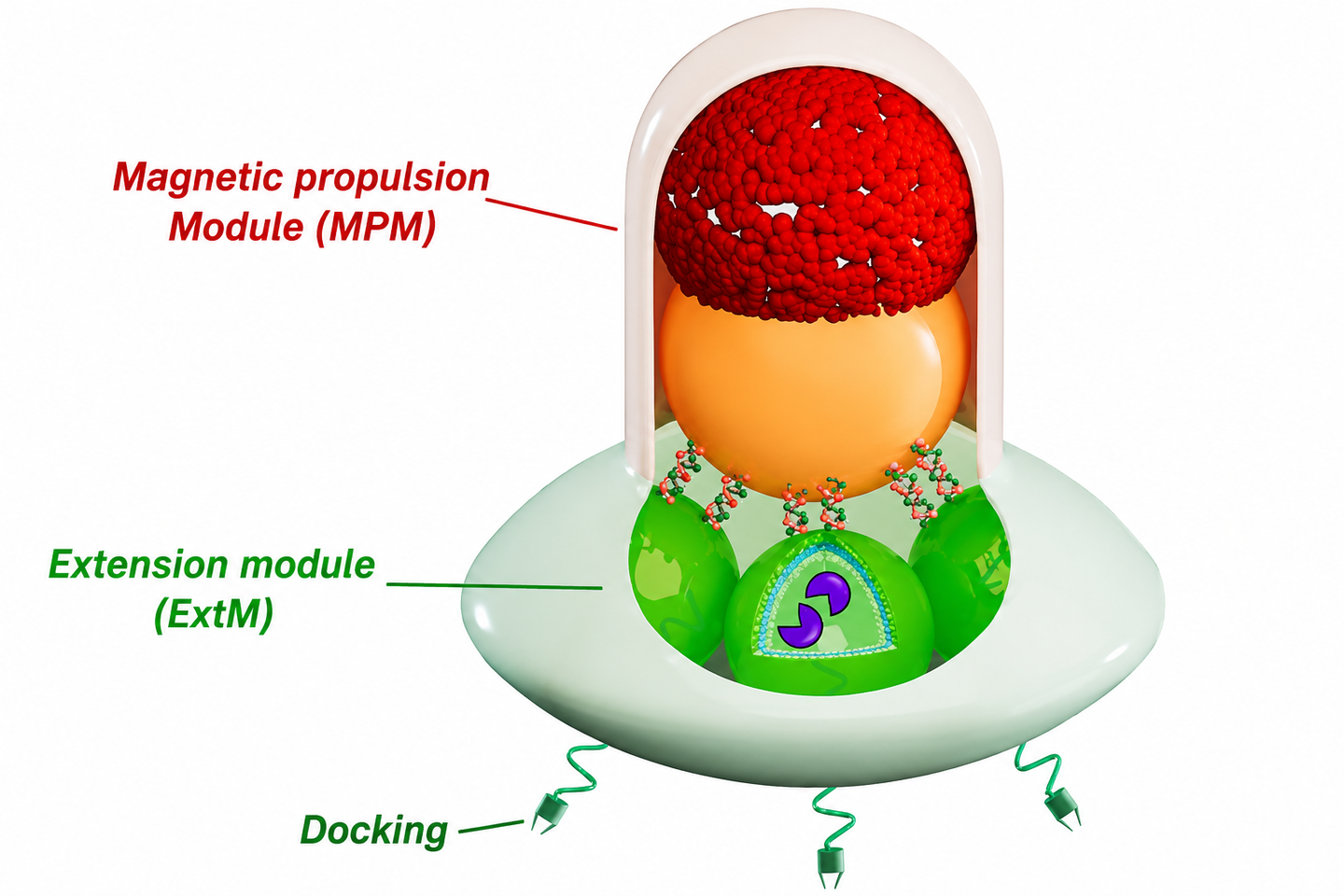
New modular nanorobots can move, target cells, and deliver drugs, offering a new path for precision medicine and industry. (CREDIT: Advanced Functional Materials)
A new class of microscopic machines is moving from theory into reality, and it could change how diseases are treated and how chemicals are produced. Built from biomolecules instead of metal and circuits, these tiny systems can move, carry cargo, and interact with living cells in ways that once seemed impossible.
Researchers at University of Basel have developed a modular nanorobot that can assemble itself, travel under magnetic control, and deliver substances to precise locations. The work marks a step forward in the growing field of nanorobotics.
“Previous nanorobots are often designed for a specific task only,” said Cornelia Palivan, who led the study. “Our modular system, on the other hand, can be adapted to different applications.”
A New Generation Of Tiny Machines
Nanorobots are machines so small they cannot be seen with the naked eye. Unlike traditional robots, they are not made from metal parts or electronic circuits. Instead, they rely on nanoparticles, polymers, and biological molecules.
These systems have long been seen as a promising tool for medicine. Scientists hope they can deliver drugs directly to diseased cells, reducing side effects and improving outcomes. They may also be used in industry to speed up chemical reactions or clean pollutants.
However, building a single nanorobot that can handle multiple tasks has proven difficult. Most designs focus on either movement or function, but not both.
The new system takes a different approach. It uses separate modules that each perform a specific role. These parts then assemble into a single working unit.
A Modular Design With Two Key Parts
The nanorobot consists of two main components. The first is a propulsion module that enables movement. The second is a payload capsule that carries functional materials.
The propulsion unit contains magnetic particles. These allow the nanorobot to move when exposed to an external magnetic field. Scientists can guide its direction by adjusting that field.
The payload capsule is built from tiny polymer vesicles. These structures can hold enzymes or therapeutic compounds inside them. They also protect these substances until they reach their target.
Each nanorobot typically carries several vesicles. In this study, the capsule included four enzyme-loaded units. These vesicles allow molecules to enter, undergo a reaction, and release products back into the environment.
This design gives the nanorobot flexibility. By changing what is loaded into the vesicles, researchers can adapt the system for different tasks.
A DNA-Based Connection
The two modules connect using a system that acts like molecular Velcro. Scientists attach short strands of DNA to each module. These strands are designed to bind only to their matching partner.
When mixed together, the modules find each other and connect automatically. This process is known as self-assembly.
The DNA link is strong enough to hold the structure together during movement. At the same time, it can be separated when needed, allowing the nanorobot to be taken apart and rebuilt.
This programmable connection is a key feature. It allows scientists to control how the nanorobot forms and functions.
Moving And Acting At The Same Time
Once assembled, the nanorobots can move under magnetic control. Researchers observed that they traveled at an average speed of about 3.5 micrometers per second.
Movement is only part of their function. The nanorobots can also carry out chemical reactions through the enzymes inside their vesicles.
To test this, scientists loaded the system with enzymes that produce therapeutic compounds. These reactions occurred while the nanorobot remained intact and active.
The design keeps movement and function separate. This prevents interference between the magnetic and biochemical components. As a result, both systems work efficiently.
Targeting Cells With Precision
A key goal of nanorobotics is to deliver substances to specific cells. To achieve this, the researchers added biomolecules to the payload capsule that allow it to attach to cell surfaces.
In laboratory tests, the nanorobots were introduced to HeLa cells, a widely used model for cancer research. The robots were loaded with fluorescent markers so their movement could be tracked.
Under a microscope, the nanorobots gathered on the surface of the cells. This confirmed that they could recognize and bind to specific targets.
The team then tested their ability to affect those cells. They loaded the nanorobots with enzymes that produce an anticancer compound.
Within 72 hours, the viability of the cancer cells dropped to about 16 percent. This suggests that the nanorobots were able to deliver their payload effectively.
“The drug can have a concentrated local effect if we use our nanorobot to specifically target it to the cancer cells,” said Voichita Mihali, the study’s first author.
Reusability And Industrial Potential
The system offers benefits beyond medicine. Because the propulsion module is magnetic, researchers can retrieve the nanorobots after use.
They can then separate the modules, refill the payload capsules, and reassemble them for another cycle. Tests showed that the nanorobots retained their function after multiple uses.
This feature could be valuable in industrial settings. For example, nanorobots could be used to carry out chemical reactions in a controlled area. After the reaction, they could be collected and reused, reducing waste.
The ability to guide reactions to specific locations also opens new possibilities. Scientists could control where and when reactions occur with high precision.
Challenges And Future Work
Despite the promising results, the technology is still in early stages. The current experiments were conducted in controlled laboratory conditions.
More research is needed before these nanorobots can be used in humans. Scientists must ensure they are safe, stable, and effective in complex biological environments.
Researchers also plan to explore new types of payloads. These may include different drugs, enzymes, or sensing molecules.
Expanding the system to other applications is another goal. The modular design makes it possible to adapt the nanorobot for a wide range of uses.
A Shift In How Machines Are Built
The study highlights a new way of thinking about robotics. Instead of building one complex device, scientists are creating systems that assemble themselves from smaller parts.
This approach allows greater flexibility and adaptability. It also makes it easier to combine different functions into a single system.
As the field advances, these tiny machines may play a larger role in medicine, industry, and environmental protection.
Practical Implications Of The Research
This research could transform how treatments are delivered in medicine. By targeting drugs directly to diseased cells, nanorobots may reduce side effects and improve effectiveness. Patients could receive more precise therapies that act only where needed.
In cancer treatment, this approach may allow higher concentrations of drugs at tumor sites while minimizing damage to healthy tissue. This could lead to better outcomes and fewer complications.
The ability to reuse nanorobots also has important implications for industry. Companies could use these systems to carry out chemical reactions more efficiently and with less waste. This could reduce costs and support more sustainable processes.
In environmental applications, nanorobots could help break down pollutants in specific areas. Their controlled movement and reusability make them well suited for targeted cleanup efforts.
While human use remains a long-term goal, the technology already shows promise in laboratory and industrial settings. As research continues, modular nanorobots could become a powerful tool for solving complex problems across many fields.
Research findings are available online in the journal Advanced Functional Materials.
The original story "New nanorobots can target cancer cells with precision" is published in The Brighter Side of News.
Related Stories
- Scientists use light-controlled nanorobots to quickly grow bone cells
- Urine-powered nanorobots shrink bladder tumors by 90%, study finds
- New modular nanorobot can move, dock to cancer cells, deliver therapy, and be reused
Like these kind of feel good stories? Get The Brighter Side of News' newsletter.
Shy Cohen
Writer