New platinum-free photocatalyst turns sunlight and water into renewable energy
Chalmers researchers used conductive plastic nanoparticles to make hydrogen from water and light, avoiding costly platinum.

 Edited By: Joseph Shavit

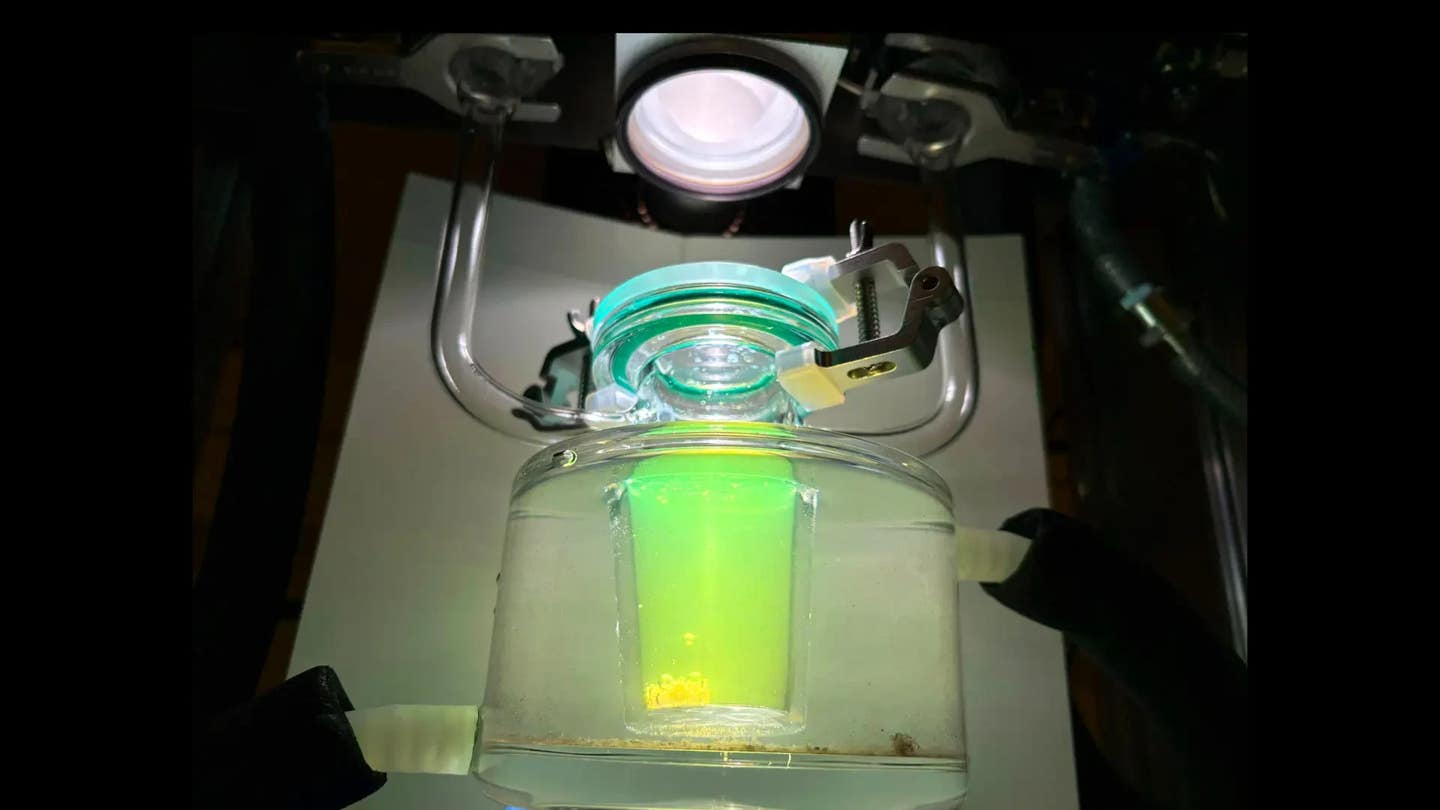
A Swedish-led team reports platinum-free solar hydrogen using conductive plastic nanoparticles, producing visible bubbles and strong lab output. (CREDIT: Mia Halleröd Palmgren)
A small beaker of water can look ordinary. Under the right light, it can also become a quiet factory. In a chemistry lab at Chalmers University of Technology in Sweden, researchers have shown that sunlight, water and tiny particles of electrically conductive plastic can quickly produce hydrogen gas. The advance matters because it avoids platinum, a scarce and expensive metal that often sits at the center of solar hydrogen research.
The work describes a platinum-free way to speed the chemical steps that turn water into hydrogen. The team says the method could make solar hydrogen more efficient, more sustainable and far cheaper to scale. The idea may sound simple, but it targets one of the hardest bottlenecks in clean hydrogen science.
Hydrogen is an energy carrier. You can store it, transport it and use it later, much like electricity. When you use hydrogen, the by-product is water. That promise has kept hydrogen in the spotlight as countries push toward renewable energy systems. Yet hydrogen only helps the climate if you can make it cleanly and at large scale.
Why Platinum Has Become a Roadblock
Many solar hydrogen systems depend on platinum as a co-catalyst. In those setups, light strikes a material that absorbs energy and releases charged particles. Platinum then helps those charges form hydrogen gas efficiently. It is a strong performer, but it comes with steep costs.
Earth’s reserves of platinum are limited. Mining and processing the metal can pose risks to the environment and to human health. Supply is also concentrated in only a few countries, including South Africa and Russia. That concentration can create price swings and supply concerns, especially if demand rises.
In short, platinum can work well in a lab, but it is a weak foundation for worldwide hydrogen production. That reality has pushed researchers to find new catalysts that are affordable and safe.
Chalmers researchers say they have taken a major step toward that goal.
Plastic Nanoparticles That Act Like a Catalyst
The new system uses electrically conductive plastic, also known as conjugated polymers. These plastics can absorb light efficiently. They also act as semiconductors, similar in concept to inorganic semiconductors such as silicon.
In this study, the team formed the plastic into nanoparticles, which are tiny particles suspended in water. Each particle offers a large surface area for reactions. Inside that small space, the light-absorbing material can interact with water and drive hydrogen formation.
The approach is led by Professor Ergang Wang at Chalmers. Joint first authors Alexandre Holmes at Chalmers and Jingwen Pan from Jiefang Zhu’s group at Uppsala University helped report the work.
“Developing efficient photocatalysts without platinum has been a long-standing dream in this field. By applying advanced materials design to our conducting-plastic particles, we can produce hydrogen efficiently and sustainably without platinum; at radically lower cost, and with performance that can even surpass platinum-based systems,” Holmes said.
The claim is not only about cost. The team says the performance can match or even exceed platinum systems under their test conditions.
Fixing the “Fear Of Water” Problem
Conjugated polymers can absorb light well, but they often do not mix well with water. That mismatch has limited their use in water-based chemistry. In simple terms, the plastics can act like they fear water, which holds back the reactions that need close contact.
The key advance here is molecular design. The researchers adjusted the properties of the plastic at the molecular level to make it far more compatible with water. They also developed a way to form the plastic into nanoparticles that improve contact with the surrounding liquid.
“We also developed a way to form the plastic into nanoparticles that can enhance the interactions with water and boost the light-to-hydrogen process. The improvement comes from more loosely packed, more hydrophilic polymer chains inside the particles,” Holmes said.
That “looser packing” matters. If the chains inside the particle are less tightly bundled, water can move in more easily. Better contact helps the charge transfers that lead to hydrogen gas.
You can see the effect with your own eyes in the lab setup described by the team. When a lamp that simulates sunlight shines into a beaker holding water and nanoparticles, hydrogen bubbles begin to form almost right away. The bubbles rise and can be collected through tubes into a storage container. The researchers can track the gas output in real time.
“With as little as one gram of the polymer material, we can produce 30 litres of hydrogen in one hour,” Holmes said.
That figure is striking because it translates a materials experiment into an output you can picture. One gram is about the mass of a paperclip. Thirty liters is a visible volume of gas.
The Lab Setup and What it Shows
The description of the experiment keeps the focus on a practical outcome. Water sits in a beaker. Nanoparticles float in the liquid. A light source stands in for sunlight. When the light hits, hydrogen bubbles appear quickly.
The team’s ability to monitor hydrogen production in real time also matters. It means they can evaluate how changes in polymer design affect the output. They can test different particle structures. They can adjust conditions and see results right away.
This is the kind of feedback loop that drives materials research forward. It is also why nanotechnology matters here. A nanoparticle can be tuned. You can change the shape, size and internal packing to shift performance.
The study’s title captures its aim: “Highly Efficient Platinum-Free Photocatalytic Hydrogen Evolution From Low-cost Conjugated Polymer Nanoparticles.”
A Cleaner Path to Making the Plastic Itself
The Chalmers team also points to a second win, beyond hydrogen output. Colleagues have recently published a breakthrough showing the conductive plastic can be produced without harmful chemicals and in a more cost-effective way.
That matters because a “green” catalyst is only truly green if the whole supply chain improves. If the plastic can be made more safely, it removes another barrier to scale.
It also strengthens the case that conjugated polymers belong in future energy systems. These materials already support a wider field called organic electronics. That technology can connect to energy conversion and storage, wearable electronics, electronic textiles and biotechnology.
Conjugated polymers have a long history in science. The discovery that certain plastics can conduct electricity dates back to the 1970s. It later earned the Nobel Prize in Chemistry in 2000 for Alan J. Heeger, Alan G. MacDiarmid and Hideki Shirakawa.
The Catch: Vitamin C Still Plays a Role
Even with the platinum problem solved, the current system still relies on an added helper chemical. The team uses vitamin C, also known as ascorbic acid. It acts as a sacrificial antioxidant in the reaction.
In the lab, vitamin C donates electrons. That donation keeps the reaction moving. Without it, the process can stall and hydrogen production can drop.
The researchers say the next major step is to eliminate that additive. Their long-term goal is “overall water splitting,” where sunlight and water are the only inputs. In that ideal version, the system produces hydrogen and oxygen at the same time.
Professor Wang said the group is now exploring materials and strategies aimed at overall water splitting without additives.
“Removing the need for platinum in this system is an important step towards sustainable hydrogen production for society. Now we are starting to explore materials and strategies aimed at achieving overall water splitting without additives. That will need a few more years, but we believe we are on the right track,” Wang said.
That timeline matters because it keeps expectations realistic. The current result shows strong hydrogen production, but it is not yet the full “sunlight plus water only” dream.
Practical Implications of the Research
This work offers a path to solar hydrogen production that avoids platinum, which can lower costs and reduce reliance on scarce supply chains.
By showing strong hydrogen output from conductive plastic nanoparticles, the study may expand research into polymer-based photocatalysts for energy.
If researchers remove the need for vitamin C, future systems could run on sunlight and water alone, producing hydrogen and oxygen together.
The ability to produce the conductive plastic without harmful chemicals could make the full process safer and more sustainable to scale.
More affordable hydrogen production could support renewable energy storage and help cut emissions in sectors that need clean fuels.
Research findings are available online in the journal Advanced Materials.
The original story "New platinum-free photocatalyst turns sunlight and water into renewable energy" is published in The Brighter Side of News.
Related Stories
- Nanotechnology drives new breakthrough in artificial photosynthesis
- AI tackles one of the most difficult challenges in quantum chemistry
- Revolutionary self-cleaning wall paint developed using nanotechnology and recycled materials
Like these kind of feel good stories? Get The Brighter Side of News' newsletter.
Melanie Livingstone
Writer
Melanie is a San Diego–based journalist for The Brighter Side of News, an online publication focused on uplifting, transformative stories from around the globe. Passionate about spotlighting groundbreaking discoveries and innovations, Melanie covers a broad spectrum of topics including biology, geology and historical achievements. With a talent for making complex science clear and compelling, she connects readers to the advancements shaping a brighter, more hopeful future.