New research links quantum collapse to time and gravity
Physicists studying quantum collapse models found that if gravity drives collapse, time itself must fluctuate slightly.

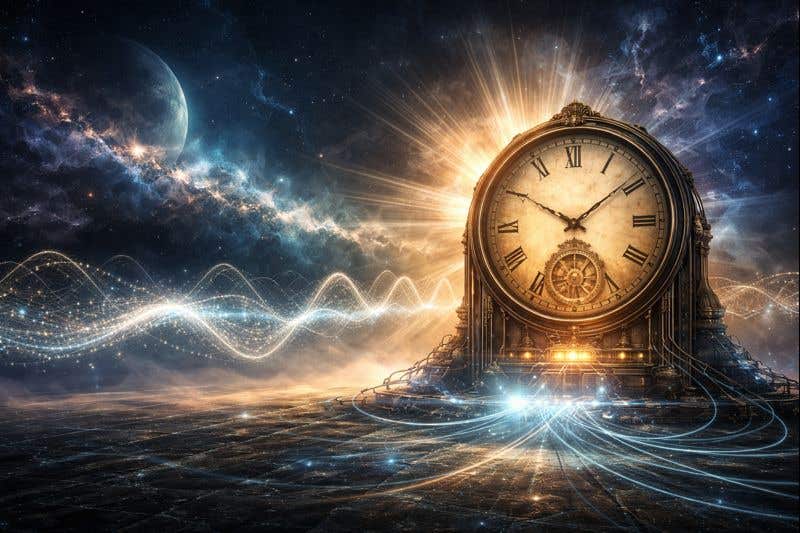
New physics research links quantum collapse models to gravity and finds tiny limits on clock precision. (CREDIT: AI-generated image / The Brighter Side of News)
Quantum mechanics has always carried a quiet tension. At its core, the theory allows particles to exist in many states at once, described by a mathematical object called a wavefunction. Yet daily life never shows objects in two places at the same time. To bridge that gap, physicists usually say the wavefunction collapses into a single outcome when a measurement occurs.
An international research team has now taken a different approach. With support from the Foundational Questions Institute, or FQxI, scientists from institutions in Italy and Hungary examined what happens if collapse is not tied to observation at all. Instead, collapse would occur spontaneously and continuously. Their findings, published in Physical Review Research, suggest this idea carries unexpected consequences for the nature of time itself.
The work was led by Nicola Bortolotti, a PhD student at the Enrico Fermi Museum and Research Centre in Rome. He collaborated with Catalina Curceanu, research director at the National Institute for Nuclear Physics’ Laboratori Nazionali di Frascati; Kristian Piscicchia of the same institutions; Lajos Diósi of the Wigner Research Center for Physics and Eötvös Loránd University in Budapest; and Simone Manti of INFN-LNF.
“What we did was to take seriously the idea that collapse models may be linked to gravity,” Bortolotti says. “And then we asked a very concrete question: What does this imply for time itself?”
Why collapse models matter
In standard quantum theory, the rules feel split. One equation describes smooth, predictable evolution. Another rule says collapse happens suddenly during measurement. Collapse models aim to replace that patchwork with a single process. In these models, the wavefunction constantly undergoes tiny, random reductions, whether or not anyone is watching.
Unlike philosophical interpretations of quantum mechanics, collapse models make testable predictions. Two leading versions are the Diósi-Penrose model and Continuous Spontaneous Localization, or CSL. The Diósi-Penrose approach has long proposed a link between gravity and collapse. The new study shows that CSL, too, can be interpreted in terms of gravitational fluctuations.
The researchers focused on models that suppress large changes in mass distribution. That choice reflects experience: everyday objects never appear smeared across space. The mathematics describing this behavior can also be written as quantum matter evolving in a randomly fluctuating Newtonian gravitational field.
This reinterpretation leads to a striking idea. If gravity fluctuates randomly, then time should fluctuate as well.
Time through the lens of gravity
General relativity ties gravity directly to time. Stronger gravity slows clocks. Weaker gravity lets them run faster. If the gravitational potential jitters, even slightly, clock readings should also jitter.
Curceanu explains the contrast. “In standard quantum mechanics, time is treated as an external, classical parameter that is not affected by the quantum system being studied,” she says. In Einstein’s theory, time bends and shifts.
"Our team explored how these tiny gravitational fluctuations would affect real clocks. We modeled clocks not as points, but as objects with size. A clock effectively averages time over its volume, which turns out to matter," Bortolotti explained to The Brighter Side of News.
"Our calculations show that collapse models imply a fundamental uncertainty in time. That uncertainty grows with how long the clock runs and depends on its size. Smaller clocks are more sensitive. Larger ones average out the noise," he added.
The key result is reassuring. The effect is real in theory but incredibly small.
“Once you do the calculation, the answer is clear and surprisingly reassuring,” Bortolotti says.
How small is small?
Using commonly discussed parameters for collapse models, the researchers estimated how much uncertainty would build up. For an optimally sensitive clock running for a year, CSL predicts a time uncertainty of about one ten-million-trillion-trillionth of a second. The Diósi-Penrose model predicts an even smaller effect.
“The uncertainty is many orders of magnitude below anything we can currently measure, so it has no practical consequences for everyday timekeeping,” Curceanu says.
“Our results explicitly show that modern timekeeping technologies are entirely unaffected,” Piscicchia adds.
The team also compared their predictions with the best clocks available today. Optical lattice clocks, which use thousands of atoms oscillating in sync, can keep time to better than one part in a quintillion over hours or days. Even these devices are far noisier than the limits predicted by collapse models.
Millisecond pulsars, often described as nature’s most stable clocks, are even less affected. Their enormous size suppresses the predicted effect almost completely.
A window into deeper physics
Although the findings do not threaten clock accuracy, they matter in a different way. They show that radical ideas about quantum mechanics can be connected to measurable quantities, even if current technology cannot reach the required precision.
The study also highlights possible links between quantum mechanics, gravity, and time, three pillars of physics that remain difficult to unify.
“There are not many foundations in the world which are supporting research on these types of fundamental questions about the universe, space, time, and matter,” Curceanu says. “Our work shows that even radical ideas about quantum mechanics can be tested against precise physical measurements, and that, reassuringly, timekeeping remains one of the most stable pillars of modern physics.”
Practical Implications of the Research
The research does not change how clocks are built or used today. Atomic clocks, GPS systems, and future timing technologies remain unaffected. Instead, the value lies in theory. The study offers a new way to test collapse models against physical reality, using time as a probe.
By linking wavefunction collapse to gravity and time, the work helps narrow the range of viable theories beyond standard quantum mechanics. Future experiments that improve precision by many orders of magnitude could one day explore these ideas directly.
More broadly, the findings help guide the search for a deeper theory that unites quantum physics and gravity, a goal with long-term implications for fundamental science.
Research findings are available online in the journal Physical Review Research.
Related Stories
- Physicists discover that time may be an illusion born from quantum entanglement
- New tachyon study could unlock the secrets of time travel and reality
- Physicists rewrite quantum rules by bending light through both time and space
Like these kind of feel good stories? Get The Brighter Side of News' newsletter.
Joshua Shavit
Writer and Editor
Joshua Shavit is a NorCal-based science and technology writer with a passion for exploring the breakthroughs shaping the future. As a co-founder of The Brighter Side of News, he focuses on positive and transformative advancements in technology, physics, engineering, robotics, and astronomy. Joshua's work highlights the innovators behind the ideas, bringing readers closer to the people driving progress.