NFL teams may be overpaying to move up in the draft, study finds
NFL teams may be overpaying to move up in the draft, while later picks often perform just as well.

 Edited By: Joseph Shavit

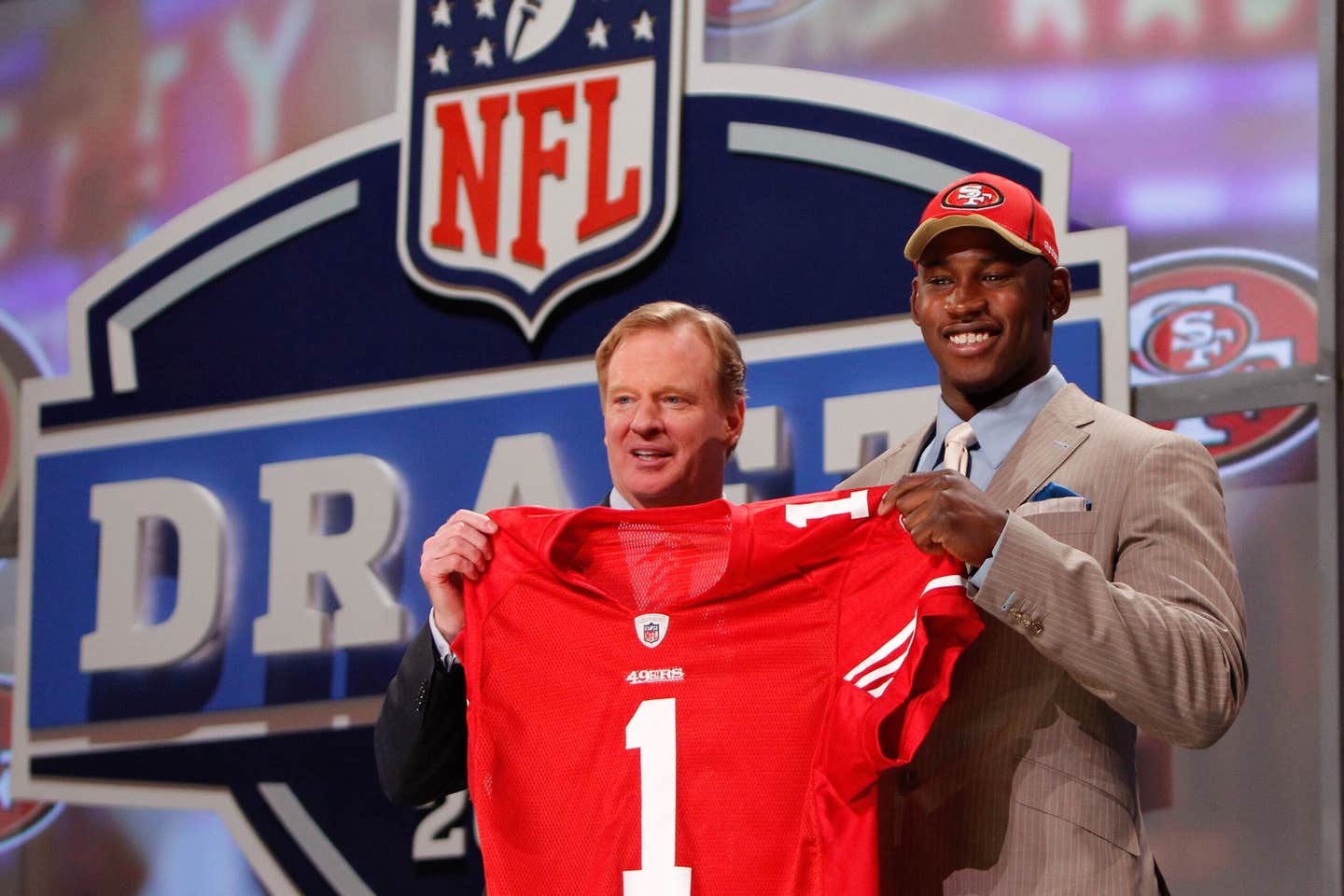
Aldon Smith is introduced by Commissioner of the National Football League in the 2011 draft. (CREDIT: Shutterstock)
The NFL draft has long been treated like a ladder of certainty. The higher you pick, the thinking goes, the better player you should get. Also, the more that selection ought to be worth in trades, contracts, and roster planning.
This new analysis argues that the league’s confidence in that ladder may be stronger than the results justify.
Looking at players drafted from 2011 through 2020, researchers found that draft position was not closely tied to how players actually performed in their first four years in the league. That disconnect showed up in the way teams value picks on trade charts. It also appeared in the salaries attached to rookie contracts. Furthermore, it was evident in the on-field grades players later earned.
“For what the NFL is currently doing, performance doesn’t bear out according to draft values or rookie contracts,” said Dennis Shaffer, lead author of the study and a professor of psychology at The Ohio State University. “It doesn’t matter how you look at it in terms of valuation, in trade values or rookie salaries, which are greater for higher picks.”
The study, published in The Sport Journal, examined 2,544 drafted players across 10 years. The team used Pro Football Reference to identify every player selected from 2011 to 2020. Then the researchers gathered Pro Football Focus season grades for each player’s first four years in the NFL.
That four-year window mattered because it matches the length of rookie contracts. It is the period when teams are supposed to be getting the value they thought they bought on draft day.
Where draft value starts to wobble
The analysis tested a basic assumption behind the draft, that differences in pick value should track with differences in player performance. In theory, if pick No. 1 is dramatically more valuable than pick No. 10, and No. 10 more valuable than No. 20, those gaps should show up in the quality of players teams actually get.
They did not.
Bayesian analyses found close to zero correlation between player performance and the values assigned by the Rich Hill and Jimmy Johnson trade charts, as well as the rookie wage scale. In practical terms, the researchers found substantial to strong evidence that those valuation systems were not meaningfully tied to later PFF performance grades.
That matters because trade charts are not some fringe exercise. They are part of the league’s operating language, used as a baseline when teams move up or down the board.
Shaffer said the draft remains shaped by subjective judgment as much as by consensus. “In a draft, it’s not like everybody agrees that player X is always number one, so you’re going to have teams coming at it from different perspectives and based on their own positional needs,” he said. “That kind of thing will always play a role in their choices.”
The study does not claim draft position means nothing. Early rounds still tended, in broad terms, to produce players who stayed in the league longer and graded better than later rounds. But that decline was not as smooth or as dependable as the NFL’s pricing of draft picks would suggest.
One of the clearest examples came in the middle rounds. The researchers found no meaningful difference in either performance or career length between players taken in the fourth and fifth rounds. Even so, league valuation systems treat those picks as clearly different assets.
Inside the rounds, the gaps mostly disappeared
The paper also looked within rounds, dividing picks into top, middle, and bottom thirds. Here, too, the expected hierarchy largely fell apart.
Across rounds, there was decisive evidence of no difference in either years in the league or PFF grades based on whether a player was chosen near the top, middle, or bottom of a round. When the team repeated that comparison round by round, the same pattern held. The top of a round generally did not separate itself from the rest in a meaningful way.
That finding cuts against one of the most familiar instincts in football front offices. Indeed, many believe climbing even a modest number of spots can put a team in a different class of talent.
The study also tested a favorite draft-day gamble, trading up from the top of the second round into the bottom of the first. Teams often justify that move by targeting a specific player. In addition, they do it by securing the fifth-year option attached to first-round contracts.
But over the 10-year sample, players taken in the bottom third of the first round performed no better than players taken in the top third of the second round.
That is a striking mismatch. According to the paper, the NFL’s valuation systems treat those late first-round picks as vastly more valuable. Yet the later performance data did not support that premium.
The case for moving back
The researchers then extended the logic into actual draft trades.
In a second study, they examined 29 pick-for-pick trades from the 2021 NFL draft, the first draft after the performance window used in the main analysis. Two raters reviewed the trades without knowing which side had moved up or down. Then they judged which team came away with the better-performing player group based primarily on PFF grades.
Their final decisions favored the team that traded down in 19 of the 29 deals. Trade-up teams were judged to have won only four times, with six trades rated as neither side gaining a clear edge. In the key comparison used by the authors, the evidence strongly favored trading down over trading up when it came to better-performing players.
That result supports the broader conclusion of the paper. Teams often pay a steep price to chase draft slots that do not consistently deliver better outcomes.
There is also a personal angle for players. A lower draft slot still means lower guaranteed money at the start of a career. However, the study suggests that players chosen later within the same general draft range may perform just as well and last just as long as higher-picked peers.
“At least right off the bat, while higher draft position equals a greater salary, draft position has little bearing on how much you earn over the course of your contract,” said Shaffer. “You could equal or exceed that of a higher-drafted peer because your performance is better over more time in the league.”
The researchers note several limitations. PFF grades, though widely used, are not perfect. The study also used trade charts and rookie salaries as stand-ins for how teams value draft positions, rather than asking executives directly how they think about those choices.
Still, the paper raises a pointed question about one of football’s most ritualized beliefs. If the league keeps paying a premium for moving up, but the players taken there do not reliably separate from those chosen later, then the draft may reward patience more than urgency.
Practical implications of the research
For NFL teams, the findings suggest that traditional draft value charts may overstate the benefit of moving up the board, especially within the same round or across the late first and early second rounds. That could affect how teams trade picks. In addition, it may change how they manage salary cap space and weigh positional need against overall talent.
For players, the results suggest that being drafted lower does not necessarily mean a shorter or less productive early career.
For analysts and executives, the study points to a need for valuation systems built more directly on long-term performance. This is important rather than following inherited draft conventions or past trade habits.
Research findings are available online in The Sport Journal.
The original story "NFL teams may be overpaying to move up in the draft, study finds" is published in The Brighter Side of News.
Related Stories
- The long-term effects of repeated head trauma in football
- Scientists develop a light-based approach to protecting football players’ brains
- An early focus on a single sport may carry lasting injury risks for athletes
Like these kind of feel good stories? Get The Brighter Side of News' newsletter.