Physicists solved a decades-old mystery about static electricity
A thin film of carbon molecules from ordinary air, has been identified as the hidden force that determines which way static electricity flows.

 Edited By: Joseph Shavit

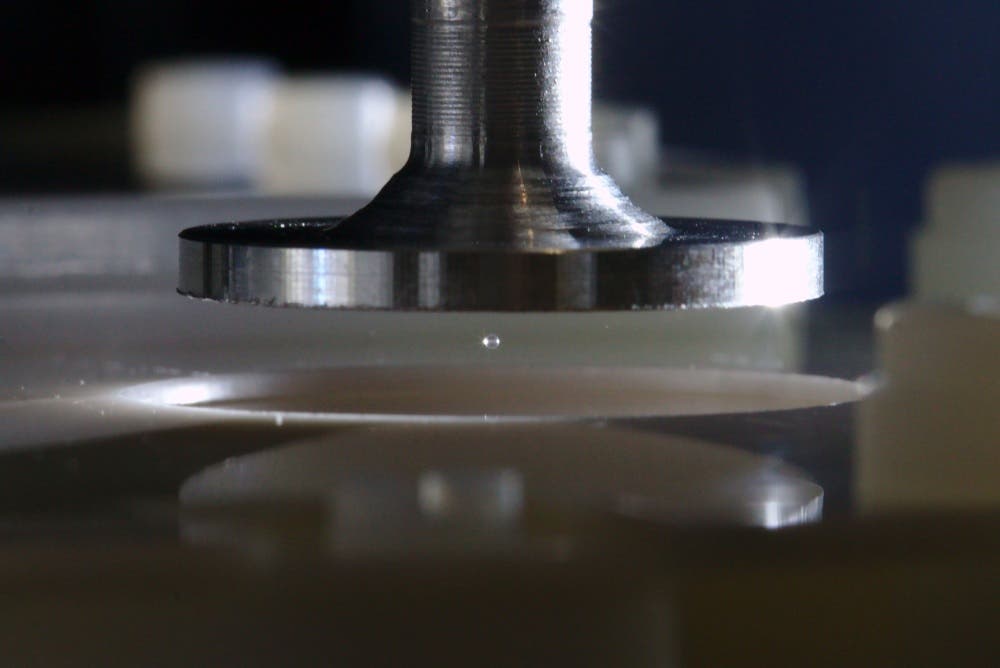
Levitating matter with sound. Experimental setup with an acoustically levitated particle of silica. (CREDIT: Thomas Zauner/ISTA)
Rub two identical pieces of glass together and something strange happens. One picks up a positive charge. The other goes negative. This much has been known for centuries. What nobody could explain was why, when the two objects are made of the same material, charge should flow in any particular direction at all. Both pieces of glass are chemically identical. Both have been sitting in the same room. By every obvious measure, the situation is perfectly symmetric.
Yet the charge picks a direction. Every time.
A team of physicists at the Institute of Science and Technology Austria has now identified what breaks that symmetry: a thin, invisible coating of carbon-based molecules that drifts onto every surface from the surrounding air and quietly accumulates there, different in amount and composition from one object to the next even when those objects sit side by side.
The findings, published in Nature, resolve a puzzle that has persisted for decades and carry implications far beyond laboratory physics. The same phenomenon governs how volcanic lightning forms, how Saharan dust travels thousands of miles, and potentially how planets coalesce from the swirling clouds of material around young stars.
A Phenomenon With No Satisfying Explanation
Contact electrification, the formal term for what happens when two surfaces touch and exchange charge, is one of the most familiar processes in physics and one of the least understood at a fundamental level. It is why socks stick together from the dryer, why a rubbed balloon clings to a wall, and why fuel tankers must be grounded before loading to prevent static discharge from igniting vapors.
For metals, the mechanism is well established. Electrons flow from the surface with the lower work function to the one with the higher work function, following a quantifiable electrochemical gradient. For insulators, particularly the oxygen-rich mineral compounds called oxide insulators that make up most of the rocky material in the solar system, no equivalent explanation has been demonstrated. Experiments have consistently shown that two chemically identical pieces of quartz glass, or silica, placed together will exchange charge with a clear, reproducible directionality. Existing theories offered no satisfying account of why.
Two prominent models had been widely discussed. One imagined that surfaces were covered with a mosaic of randomly distributed microscopic patches with subtly different properties, a pattern that researchers sometimes compared informally to a dairy cow's markings. The other pointed to water vapor from the atmosphere, which adsorbs to surface hydroxyl groups and might preferentially donate or accept charge.
Both ideas had problems. The random mosaic model predicted that the effect would average out to zero as contact happened at different spots, but experiments showed clear, consistent directionality. The water model predicted that surfaces made more hydrophilic by cleaning should charge positively, but they consistently charged negatively.
Scott Waitukaitis, the group leader at ISTA whose team conducted the study, described the frustration directly to The Brighter Side of News. "We focused myopically on water for a long time, which led us down so many wrong turns," he said. "We took those leading theories in the field for granted, and they took us off track."
Measuring Without Touching
The experimental challenge was severe. Charge transfers at the slightest contact with any surface, including laboratory tweezers. Studying the phenomenon without inadvertently introducing unwanted charge seemed almost paradoxical.
The solution developed by Galien Grosjean, the study's first author and a former postdoctoral researcher at ISTA, was to levitate the material being tested. Using acoustic levitation, in which precisely tuned sound waves hold a small object suspended in midair, Grosjean suspended individual spheres of silica about 500 micrometers across above flat silica plates made from the same material.
A brief interruption in the acoustic field allowed each sphere to fall, bounce off the plate, and be caught again, creating a controlled collision without any other contact. By measuring the charge before and after each bounce with a resolution of 500 electrons, the team could build up a precise picture of how charge moved with each contact.
Running this experiment across many sphere-plate pairs, they found that each pair showed a consistent, reproducible charging direction, but the direction varied randomly across different pairs. Some always charged positively. Others always charged negatively. The two objects in a given pair were made from the same material, cleaned with the same protocol, stored in the same conditions, and yet they reliably behaved as though they were different materials from each other.
Heat Treatment Changes Everything
The breakthrough came when Grosjean subjected some samples to heat treatment before measuring. Baked samples, regardless of how they had behaved before, consistently charged negatively after contact.
"Since quartz glass is highly resistant to thermal changes, heat does not affect the material itself," Grosjean said. "As a result, we thought that any alteration must be due to molecules adsorbed to the material's surface."
The same effect appeared when samples were treated with low-power plasma, another standard technique for stripping material from surfaces. Intriguingly, the effect didn't last indefinitely. Over the course of about ten hours, the charging behavior of treated samples slowly drifted back toward its pretreatment state.
That timescale was the key. Water vapor, which was also being tracked, returned to surfaces almost instantly after treatment. Whatever was responsible for the charging effect was returning much more slowly, on a roughly ten-hour timescale. When the team brought in collaborators who specialize in surface science and can directly measure what's present on a material's outermost atomic layer, the answer came into focus.
Treated Surfaces
The treated surfaces had been stripped of adventitious carbon, the thin, perpetually accumulating film of carbon-containing organic molecules that condenses onto virtually every surface exposed to air. These molecules, present in the atmosphere at only parts-per-trillion concentrations, gradually coat every surface they can reach.
Their composition and thickness depend on the specific history of each object: how long it has been in a given environment, what temperature it was previously stored at, what air currents have passed over it. Two objects sitting in the same room will not necessarily accumulate identical carbon coatings, because the process is not in equilibrium.
Surface chemistry researchers have known about adventitious carbon for decades, primarily as a nuisance. It appears in nearly every surface analysis and is routinely used as a convenient calibration reference in X-ray photoelectron spectroscopy precisely because it is always there. But it had been treated as noise, something to account for or remove, rather than as a meaningful signal.
"It is tempting to think that any finding must apply to all materials," Grosjean said. "But we stopped making this mistake."
Overturning the Triboelectric Series
The researchers then tested whether adventitious carbon's influence extended beyond identical materials, examining whether it could alter the established ordering of different oxide materials by their tendency to charge. Alumina, spinel, silica, and zirconia were tested against each other in every possible pairing. Under standard cleaning conditions, they formed a clean, consistent sequence from most positive to most negative, consistent with the known triboelectric series.
Then the team took whichever material in each pairing charged more positively, stripped its carbon coating by baking it, and repeated the measurement. In every case, the sign of charge reversed. The material that had charged positively now charged negatively. The entire triboelectric series inverted.
This result establishes adventitious carbon not as a minor confounding factor but as a primary driver of the charging direction. When carbon coverage is roughly equal between two surfaces, the intrinsic properties of the materials determine which way charge flows. When carbon coverage is sharply asymmetric, it overrides those intrinsic tendencies entirely.
Sparks That May Have Started Life
The stakes of understanding this phenomenon extend well beyond static electricity in laboratories. Silica and related oxide minerals make up the dominant solid material in Earth's crust, on the Moon and Mars, and in the chondritic meteorites thought to represent the raw material from which the solar system's rocky bodies formed.
In volcanic plumes, collisions between ash particles generate powerful electrical discharges. Research going back to the 1950s suggested that volcanic lightning may have supplied the energy to convert simple primordial molecules into amino acids, the molecular building blocks of proteins. The same contact electrification process drives the charging of Saharan dust storms, which carry fine mineral particles across the Atlantic to fertilize South American rainforests.
In protoplanetary disks, the clouds of gas and dust that surround young stars and eventually form planets, the electrostatic forces from charged particle collisions are thought to play a crucial role in helping small particles stick together and grow into larger bodies.
Current models of planetary formation rely on these electrostatic effects to explain how material aggregates fast enough to avoid being swept into the star by gas drag. What drives the charging in those pristine, airless environments is not yet known, but understanding the mechanism more precisely here should inform those models.
"Some current models of planetary formation rely on a predominant effect of charge," Waitukaitis said. "As such, our research might have just shed light on the mechanism underlying the sparks of creation."
Practical Implications
The immediate practical value of this research lies in the fields that already grapple with contact electrification as an engineering problem. Pharmaceutical manufacturing, semiconductor fabrication, grain storage, and any process involving the flow of fine powder or particles through equipment must contend with static buildup.
Understanding that adventitious carbon plays a controlling role in charge direction suggests that managing surface carbon content, something already done routinely in precision surface science, might offer a new handle on controlling or predicting charging behavior in industrial contexts.
For space missions, where electrostatic charging of regolith and dust poses real hazards to equipment and astronauts, the findings add a layer of complexity. The carbon coatings that govern charging behavior on Earth will be absent or radically different on the Moon or Mars, meaning that charge exchange between mineral grains in those environments may behave quite differently from what terrestrial experiments would predict.
The research also clarifies what future experiments will need to control for. Any study of contact electrification between oxide insulators that doesn't account for the state of the carbon coating on each surface is, by these findings, working with an uncontrolled variable. A decades-long literature of such experiments may need to be reinterpreted in that light.
Research findings are available online in the journal Nature.
The original story "Physicists solved a decades-old mystery about static electricity" is published in The Brighter Side of News.
Related Stories
- Student made cosmic dust in the lab revealing life’s early chemical origins
- Cosmic dust could spread life from planet to planet across the Milky Way
- Complex building blocks of life form spontaneously in space, study finds
Like these kind of feel good stories? Get The Brighter Side of News' newsletter.
Joshua Shavit
Writer and Editor
Joshua Shavit is a NorCal-based science and technology writer with a passion for exploring the breakthroughs shaping the future. As a co-founder of The Brighter Side of News, he focuses on positive and transformative advancements in technology, physics, engineering, robotics, and astronomy. Joshua's work highlights the innovators behind the ideas, bringing readers closer to the people driving progress.