Princeton engineers link origami and tensegrity into fantastic new shapes
A new Princeton method could help engineers design irregular structures that keep nature’s mechanical strengths.

 Edited By: Joseph Shavit

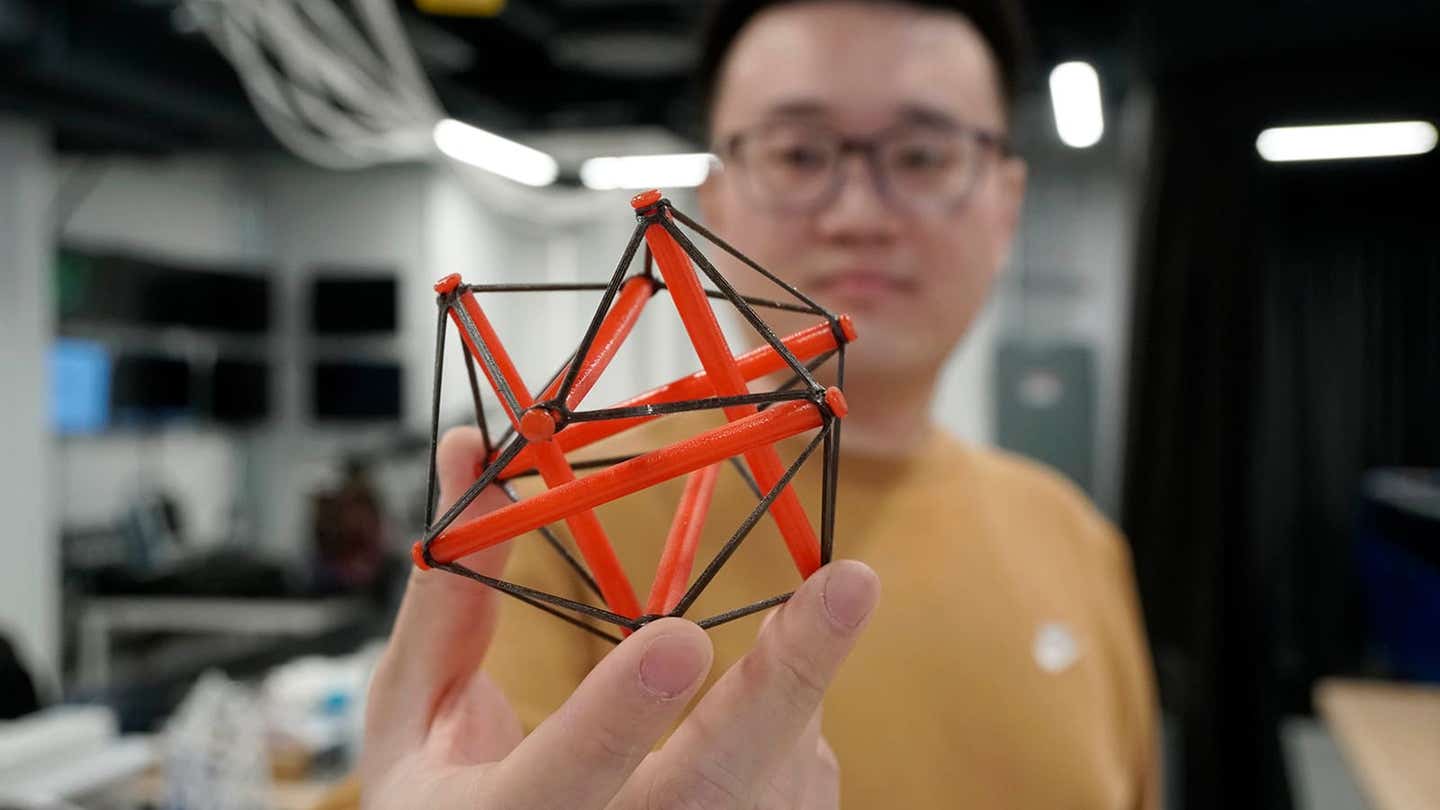
Princeton researchers combined two disciplines to help designers create unique shapes. (CREDIT: Aaron Nathans)
A termite mound does not look engineered.
It rises in rough, uneven towers, full of crooked passages and shifting pockets of air, yet it can regulate temperature, manage airflow and stay standing in punishing conditions. Bone can do something similar. Its internal lattice looks irregular and disordered, but it carries weight, absorbs stress and holds together with surprising efficiency.
That kind of structural messiness has long been hard for engineers to copy. Regular forms like cubes and spheres are easier to describe, model and optimize. Natural systems are not.
Researchers at Princeton University say they have now built a mathematical framework that could make those unruly forms far easier to reproduce, not just in appearance but in how they behave mechanically. Their method links two fields that might seem unrelated at first glance: origami, the study of folding surfaces along creases, and tensegrity, the study of structures stabilized by a balance of compression and tension.
“We created a theory that is applicable to two distinct physical systems,” said Glaucio Paulino, the Margareta Engman Augustine Professor of Engineering at Princeton. “Knowing one such system can help to understand the other one better.”
The work appeared in the Proceedings of the National Academy of Sciences.
Folding and force, tied together
Origami has become more than an art form. Engineers use it to design structures that can fold into compact shapes and later expand, a useful trait in areas such as space exploration. Tensegrity describes a different kind of order, one seen in systems like the human skeleton, where hard bones and softer tissues share stress to maintain shape.
The Princeton team found that the mathematics behind these two systems are, at a deep level, the same.
“It turns out that the same equation describes both engineering structures, origami and tensegrity,” said Xiangxin Dang, a postdoctoral researcher at Princeton and the article’s first author. “These two different types of structures are connected by math.”
To non-mathematicians, that may sound abstract. But the practical idea is simple enough: the rules that describe how an origami surface folds can be translated into the rules that describe how a tensegrity structure distributes force.
That connection matters because it opens a way around one of engineering’s stubborn problems. Symmetrical objects are manageable because they can be described with relatively few variables. Once symmetry disappears, the math becomes much harder.
“Without symmetry, the math appears far more complex,” Dang said. “But we found a way to bypass that complexity when a non-symmetric system inherits properties from a symmetric one.”
Starting simple, then warping the form
The researchers call their framework the invariant dual mechanics of tensegrity and origami.
The key word is “invariant,” a mathematical term for something that stays unchanged during a transformation. In this case, the team showed that engineers can begin with a symmetric structure whose properties are already known, then transform it into an irregular form while preserving core mechanical traits such as stability, flexibility, or instability.
That means a designer does not have to solve a brand-new giant problem each time the shape gets strange.
Instead, the underlying behavior carries over.
The source material describes the approach as optimization-free. Rather than relying on repeated trial and error, engineers could start with a regular design and apply linear, or more generally projective, transformations to generate irregular versions. The resulting structures would keep the original mechanical characteristics automatically.
In the research, the team argues that this duality remains intact under nondegenerate linear transformations applied to both tensegrity and origami configurations. They also report that the stability property of tensegrity, especially a condition known as superstability, survives those transformations as well.
From one regular pair, the authors write, engineers can systematically generate infinite irregular tensegrities and origami mechanisms while conserving their static and kinematic behavior.
Why irregularity matters
That matters because irregular structures are everywhere.
The source points to termite nests and cancellous bone, the porous inner tissue found in bones, as examples of forms that are common in nature but difficult to harness in artificial systems. These shapes are not random junk. Their disorder often serves a purpose, helping them handle loads, flow, temperature or motion in ways regular forms cannot.
Modern engineering can struggle to keep up because each irregular design may demand a huge system of equations and extensive analysis.
The Princeton group’s idea is to borrow the reliability of a simpler structure, then carry it into a more complicated one.
The team says the framework could help not only with design, but also with optimization. If engineers want a structure to be especially stable or especially flexible, they could move through many variations without having to recalculate everything from scratch each time.
Dang offered an analogy outside the immediate study. An auto designer searching for an efficient body shape, he said, might normally have to model each version and compute its aerodynamics repeatedly. In a comparable invariant system, the designer could begin with a simple shape and tweak it instead of rebuilding the math every time. The article does not claim that this exact aerodynamic method already exists, but uses the example to show the broader logic.
A mathematical bridge with engineering ambitions
Dang said some of the earlier groundwork linking force and motion had been explored decades ago through rigidity theory, a branch of mathematics. But he said that line of work had not been pushed very far in practice.
“We wanted to explore the problem in a way that could lead to engineering solutions,” Dang said.
That helps explain the tone of the Princeton work. It is theoretical, but not theory for theory’s sake. The analysis focuses on the relationship between statics and kinematics, the mechanics of force and motion, and uses the principle of virtual work as part of the conceptual foundation. For a system in static equilibrium, that principle says the total work performed by all forces during any virtual displacement must be zero.
From there, the researchers make the connection more explicit by identifying what they describe as a quantitative duality between self-stress in tensegrity and infinitesimal mechanisms in origami.
They tested the framework on tensegrity and origami structures with prismatic and polyhedral geometries, which the authors say shows the breadth of the method’s applicability.
The work also points toward fast generation of irregular, three-dimensional architected materials and structures, a category that includes materials whose geometry strongly shapes their properties.
Practical implications of the research
The immediate impact of this work is not a new robot, building or medical implant on its own. It is a design shortcut, one rooted in mathematics, that could make those future systems easier to create.
The source says the framework could be useful in robotics, where components often have irregular shapes, and in metamaterials, where geometry directly affects performance. It could also help engineers think more clearly about how to mimic natural forms that have long resisted neat manufacturing logic.
In plain terms, the research offers a way to begin with order and end with useful disorder, without losing control of the mechanics along the way.
That is a meaningful shift. Nature rarely builds in perfect cubes.
Research findings are available online in the journal Proceedings of the National Academy of Sciences.
The original story "Princeton engineers link origami and tensegrity into fantastic new shapes" is published in The Brighter Side of News.
Related Stories
- ‘Chinese lantern’ material snaps into 13 shapes using stored elastic energy
- Origami robots with magnetic muscles could revolutionize medicine delivery
- Engineers reinvent the parachute using Japanese paper-cutting art Kirigami
Like these kind of feel good stories? Get The Brighter Side of News' newsletter.
Rebecca Shavit
Writer
Based in Los Angeles, Rebecca Shavit is a dedicated science and technology journalist who writes for The Brighter Side of News, an online publication committed to highlighting positive and transformative stories from around the world. Having published articles on MSN, AOL News, and Yahoo News, Rebecca's reporting spans a wide range of topics, from cutting-edge medical breakthroughs to historical discoveries and innovations. With a keen ability to translate complex concepts into engaging and accessible stories, she makes science and innovation relatable to a broad audience.