Reinventing the helicopter: The next chapter of sustainable air travel takes flight
A prototype cyclocopter lifts off using six barrel rotors, offering a new vision for urban air mobility.

 Edited By: Joseph Shavit

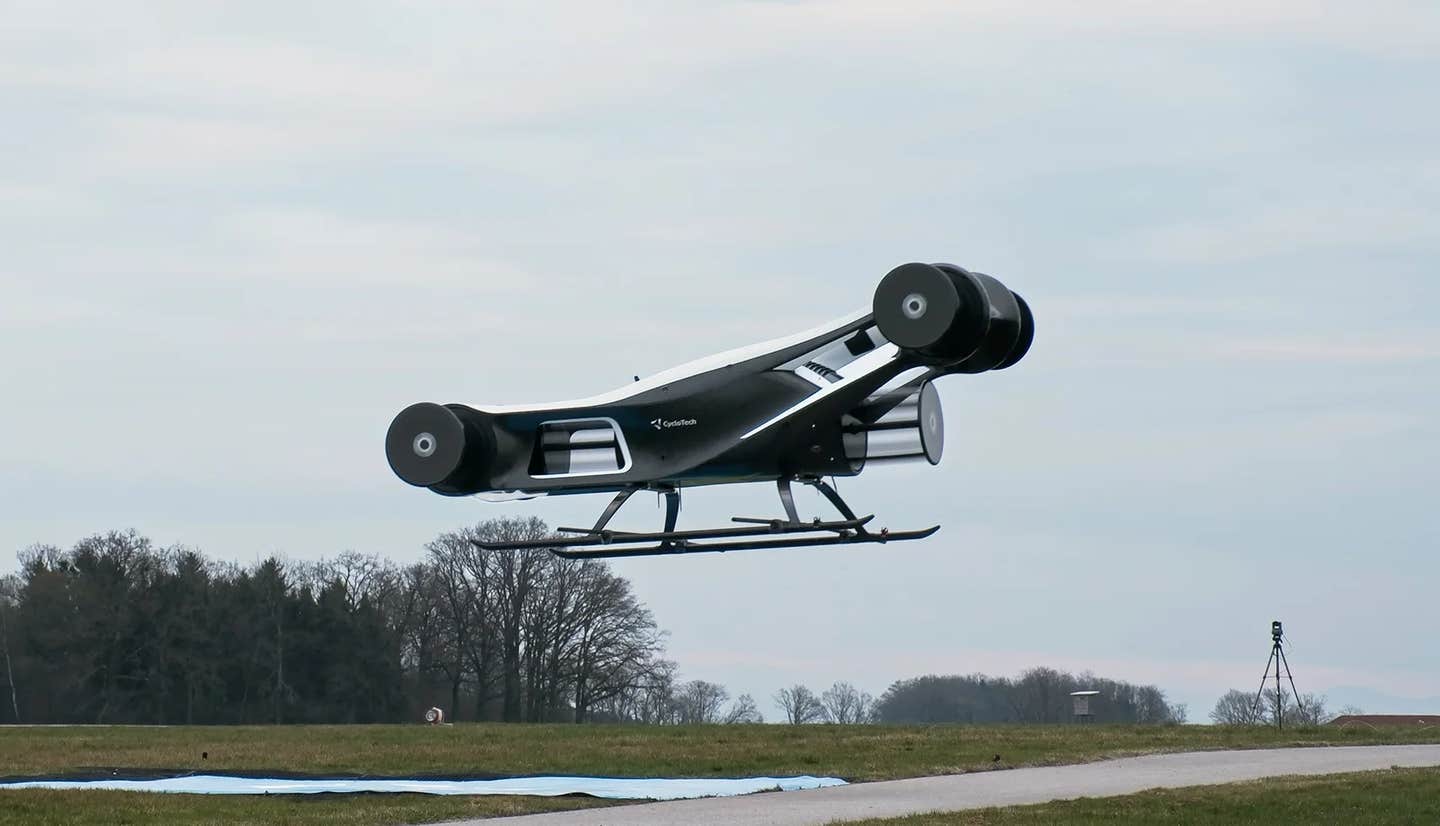
A new cyclocopter prototype with barrel rotors completes its first flight, hinting at quieter urban air travel. (CREDIT: Cyclotech)
The aircraft lifted only briefly off the ground, hovering under remote control. Still, the moment mattered.
On March 27, 2025, an experimental vehicle called BlackBird rose into the air during its maiden test, powered not by conventional helicopter blades but by six barrel-shaped rotors that spin and change angle at the same time. The flight marked the first time an aircraft with that configuration had taken off, according to Austrian aviation company CycloTech, which built the prototype.
For decades, engineers have chased new ways to make vertical flight quieter, more precise, and better suited for crowded cities. Cycloidal propulsion, the technology behind BlackBird, may offer one path forward. The idea dates back more than a century, yet only recently has it begun moving from theory into working aircraft.
CycloTech chief technology officer Tahsin Kart described the milestone in a company video. “This is not the finish line — it’s the launchpad,” he said.
A Propulsion Idea Older Than Helicopters
Cycloidal propulsion traces its roots to 1909, when Russian aerodynamicist Nikolai Jukovski proposed a system that used rotating cylinders with adjustable blades instead of traditional propellers. The concept proved difficult to apply to aircraft at the time. Mechanical complexity and limited materials made practical flight unlikely.
The same principle later succeeded in marine engineering through the Voith-Schneider propeller, which allows ships to maneuver precisely in tight spaces. Tugboats and ferries still use the system today.
Only in recent decades have advances in lightweight materials, electric motors, sensors, and digital control systems revived interest in adapting cycloidal propulsion for aviation. Modern electronics can rapidly adjust blade angles in real time, something early engineers could not achieve reliably.
That technological shift opened the door for companies like CycloTech to experiment with aircraft designs that behave very differently from helicopters or drones.
Six Rotors, Full Directional Control
The BlackBird demonstrator uses six so-called CycloRotors, four mounted horizontally and two vertically. Each rotor contains blades that change angle continuously as the cylinder spins. This allows thrust to point in any direction without tilting the aircraft body.
Traditional rotorcraft must lean or pitch to move forward or sideways. Cycloidal systems can generate sideways motion directly, enabling maneuvers such as midair braking or lateral movement similar to parallel parking.
According to the company, the configuration allows vertical takeoff and landing, hovering at a pitch angle, and stable flight even in challenging conditions. The aircraft can also stop midair quickly while maintaining balance.
The prototype flight itself was unmanned and controlled remotely by technicians. Its purpose was not transportation but technology validation for a larger project called CruiseUp, a planned two-seat personal air vehicle.
The BlackBird weighs about 340 kilograms and was built in less than a year. CycloTech said it took 11 months to move from concept to first flight, with assembly completed in roughly 10 months after extensive ground testing of propulsion, battery, software, and avionics systems.
“The BlackBird is more than a demonstrator—it’s a flying testbed for the future of aviation,” Kart said.
Why Engineers Keep Returning to Cyclocopters
Cycloidal propulsion offers several features that attract aviation designers.
One is omnidirectional thrust control. Because the rotor blades adjust continuously, the aircraft can hover, move laterally, or change altitude with high precision. That capability could prove valuable in dense urban environments where landing space is limited.
Noise reduction is another potential advantage. Lower rotor speeds and more uniform airflow may produce quieter operation than conventional helicopter blades, an important consideration for urban air mobility projects.
Safety is also part of the appeal. Rapid thrust adjustments and redundant propulsion units could improve stability during gusty conditions or system failures.
The design may also reduce mechanical stress compared with systems that rely on large tilting motions, potentially extending component lifespan.
These characteristics help explain why cyclocopters are often discussed in connection with urban air taxis, delivery drones, and emergency response missions.
The Engineering Tradeoffs
Despite its promise, cycloidal propulsion comes with significant challenges.
The system involves many moving parts that operate under high stress. That complexity increases maintenance demands and raises costs compared with simpler rotor designs. Current cyclocopter configurations also tend to be heavier.
Energy efficiency remains another obstacle. Cycloidal propulsion systems currently consume more power than conventional rotors, which can limit flight range and endurance.
Engineers continue working on improvements in materials, motor performance, and energy storage to address those limitations. Until those gains arrive, widespread adoption remains uncertain.
Still, the technology’s unique flight characteristics keep interest alive.
From Demonstrator to Personal Aircraft
The BlackBird serves as a stepping stone toward CycloTech’s planned production vehicle, the CruiseUp. The company envisions the aircraft as a two-seat electric vertical takeoff and landing vehicle for urban and suburban travel.
Design targets include a top speed of about 95 miles per hour and a range near 60 miles, suitable for city commuting. A market debut is projected for 2035 or later.
Electric vertical takeoff aircraft in general have drawn attention for potential environmental benefits. Studies suggest that an eVTOL carrying three passengers could produce about 52 percent less carbon pollution than a gas-powered car, even when charged using electricity generated from polluting sources. Cleaner power would increase the advantage.
Following the March demonstration, CycloTech said it plans to expand its flight test program to refine the propulsion system for future vehicles.
Company chief executive Marcus Bauer described the broader ambition in a statement: “We’re redefining what’s possible in vertical flight, pioneering the future with our groundbreaking propulsion technology to open the skies for a new generation in aviation.”
A Different Shape of Flight
Cyclocopters challenge long-standing assumptions about how aircraft should move. Instead of large spinning discs, they rely on coordinated blade motion inside cylindrical rotors. The result is a flight style closer to controlled thrust vectoring than traditional helicopter aerodynamics.
Whether that difference leads to widespread adoption will depend on engineering progress, economics, and public acceptance.
For now, the BlackBird’s brief hover represents a proof of concept, not a finished solution.
The original story "Reinventing the helicopter: The next chapter of sustainable air travel takes flight" is published in The Brighter Side of News.
Related Stories
- AltoVolo redefines personal air travel with 220 mph hybrid eVTOL aircraft
- Airwolf takes off: The 140 mph flying motorcycle is here
- Meet Joby: The 200 mph electric aircraft that will redefine commuting
Like these kind of feel good stories? Get The Brighter Side of News' newsletter.
Shy Cohen
Writer