Researchers discover a hidden whistle inside a horse’s whinny
A horse’s whinny carries two pitches, one from vocal folds and one from a laryngeal whistle, the study finds.

 Edited By: Joseph Shavit

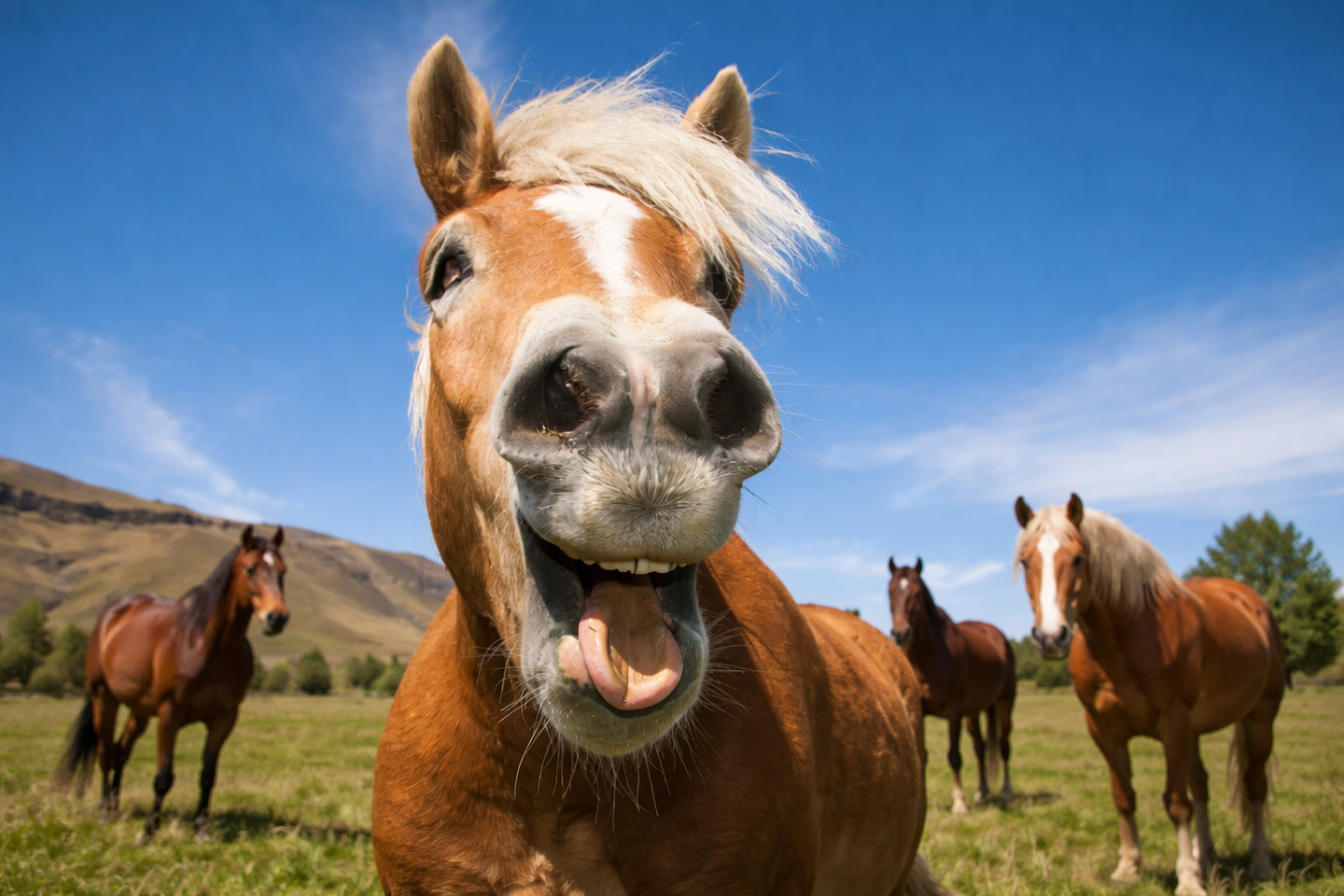
Horses whinny with two pitches at once, by vibrating vocal folds and whistling inside the larynx. (CREDIT: Wikimedia / CC BY-SA 4.0)
A horse’s whinny can sound like two calls at once. One part sits low and rough, like a familiar mammal voice. Another rides high, almost piercing, and it does not seem to fit a 500-kilogram animal.
That mismatch has bothered researchers for years. Big bodies usually mean big larynges, and big larynges usually mean low pitches. Yet horses break that pattern in a very public way, every time they call across a field.
Reporting in the Cell Press journal Current Biology, a team says it has pinned down the mechanics behind that strange blend. Horses, they argue, create a two-frequency sound by using two sound sources at the same time: vibrating vocal folds for the lower tone, and a whistle formed inside the larynx for the higher tone.
“We now finally know how the two fundamental frequencies that make up a whinny are produced by horses,” says author Elodie Briefer of the University of Copenhagen. “In the past, we found that these two frequencies are important for horses, as they convey different messages about the horses’ own emotions. We now have compelling evidence that they are also produced through distinct mechanisms.”
Two frequencies, one call
The phenomenon has a name: biphonation. It means a vocalization carries two independent frequency components, a low one and a high one.
For horses, the low component, called fo in the paper, comes from vocal-fold vibration. That part works much like human singing or a cat’s meow.
The mystery has been the high component, called go. Horse whinnies can carry a go around 1,500 Hz. The team notes that “acoustic allometry” would predict a fundamental frequency below 100 Hz for a 500 kg mammal.
So the question was blunt. Do horses somehow push their vocal folds into the stratosphere, or do they use a different trick?
The team pulled together veterinary anatomy, clinical observations, endoscopy, CT imaging, and acoustic analysis. “Solving this biomechanical puzzle required combining approaches from veterinary medicine to acoustic physics,” says author Romain Lefèvre of the University of Copenhagen.
Helium in the larynx
The clearest test came from excised larynx experiments. The researchers blew air through larynges removed from six deceased horses and recorded the sounds.
Then they swapped the air for helium, and later switched back. The logic is simple. The speed of sound is higher in helium. Whistles shift upward in helium. Tissue vibration, like vocal-fold vibration, should not.
In those experiments, low-frequency sounds in the fo range averaged 580 ± 458 Hz, with a range of 41–1,254 Hz. High-frequency sounds in the go range averaged 1,879 ± 635 Hz, with a range of 1,269–5,083 Hz.
The result split cleanly. Low-frequency sounds did not significantly change between air and helium (Tukey post hoc test: Z = −0.36, p = 0.98). High-frequency sounds shifted upward in helium (p < 0.0001 for all). A statistical model found a strong effect of the experimental condition on mean fundamental frequency (LMM: χ2(3) = 252.15, p < 0.001).
“When we blew helium through the larynges for the first time, the frequency shift was immediately obvious, and we knew we'd solved the mystery,” says author William Tecumseh Fitch of the University of Vienna. “We were thrilled!”
That shift, the team argues, points to a whistle-like aerodynamic source for go. It also fits with what is known in small rodents, where laryngeal whistles can produce very high tones.
Horses stand out for their size. The researchers say horses are the first large mammal found to whistle this way. They also say horses are the only animals known to do it while vocal folds vibrate.
Anatomy that cannot stretch that far
CT scans of three excised larynges added another constraint. The team measured the vocal folds and surrounding structures, looking for anything that could plausibly generate the high component through tissue vibration.
The average vocal fold length was 24 ± 5 mm. Using Titze’s string model, the team estimated that length could support frequencies from about 24 Hz up to about 400 Hz, depending on stress. That range roughly matches fo in whinnies or nickers, which they cite as 399 ± 99 Hz.
But it falls far short of go. To reach a mean go near 1,500 Hz through tissue vibration, the model implied a tissue stress of 5.40 MPa. The team says that exceeds known physiological limits for mammalian vocal fold stress, which typically range from 1–5 kPa during soft phonation and up to 100–300 kPa during forceful or high-frequency phonation.
They also report asymmetrical lateral ventricles, and a small anterior bulla above the glottis, with a volume of 192 ± 58 mm³. Either, they suggest, could shape airflow and resonance at go frequencies. Still, they do not claim a final map of the whistle’s exact resonator.
Watching a whinny happen
To see what living horses do, the team recorded endoscopic video from 10 healthy Franches-Montagnes stallions during natural vocalizations.
At the onset of a whinny, arytenoid cartilages moved inward, narrowing the glottis and starting go production. The median go mean in those observations was 1,619 Hz (IQR = 180 Hz).
Later, during the whinny’s climax, the thyroid cartilage tilted ventrally and fo began. The median fo mean was 385 Hz (IQR = 233 Hz). The arytenoid cartilages stayed adducted, consistent with a continued role in shaping airflow for go.
During concurrent production, fo and go showed only a weak correlation (Spearman’s R = 0.34, p = 0.003). That weak link supports the idea of two sources that can run in parallel.
One line of the paper stays honest about what remains unknown. The specific site of vortex shedding and the stabilizing resonance still need characterization.
A natural test case: nerve damage
The team also leaned on a clinical condition, recurrent laryngeal neuropathy (RLN). RLN can partially or completely paralyze one vocal fold, usually the left. That creates a natural way to separate tissue vibration effects from aerodynamic ones.
They compared calls from four RLN-affected horses (3 stallions, 1 gelding) with calls from 11 controls (2 stallions, 1 gelding, 8 mares), recorded under the same conditions.
Overall call structure did not differ significantly between groups (cross-classified pDFA: p ≥ 0.52 for all). Yet fo in whinnies did. Spectrograms showed fragmented or absent fo in 39% of whinnies from a horse with grade 3 RLN, and in 18% from a horse with grade 4 RLN.
Across RLN whinnies, fo was absent far more often: 29% ± 46% of whinnies had absent fo, compared with 3.03% ± 17.27% in non-RLN whinnies (χ2 = 10.61, p = 0.001). The within-call time when fo and go overlapped also dropped, from 71% ± 30% in controls to 59% ± 23% in RLN whinnies (χ2 = 604.05, p < 0.0001).
Go, by contrast, stayed intact across call types, regardless of RLN.
The team also tracked “deterministic chaos,” another nonlinear phenomenon. RLN whinnies showed 17% ± 38% of call duration containing chaos, versus 5% ± 21% in controls, though the difference was not significant (χ2 = 2.11, p = 0.15).
Evolution, and the open questions
The researchers point out that Przewalski’s horses also produce biphonated whinnies. More distant equids, like donkeys and zebras, appear to lack the high component as a systematic feature.
They also place horse calls in a wider landscape of mammals that cheat the size-to-pitch rule. Koalas can use velar vocal folds during inhalation for low bellows. Cats purr with low-frequency oscillations aided by pads in the vocal folds. Some rodents produce ultrasonic calls via a jet that strikes the thyroid inner wall.
Biphonation itself shows up across a mixed list of species, from birds to amphibians to cetaceans. The paper notes several proposed mechanisms in other animals, from left-right asymmetry in vocal folds to separate “phonic lips” in toothed whales.
The team’s broader claim is about communicative flexibility. They suggest biphonation could let horses send multiple independent messages at once, separating information across channels.
"Understanding how and why biphonation has evolved is an important step towards elucidating the origins of the amazing vocal diversity of mammalian vocal behavior,” says author David Reby of the University of Lyon/Saint-Etienne.
The study also carries limits worth keeping in view. The excised-larynx work used six larynges, and the low-frequency helium condition had a small sample of sounds because stable low-frequency oscillation is hard ex vivo without active muscle contraction. The authors also say the precise fluid dynamics remain uncharacterized, and the exact resonant structure that stabilizes the whistle still needs confirmation.
They even suggest the next tests themselves. Playback and propagation experiments using modified or synthetic calls could probe what the two channels really do in the wild.
Research findings are available online in the journal Current Biology.
The original story "Researchers discover a hidden whistle inside a horse’s whinny" is published in The Brighter Side of News.
Related Stories
- Kawasaki designed a crazy 4-legged robot you ride like a horse
- Groundbreaking AI can accurately decode emotions from multiple animal species
- How we speak to animals matters, new research finds
Like these kind of feel good stories? Get The Brighter Side of News' newsletter.
Hannah Shavit-Weiner
Medical & Health Writer
Hannah Shavit-Weiner is a Los Angeles–based medical and health journalist for The Brighter Side of News, an online publication focused on uplifting, transformative stories from around the globe. Passionate about spotlighting groundbreaking discoveries and innovations, Hannah covers a broad spectrum of topics—from medical breakthroughs and health information to animal science. With a talent for making complex science clear and compelling, she connects readers to the advancements shaping a brighter, more hopeful future.