Salamander gene could hold the key to regrowing human limbs
Shared genes in three species point to a new gene therapy path for boosting limb and digit regeneration.

 Edited By: Joseph Shavit

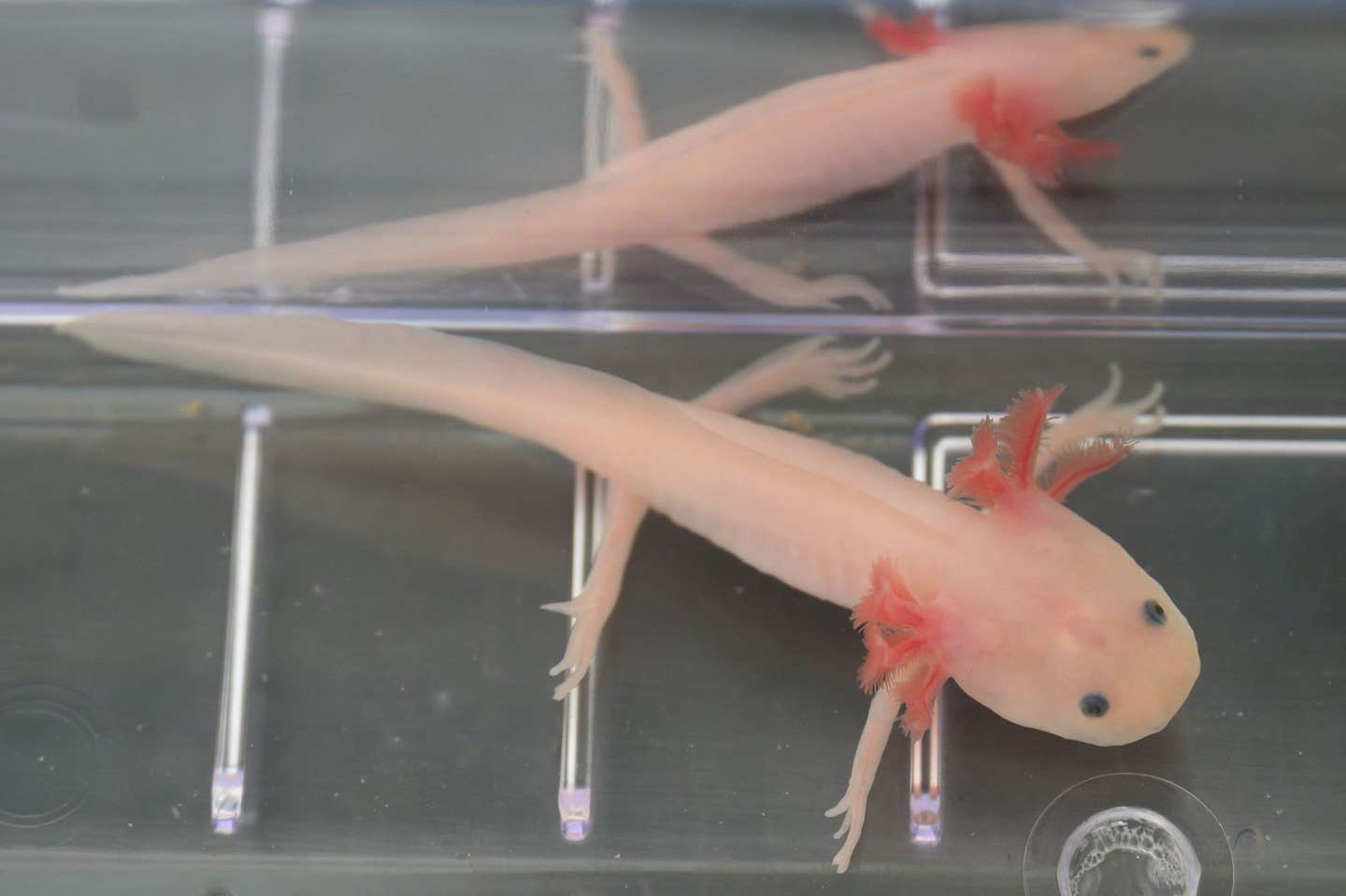
A Mexican axolotl in Wake Forest University biologist Josh Currie’s regeneration lab. (CREDIT: Wake Forest University)
The skin over a fresh wound might not look like much. In some animals, though, that thin covering becomes command central for rebuilding what was lost.
That idea sits at the heart of new research on axolotls, zebrafish, and mice, three species that are very different on the surface but share part of the same genetic machinery when they regenerate damaged body parts. By tracing that overlap, scientists say they have found an early clue toward a gene therapy strategy that might someday help people regrow complex tissues after injury.
“This significant research brought together three labs, working across three organisms to compare regeneration,” said Josh Currie, an assistant professor of biology at Wake Forest whose lab studies the Mexican axolotl salamander. “It showed us that there are universal, unifying genetic programs that are driving regeneration in very different types of organisms, salamanders, zebrafish and mice.”
The work brought together Currie, Duke University plastic surgeon David A. Brown, and Kenneth D. Poss of the University of Wisconsin-Madison. Their shared target was limb and appendage regeneration, a biological feat that remains far out of reach in humans.
That gap matters. More than 57 million people worldwide were living with limb loss as of 2017, according to the research paper, with major causes including trauma, cancer, vascular disease, and congenital conditions. The paper also notes that more than 1 million limb amputations occur globally each year, often tied to vascular disease such as diabetes, along with injuries, infections, and cancer.
Modern prosthetics can do a great deal, but they still cannot recreate the full sensory and motor abilities of a living limb. They also come with challenges such as chronic pain and tissue interfacing. So the question for researchers has become whether biology itself can be pushed to do more.
A shared signal in skin
The scientists focused on what happens soon after amputation, when a special layer of skin forms over the wound. In animals that regenerate well, that skin does more than seal the injury. It acts as a signaling center, helping organize the growth of new tissue underneath.
In zebrafish fins, axolotl limbs, and regenerating mouse digit tips, the team found activity from two related genes, Sp6 and Sp8, in that epidermal layer. Those genes belong to the SP family of transcription factors, which help control other genes.
The pattern mattered because the same genes appeared in all three species during regeneration, even though the animals rebuild different structures and live very different lives.
Axolotls are famous for their regenerative powers. They can regrow full limbs and tails, including spinal cord tissue, along with parts of the heart, brain, liver, lungs, and jaw. Zebrafish can rapidly regrow tail fins and also regenerate organs including the heart, spinal cord, brain, retina, kidneys, and pancreas. Mice are much more limited, but they can regenerate the tips of their digits. Humans can also regrow fingertips in some cases, when the injury leaves the nail bed intact.
That made the three animals useful points on a spectrum. One sits at the high end of regeneration, one offers a fast and flexible appendage model, and one stands closer to people.
What happened when the genes were removed
The next step was to test whether those SP genes were simply present during regeneration or actually necessary for it.
In axolotls, Currie’s lab used CRISPR gene editing to remove Sp8. The salamanders still developed normal limbs, but once those limbs were amputated, regeneration went wrong. The animals failed to correctly pattern the new skeletal elements, and repeated rounds of regeneration made the defects worse.
In mice, the picture was similar. Researchers created adult animals in which Sp6, Sp8, or both could be shut off in the basal epidermis before digit tip amputation. Compared with normal mice, those animals had trouble rebuilding the tip of the digit. The epidermal covering formed late, blastema formation was disrupted, and bone regrowth was reduced.
The strongest defects appeared when both genes were knocked out together. By 56 days after amputation, those mice still showed major losses in bone length and volume. In many cases, instead of a rebuilt digit tip, only a blunt stump or a small amount of new bone formed.
The zebrafish result was different. Knocking out related SP genes in fish did not produce a clear fin regeneration defect. The authors suggest two possible reasons: redundancy in the zebrafish genome and the general toughness of fin regeneration, which often resists disruption even when genes are altered.
That contrast did not weaken the study. It sharpened it. A shared regeneration program can still look different depending on the species using it.
A gene therapy test in mice
Once the researchers saw that the SP genes mattered, they looked downstream for a signal they might replace.
They chose Fgf8, a gene linked to SP activity during limb development. In earlier developmental work, SP8 had been shown to help drive Fgf8 expression. So Brown’s lab built a viral gene therapy designed to deliver Fgf8 to injured mouse digits.
The delivery system used an engineered adeno-associated virus and a regeneration-linked enhancer originally identified in zebrafish. After injection, expression stayed focused at the injury site rather than spreading broadly through the body, aside from the liver, which is involved in clearing the virus.
That part was important. A targeted approach could, in theory, reduce the risks tied to high systemic doses of gene therapy.
In mice missing both Sp6 and Sp8, the treatment partly restored regeneration. By 28 days after amputation, treated digits had 32% greater total bone volume, 24% greater regenerated bone length, and greater regenerated bone volume than control digits that did not receive Fgf8.
The therapy also boosted regeneration in normal mice. In digits amputated at a level that usually regenerates, the treated animals had a 34% increase in bony regenerate volume at 21 days.
“We can use this as a kind of proof of principle that we might be able to deliver therapies to substitute for this regenerative style of epidermis in regrowing tissue in humans,” Currie explained.
The treatment did not improve regeneration in mouse digits amputated at a non-regenerative level. The paper says that may reflect reduced viral access to the tissue or the much greater barrier to regeneration at that location.
More than one road to regrowth
The study does not claim that humans are close to regrowing whole arms or legs. The researchers are careful on that point. The experiments were done in mouse digit tips, not full limbs, and much more work is needed before any human therapy could be considered.
Currie described the findings as foundational rather than final.
“Scientists are pursuing many solutions for replacing limbs, including bioengineered scaffolds and stem cell therapies,” he said. “The gene-therapy approach in this study is a new avenue that can complement and potentially augment what will surely be a multi-disciplinary solution to one day regenerate human limbs.”
He also said the collaboration across species made the project stronger.
“Many times, scientists work in their silos: we're just working in axolotl, or we're just working in mouse, or just working in fish,” Currie said. “A real standout feature of this research is that we work across all these different organisms. That is really powerful, and it's something that I hope we'll see more of in the field.”
Practical implications of the research
For now, the study offers a new way to think about regeneration as a medical target. Instead of treating wound healing and bone repair as separate problems, it points to a shared genetic program in the epidermis that may help coordinate both.
That matters for patients with limb loss and for people recovering from severe injuries, where better tissue regrowth could improve function even if full limb regeneration remains distant. It also suggests gene therapy could become one part of a broader toolkit, working alongside scaffolds, stem cells, and other regenerative strategies.
The biggest takeaway is modest but important: some of the instructions for regrowth appear to be conserved across species, and at least one part of that program can be nudged in mammals. That does not put human limb regeneration around the corner. It does, however, move the field from speculation toward a more testable plan.
Research findings are available online in the journal PNAS.
The original story "Salamander gene could hold the key to regrowing human limbs" is published in The Brighter Side of News.
Related Stories
- 250-million-year-old Australian ‘sea-salamander’ sheds new light on the dawn of the dinosaurs
- The missing ingredient in limb regeneration may be oxygen
- These endangered sea creatures are over 1,000x more resistant to cancer than humans
Like these kind of feel good stories? Get The Brighter Side of News' newsletter.
Hannah Shavit-Weiner
Medical & Health Writer
Hannah Shavit-Weiner is a Los Angeles–based medical and health journalist for The Brighter Side of News, an online publication focused on uplifting, transformative stories from around the globe. Having published articles on AOL.com, MSN and Yahoo News, Hannah covers a broad spectrum of topics—from medical breakthroughs and health information to animal science. With a talent for making complex science clear and compelling, she connects readers to the advancements shaping a brighter, more hopeful future.