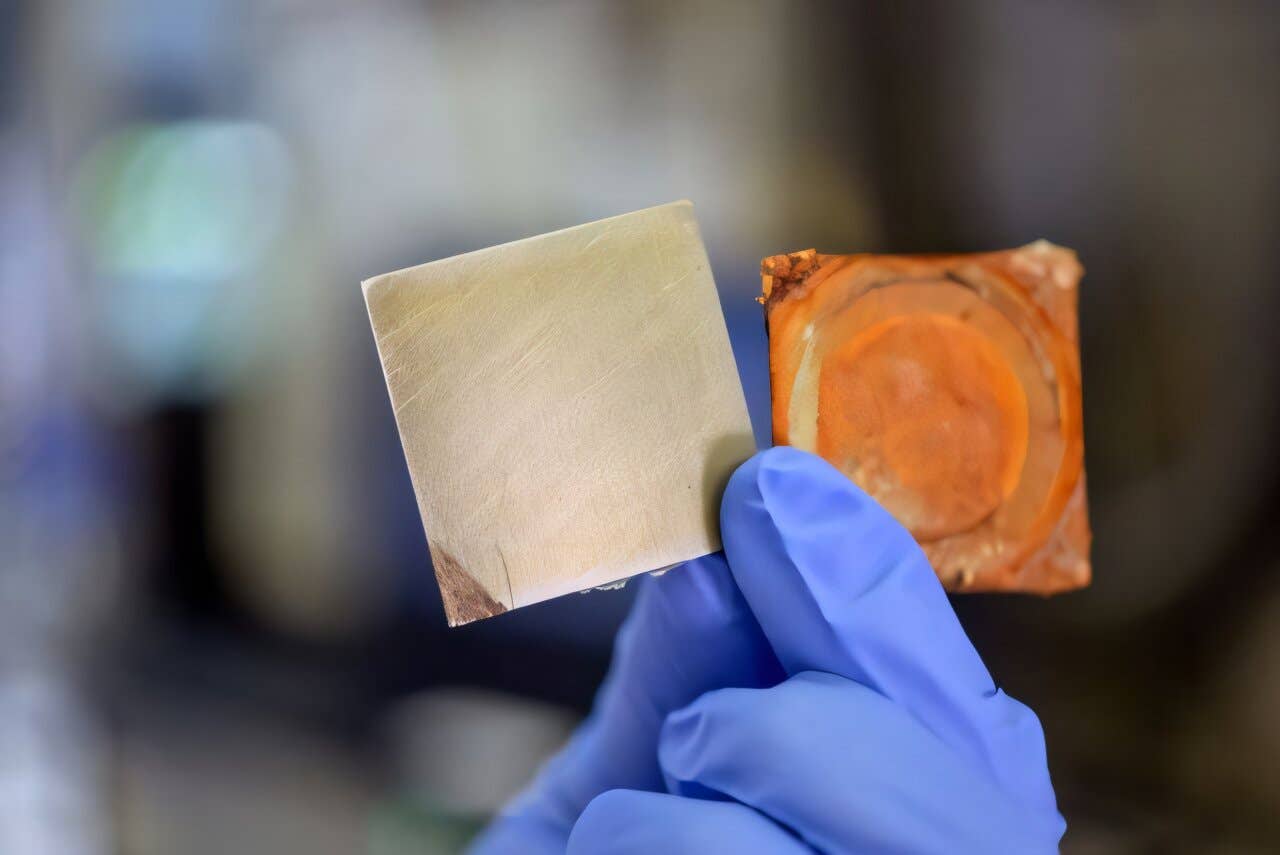
Scientists discover atomic shield that keeps gold from tarnishing
New research reveals gold resists tarnishing due to atomic surface patterns that block oxygen reactions.

 Edited By: Joseph Shavit

Scientists uncover how gold atoms rearrange to form a protective barrier, keeping the metal shiny and opening new paths for catalysts. (CREDIT: Wikimedia / CC BY-SA 4.0)
Gold has long stood apart from other metals. It does not rust like iron or tarnish like silver. Its shine endures across centuries, even in open air. For years, scientists believed this stability came down to simple chemistry. Gold, they thought, just does not react strongly with oxygen.
New research suggests a more complex story. A team at Tulane University has found that gold protects itself in a surprising way. Its atoms shift into patterns that block reactions before they begin. The findings reveal a hidden defense that helps explain gold’s lasting brilliance.
The work also points toward new ways to improve gold-based catalysts, which play a role in manufacturing and energy systems. By understanding how gold resists change, scientists may learn how to control that behavior.
A Closer Look At Gold’s Surface
At first glance, a piece of gold looks smooth and still. At the atomic level, the surface is anything but static. Atoms sit in organized layers, forming patterns that depend on the structure of the crystal.
Matthew Montemore, an associate professor of chemical engineering, led the study. He and his colleague Santu Biswas used computer simulations to examine how oxygen interacts with gold. These simulations predict how atoms and electrons behave during chemical reactions.
The researchers focused on two common surface structures found in gold. Scientists label them as different crystal faces. These faces describe how atoms arrange themselves at the surface.
The key discovery came when the team noticed that these surfaces do not stay in their simplest form. Instead, they rearrange. Atoms shift positions to create new patterns that lower the system’s energy.
“People have generally thought gold doesn’t tarnish simply because it doesn’t interact strongly with oxygen,” Montemore said. “What we show is that for two of the most common gold surface types, the surface atoms actually rearrange themselves in a way that makes the gold much more resistant to oxidation.”
A Protective Pattern At The Atomic Scale
These rearranged surfaces form tightly packed patterns. Many resemble hexagonal shapes, similar to a honeycomb. This geometry turns out to be critical.
When oxygen molecules approach gold, they must first split apart before reacting. This step is called dissociation. On most metals, oxygen can break apart with relative ease. Once split, the atoms bond with the metal, leading to corrosion or tarnishing.
On gold, the process becomes much harder.
The study found that the rearranged surface raises the energy needed for oxygen to split. This energy barrier slows the reaction to an extreme degree. Oxygen molecules struggle to break apart, so they cannot easily bond with the metal.
Without this rearrangement, the situation changes completely. Oxygen can split much more easily on a simpler surface. In that case, gold would react far more readily.
The difference is enormous. The rearranged surfaces reduce oxygen reactions by factors ranging from a billion to a trillion. This creates a powerful shield at the atomic level.
Why Shape Matters More Than Expected
The researchers discovered that geometry plays a major role in this process. Surfaces with square or rectangular patterns allow oxygen to split more easily. In contrast, hexagonal patterns resist the reaction.
This difference comes down to how atoms must move during the reaction. Oxygen prefers to interact with atoms arranged in certain ways. Square-like patterns provide a better fit.
On hexagonal surfaces, gold atoms must shift into new positions during the reaction. That movement requires energy. The extra energy raises the barrier, slowing the process.
The team also found another effect. In some cases, two oxygen atoms compete to bond with the same gold atom. This competition weakens the interaction and further increases the energy needed for the reaction.
Together, these effects explain why gold remains so stable. Its surface shape creates both structural resistance and bonding challenges for oxygen.
Modeling Gold In Action
To understand how these effects play out over time, the researchers ran simulations of real reactions. They modeled how oxygen would behave on different gold surfaces under realistic conditions.
The results showed stark differences.
On unreconstructed surfaces, oxygen could build up quickly. Within seconds, a noticeable layer of oxygen atoms formed. This suggests that gold would begin to oxidize if its surface stayed in this simpler state.
On reconstructed surfaces, almost no oxygen accumulated. The reaction remained so slow that the surface stayed effectively unchanged.
Even when the researchers adjusted conditions, the outcome remained consistent. The rearranged surface always resisted oxidation far more strongly.
These findings confirm that gold’s stability depends not just on its chemical makeup but also on its structure.
Implications For Catalysts And Industry
Gold’s resistance to oxygen has both benefits and drawbacks. Its stability makes it valuable for jewelry and electronics. It also limits its usefulness in some chemical processes.
In many industrial reactions, catalysts must help oxygen molecules split apart. Gold struggles with this step because of its protective surface structure.
Despite this challenge, gold catalysts are already used in several applications. Gold-palladium materials help produce vinyl acetate, a key ingredient in plastics. Gold also plays a role in cleaning carbon monoxide from vehicle exhaust and producing propylene oxide.
“If you can trick gold into dissociating oxygen, it can actually become a very effective catalyst for certain reactions,” Montemore said. “Our work suggests a new strategy for potentially doing that by preventing or reversing these surface rearrangements.”
This insight could lead to new approaches in catalyst design. Instead of combining gold with other metals, researchers might focus on controlling surface shape.
By stabilizing square or rectangular patterns, scientists may create gold surfaces that react more easily. This could improve efficiency in chemical manufacturing and energy systems.
Rethinking Gold’s Nature
The study challenges a long-standing belief. Gold’s resistance to tarnishing does not come from chemistry alone. It also comes from how its atoms arrange themselves.
This discovery adds a new layer of understanding to a familiar material. It shows that even well-known substances can still hold surprises.
The findings also highlight the importance of structure in chemistry. Small changes at the atomic level can produce massive differences in behavior.
For gold, these changes create a natural shield. The metal protects itself by forming patterns that block reactions before they begin.
Practical Implications of the Research
This research could influence both everyday materials and advanced technologies. By understanding how gold resists oxidation, scientists can design surfaces that either enhance or reduce this property depending on the need.
In industrial settings, improved gold catalysts could make chemical reactions faster and more efficient. This may lower energy use and reduce waste in manufacturing processes. Cleaner catalytic systems could also improve environmental outcomes, such as reducing harmful emissions.
The findings may also guide the development of new materials with built-in resistance to corrosion. Engineers could mimic gold’s surface behavior to create longer-lasting coatings or components.
For research, the study opens new directions in surface science. It encourages scientists to focus not only on chemical composition but also on atomic arrangement. This approach could lead to breakthroughs in other metals and materials.
In the long term, the ability to control surface geometry may help advance energy technologies, including fuel cells and pollution control systems. Understanding how atoms arrange themselves may become a key tool in solving complex engineering challenges.
Research findings are available online in the journal Physical Review Letters.
The original story "Scientists discover atomic shield that keeps gold from tarnishing" is published in The Brighter Side of News.
Related Stories
- Gold’s origins lie beneath the ocean deep inside the Earth's mantle
- New gold nanospheres capture nearly the full spectrum of solar energy
- Earth’s core is leaking vast amounts of gold through the mantle, study finds
Like these kind of feel good stories? Get The Brighter Side of News' newsletter.
Shy Cohen
Writer