Scientists generate electricity using Tesla turbine-inspired technology
A new turbine design captures static electricity from compressed air, turning industrial airflow into power.

 Edited By: Joseph Shavit

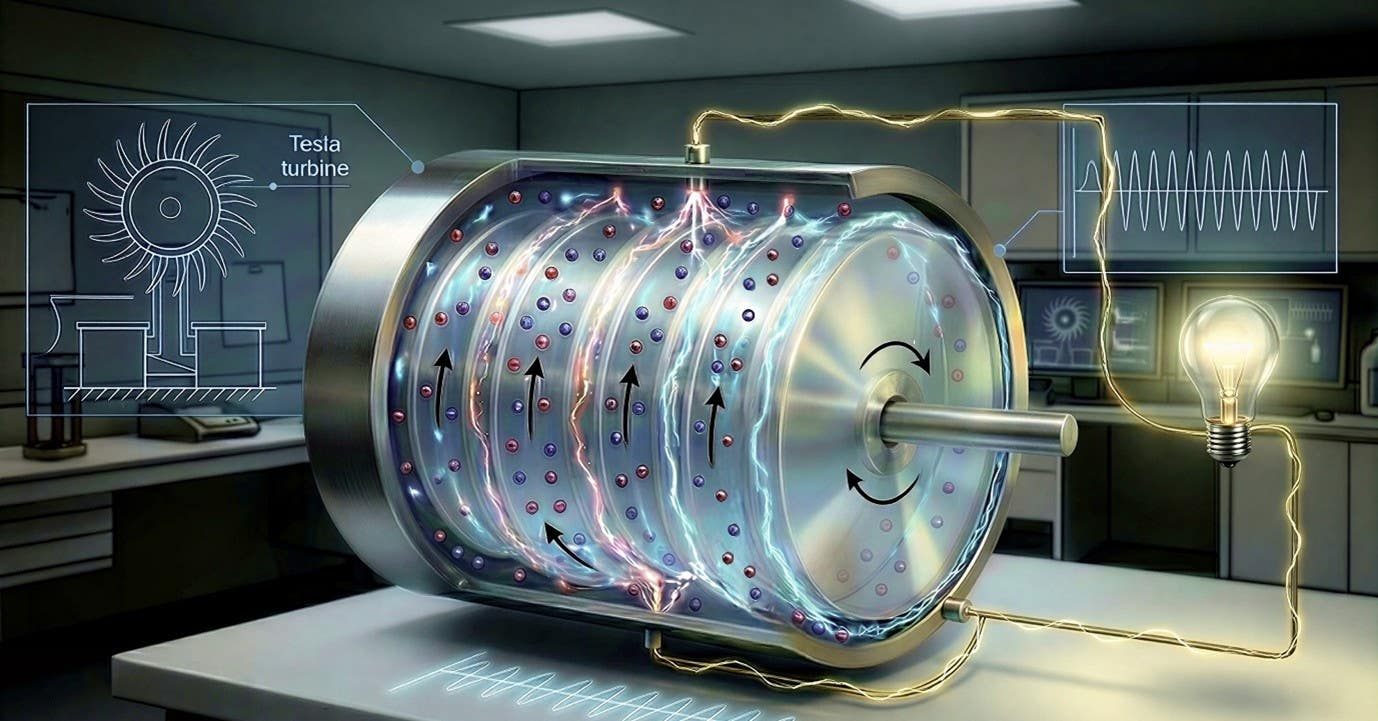
Researchers have demonstrated a particulate static effect-induced electricity generation technology inspired by the Tesla turbine. (CREDIT: Professor Sangmin Lee from Chung-Ang University, Republic of Korea via Google Gemini)
A stream of compressed air does not look like a power source. In factories, it usually hisses through pipes, drives tools, then disappears as waste. But under the right conditions, that same airflow carries invisible electrical potential, especially when tiny particles move with it.
Engineers have now found a way to tap that overlooked energy.
Researchers from Chung-Ang University in South Korea, working with collaborators from Kumoh National Institute of Technology, the Massachusetts Institute of Technology, and National Taiwan University, built a device that converts compressed air into electricity using static charge. Their work appeared in Advanced Energy Materials.
The system takes inspiration from a Tesla turbine, a design that spins using fluid flow rather than traditional blades. Instead of friction-based contact, the new generator relies on what the team calls the particulate static effect.
“During the research, we were curious about what would happen if high-speed—or high-pressure—wind blows onto the triboelectric nanogenerator. So, we fabricated a Tesla turbine-inspired triboelectric nanogenerator structure that can be operated with high-pressure air and analyzed the data. From these results, we observed the particulate static effect: the particulate matter in air can also generate surface charge on the triboelectric layer,” said Professor Sangmin Lee of Chung-Ang University.
That observation led to a new approach to harvesting static electricity without direct contact.
Static Electricity Without Friction
Traditional triboelectric generators often rely on surfaces rubbing together. That contact creates wear and limits durability. It also restricts performance at high speeds or pressures.
The new device avoids those problems.
Compressed air enters the turbine and creates rotational motion through viscous force. Inside, layers with different electrical properties pick up charge from airborne particles. Because there is no sliding contact, the system behaves like a non-contact triboelectric generator.
“The viscous force of compressed air induces rotational motion within the device. Tribo-negative and tribo-positive layers inside acquire surface charge from the particulate static effect without the need for frictional sliding, allowing operation similar to non-contact tribo-electric generators. This facilitates electricity generation via electrostatic induction in the rotating electrodes, and the frictionless rotation enables high-frequency peak outputs,” Lee explained.
The performance numbers are notable.
At rotational speeds of 8,472 revolutions per minute, the generator produced outputs up to 800 volts and 2.5 amperes at 325 hertz. The team confirmed the mechanism by measuring transferred charge in compressed air and mapping electrostatic forces on the generator surface.
This marks the first demonstration of electricity generation from particulate static effects using a Tesla turbine structure.
From Industrial Waste to Useful Energy
Compressed air systems are common in manufacturing, energy production, and transportation facilities. Much of that airflow eventually becomes waste, vented into the environment after use.
The new generator could convert some of that wasted flow into electrical power.
The researchers demonstrated several practical uses during testing. The device powered electronic components, collected water from atmospheric moisture, and removed airborne dust using its high-voltage output. Those functions depend on negative ion generation, which helps particles and droplets aggregate.
One potential application involves humidity control.
Another involves air purification in industrial settings where dust accumulation poses safety risks. Static electricity in particulate environments can create ignition hazards. Previous attempts to manage this risk sometimes required adding water or extra particles, which limited usefulness.
This design avoids those additions by using only compressed air already present in many facilities.
Because the generator produces high voltage without direct friction, it may also reduce wear-related maintenance compared with contact-based systems.
A Different Way to Think About Airflow
The concept highlights an overlooked feature of moving air. Particles carried in compressed streams naturally acquire charge through collisions and interactions. Instead of treating that charge as a hazard, engineers can convert it into a resource.
That shift in perspective could open interdisciplinary research paths.
The team suggests future work could explore broader industrial integration and other environments where particulate-laden airflow exists. Mining operations, pneumatic transport systems, and environmental control systems all generate similar conditions.
Scaling and long-term durability remain areas for continued study, as with most early-stage energy technologies.
Still, the principle is clear.
Airflow does more than move objects. It can also carry electricity.
Research findings are available online in the journal Advanced Energy Materials.
The original story "Scientists generate electricity using Tesla turbine-inspired technology" is published in The Brighter Side of News.
Related Stories
- Safer, low-cost alternative to lithium batteries could bring electricity to a billion underserved people
- Revolutionary new battery turns nuclear waste into electricity
- Human heart shaped buoy converts wave motion into clean electricity
Like these kind of feel good stories? Get The Brighter Side of News' newsletter.
Shy Cohen
Writer