Scientists identify hundreds of ancient genes associated with human diseases
A map of ancient protein networks is revealing hidden gene links to kidney disease, osteopetrosis, and ciliopathies.

 Edited By: Joseph Shavit

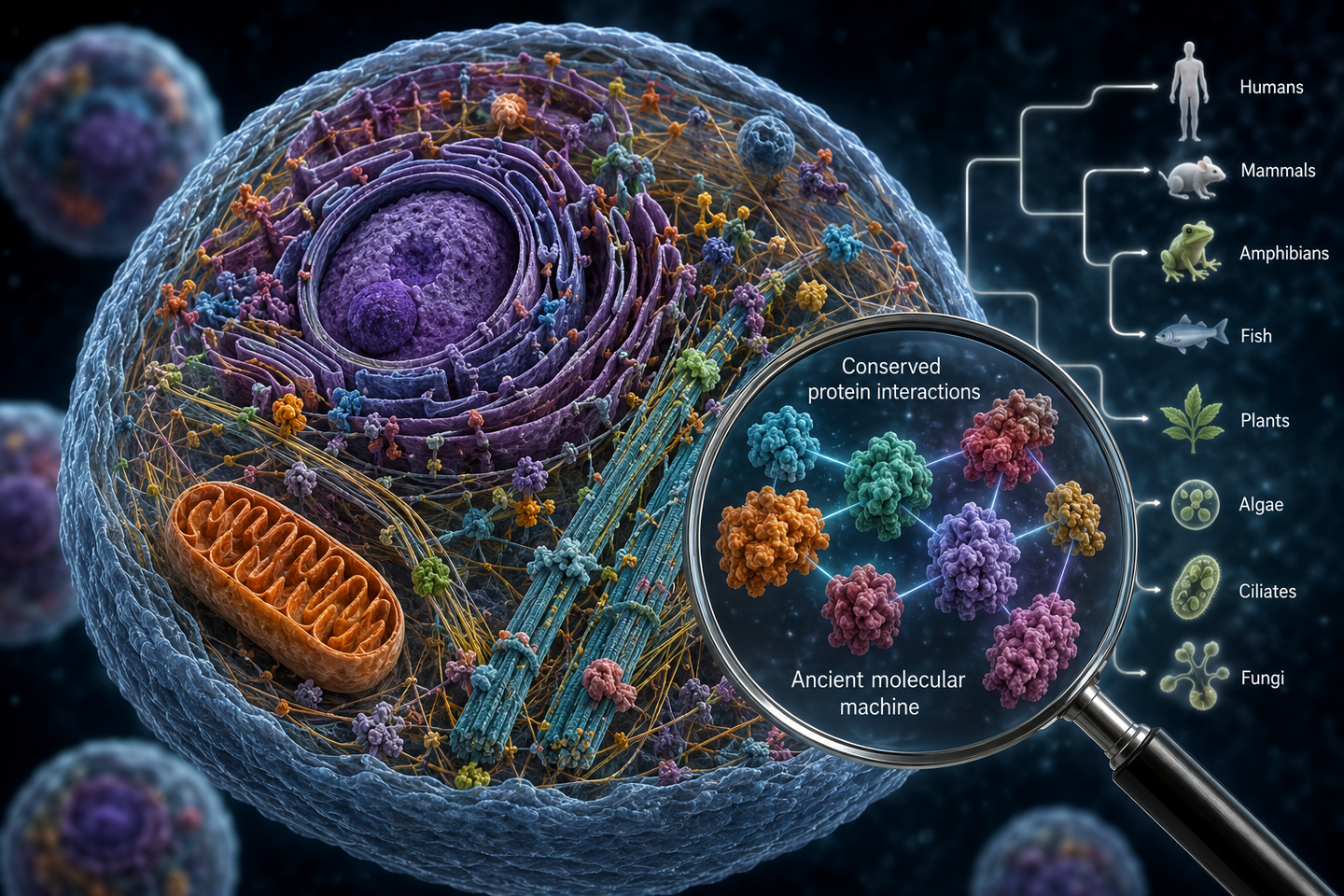
Ancient protein networks helped scientists uncover new rare disease genes rooted in the earliest complex cells. (CREDIT: AI-generated image / The Brighter Side of News)
When a child develops kidney failure or a rare bone disorder, the cause can seem painfully immediate. It may be a single broken gene, a sudden diagnosis, or a family searching for answers. However, some of those faults may trace back nearly two billion years, to a one-celled ancestor shared by every plant, animal, and fungus alive today.
A University of Texas at Austin-led team has now reconstructed the most detailed map yet of the protein networks inside that ancestor, known as the last eukaryotic common ancestor, or LECA. In doing so, the researchers built a new way to hunt for disease genes in humans. They used some of the oldest molecular machinery in complex life as a guide.
Their study, published in Cell Genomics, suggests that the deep history of life is not just a story about origins. It can also help explain why modern bodies fail.
Rachael Cox, a former UT doctoral student who led the data analysis in the lab of senior author Edward Marcotte, said the approach proved unexpectedly powerful. “There was a huge range of diseases that we could predict pretty well, just using ancient protein complexes,” she said.
A cellular map from Earth’s distant past
LECA lived about 1.5 billion to 1.8 billion years ago and is thought to have been the single-celled ancestor of all living eukaryotes, the broad group that includes humans, animals, plants, and fungi. Scientists have long believed it was already surprisingly complex. For example, it had structures such as a nucleus, internal membranes, mitochondria, and a dynamic internal skeleton.
What had been missing was a fuller picture of how its proteins worked together.
That matters because proteins rarely act alone. Inside cells, they assemble into molecular machines that build structures, move cargo, make energy, process RNA, and dispose of waste. When one part of those machines fails, the result in humans can be severe disease.
To reconstruct LECA’s protein interactome, the team first identified genes shared across 156 organisms from across the eukaryotic tree of life. They reasoned that the most broadly shared gene families were likely present in LECA too.
They then turned to experiments. Researchers analyzed cells from 31 eukaryotic species and carried out roughly 26,000 mass spectrometry experiments. This included more than 25,000 biochemical measurements designed to separate and identify protein assemblies. The final dataset captured hundreds of millions of peptide measurements across organisms. These organisms spanned about 1.8 billion years of evolution.
Using supercomputers at the Texas Advanced Computing Center, the scientists assembled those signals into a draft map of ancient protein interactions. The final network included 109,466 pairwise interactions among 3,193 orthologous groups. These were organized into protein complexes at multiple levels of detail.
More than an evolutionary portrait
The work also sharpened the genetic outline of LECA itself. Depending on the reconstruction method, the team inferred between about 6,000 and 10,000 ancestral gene families. More than half of human genes, 13,571 in all, mapped back to 4,777 unique LECA orthologous groups.
That deep conservation helps explain why ancient biology can still matter in the clinic. The molecular machines that survived across nearly two billion years usually did so because they were essential. When genes tied to those systems break, the damage can be profound.
Marcotte said the map also offers a humbling perspective on shared ancestry. “I think it gives you perspective as a human to look around at all the organisms you can see and realize you’re related to them in some deep, fundamental way,” he said. “And looking at this little cartoon of this ancestral organism is like looking at your own great, great, great, great, great, to the nth generations back, ancestor. This is the common heritage of complex living organisms.”
The team also found that some molecular systems thought to be more specialized have ancient roots. Their data recovered major vesicle-tethering complexes, cilia-related machinery, and broad components of the cytoskeleton. It also supported the idea that LECA likely had the machinery for cell projection and perhaps phagocytosis, the ability to engulf large particles.
Cox put the evolutionary closeness in plainer terms. “It puts into perspective how close we are to other organisms, relatively on the time scale of Earth,” she said. “I look at a fish and I’m like, oh, we’re basically fish. By the time you have a spine, we’re all closely related.”
Using ancient protein “friends” to spot disease genes
The disease work began with a simple idea. If proteins linked to a disease tend to cluster together in a network, nearby proteins may also be involved.
“Imagine your own social network,” Marcotte said. “You might have a friend interested in basketball. Chances are, they have friends who are also interested in basketball. We use the same idea. If we know some proteins are linked to a certain disease, maybe some of their friends are also linked to the disease. We call that guilt by association.”
The researchers overlaid known gene-disease relationships from the Online Mendelian Inheritance in Man database onto the LECA interactome. For 109 diseases, they used the network to predict additional genes that might also play a role.
Using a strong prediction threshold, the method generated new candidate genes for about one-third of the diseases tested. This was roughly 35 Mendelian disorders.
The team then followed several of those leads in animals and patient data.
One case involved a male infant with microcephaly, seizures, polycystic kidney disease, and end-stage renal failure. Genetic analysis pointed to a variant in the gene EFHC2, whose function had been poorly understood. The ancient interactome placed EFHC2 squarely among proteins involved in cilia movement. In frog cells, the normal protein localized strongly to cilia, but the disease-associated variant did not. This linked the gene to a ciliopathy-like kidney disorder.
A second case centered on osteopetrosis, a disease in which bones become abnormally dense. The network pointed to the V-ATPase subunit ATP6V1A as a candidate. In heterozygous CRISPR-Cas9 knockout mice, disruption of that gene was associated with increased bone mineral content. This supported its role in the disease.
The third involved short-rib thoracic dysplasia, a severe ciliopathy. The top non-intraflagellar transport candidate was GLG1, a Golgi protein not previously tied to ciliary biology. In frog multiciliated cells, knocking down GLG1 caused major cilia loss and abnormal buildup of transport proteins inside axonemes. This supported a role in cilia formation and function.
Practical implications of the research
The study offers a new strategy for finding disease genes by focusing on ancient cellular systems that have stayed important across evolution. That could help researchers interpret rare patient variants that now sit in genetic databases without clear meaning.
It also gives scientists a way to move from a gene name to a possible disease mechanism. In the three disorders examined here, the network did more than flag candidates. In fact, it helped explain why those genes might matter.
Because the interactome is built from conserved protein relationships shared across many eukaryotes, the approach could also support work in animal models, agriculture, and other branches of biology where similar gene networks shape different traits. The authors say many more disease links are likely still hidden in the map.
Research findings are available online in the journal Cell Genomics.
The original story "Scientists identify hundreds of ancient genes associated with human diseases" is published in The Brighter Side of News.
Related Stories
- New AI model reads the language of genes to detect diseases faster
- Genes and DNA reveal why heart disease risk is rising in Greenland
- Scientists discover the human genes involved in adaptation to desert living
Like these kind of feel good stories? Get The Brighter Side of News' newsletter.
Joshua Shavit
Writer and Editor
Joshua Shavit is a NorCal-based science and technology writer with a passion for exploring the breakthroughs shaping the future. As a co-founder of The Brighter Side of News, he focuses on positive and transformative advancements in technology, physics, engineering, robotics, and astronomy. Having published articles on AOL.com, MSN, Yahoo News, and Ground News, Joshua's work highlights the innovators behind the ideas, bringing readers closer to the people driving progress.