Scientists turn everyday wool into record-breaking ultrablack fabric
Cornell scientists turn ordinary wool into ultrablack fabric that reflects only 0.13% of light and stays dark from many angles.

 Edited By: Joseph Shavit

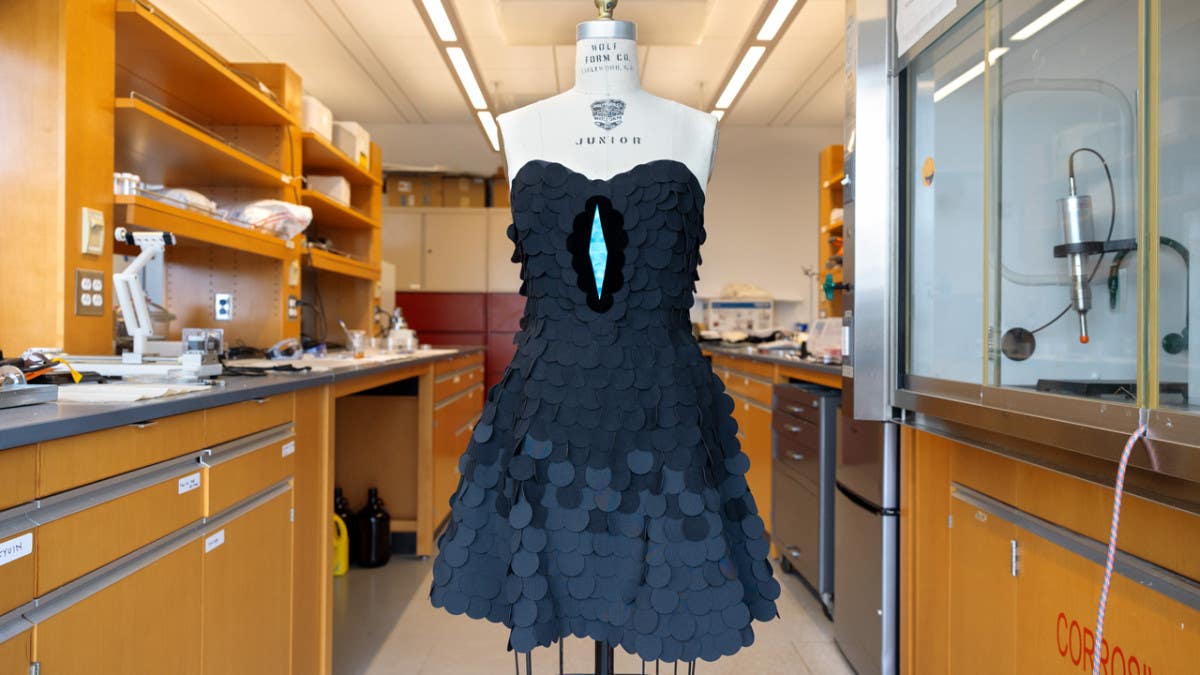
A dress designed by Zoe Alvarez ’25, a fashion design major, and inspired by the magnificent riflebird, uses the ultra-black material (the dots nearest the blue) and other deep-black fabrics. The ultrablack fabric created in the Responsive Apparel Design Lab is the darkest fabric currently reported. (CREDIT: Zoe Alvarez)
A piece of fabric that almost seems to erase light rather than reflect it now exists, and it starts as soft white wool. When you look at it, your eyes have very little to work with. Almost every photon that hits the surface vanishes into its structure.
Scientists at Cornell University have developed this new textile, an ultrablack wool that reflects only about 0.13% of visible light. For comparison, materials are usually called “ultrablack” if they reflect less than 0.5%. This fabric clears that bar by a wide margin and still behaves like normal clothing.
Learning From a Very Black Bird
To build something that dark, the team first looked to nature. They drew inspiration from the magnificent riflebird, a bird-of-paradise whose feathers can look like a cutout of pure shadow. The bird’s plumage gets its depth from two things working together: melanin pigment and intricate microscopic structures that trap incoming light.
At a glance, the riflebird appears almost impossibly black when viewed head on. But if you move to the side, the feathers become glossy. That shift happens because their light trapping structures work best from a narrow range of angles. The Cornell group wanted something different. They wanted a material that stayed just as dark even when you look from the side, and that you could actually wear.
“From a design perspective, I think it’s exciting because a lot of the ultrablack that exists isn’t really as wearable as ours. And it stays ultrablack even from wider angles,” said Larissa Shepherd, assistant professor in the Department of Human Centered Design and director of the Responsive Apparel Design Lab.
How Ordinary Wool Became Ultrablack
The researchers began with a simple white merino wool knit. Their process had only two main steps, both relatively gentle and suitable for natural fibers. First, they dyed the wool with polydopamine, a synthetic version of melanin. Melanin is the same family of pigment that helps give deep color to the riflebird’s feathers and to your own hair and skin.
They did not just coat the outside of the fibers. The polydopamine had to soak into the wool so that the entire cross section turned dark. This step mattered because of what came next. In the second stage, the team placed the dyed wool in a plasma chamber and etched the surface.
Plasma etching is like a very controlled sandstorm made of energized gas. It gently eats away some of the outer material from each fiber. As it does that, it leaves behind a forest of nanoscale spikes called nanofibrils. Under a microscope, each wool fiber now looks less like a smooth strand and more like a bristling, fuzzy branch. Those spikes become the key light trap.
Measuring Just How Dark It Is
When the team measured how much light the textile reflected, the numbers were striking. Across the visible spectrum, the average total reflectance was only 0.13%. That makes this the darkest fabric reported so far. For context, many deep black clothing fabrics still reflect several percent of light. Even specialized black coatings for cameras often sit above the 0.5% ultrablack line.
Just as important, the color barely changed with viewing angle. The fabric stayed ultrablack across a 120 degree range, which means it looked essentially the same from straight on and from up to 60 degrees to either side. That solves a major drawback of many previous ultrablack materials, including the riflebird’s own feathers, which can turn shiny when viewed off axis.
This consistency comes from the combination of pigment and structure. The polydopamine absorbs light inside the fibers, while the nanofibrils on the surface confuse and trap incoming rays before they can bounce back toward your eye. Light enters the “forest” of spikes, scatters many times, and gets absorbed instead of escaping.
From Lab Bench to Wardrobe
Earlier ultrablack technologies often relied on rigid structures such as forests of carbon nanotubes. Those coatings can be incredibly dark, but they tend to be fragile, expensive, and not comfortable to wear. They also do not breathe like textiles and may involve toxic components.
In contrast, this new process keeps the feel of the original fabric. The treated wool remains soft, flexible, and suitable for garments. The approach is also compatible with other natural fibers, including silk and cotton, which opens the door to a range of textile products. The team reports that the method is scalable, uses relatively simple equipment, and relies on a melanin-like dye rather than exotic chemistry.
The researchers have applied for patent protection and hope to form a company around the technology. They see potential for both fashion and technical uses, from dramatic couture garments to fabrics that reduce stray reflections in optical systems. Because the treatment works on knit wool, you can picture sweaters, scarves, or performance wear that look like pure shadow and still feel comfortable against skin.
Shepherd stresses that the project sits at the intersection of science and design. Her lab did not only ask how dark the fabric could get. They also cared about whether someone would want to wear it, how it moved, and how it behaved under real use. The fact that the result hits a scientific record while also being practical makes the work stand out.
Practical Implications of the Research
This research shows that you can combine bioinspired design, simple chemistry, and textile engineering to create ultrablack materials that belong in everyday life, not just in laboratories. By adapting ideas from riflebird feathers into wool, the team demonstrated a path to garments that control light at the nanoscale while staying soft, breathable, and washable.
In the future, this kind of fabric could play a role in more than fashion. Ultrablack textiles might help cut glare in wearable sensors and cameras, improve contrast in optical instruments, or absorb stray light in scientific setups without bulky rigid coatings.
Because the process works on common natural fibers, manufacturers could integrate it into existing production lines, bringing advanced light management into ordinary clothing and gear. The work hints at a wider shift where clothing does not only express style but also quietly manipulates light and energy in ways that benefit comfort, performance, and technology.
Research findings are available online in the journal Nature Communications.
Related Stories
- Smart Textiles: A New Era of Wearable Technology
- Scientists create thermal-invisible surfaces by mimicking clouds
- The whitest paint is here – and it’s the coolest. Literally.
Like these kind of feel good stories? Get The Brighter Side of News' newsletter.
Rebecca Shavit
Writer
Based in Los Angeles, Rebecca Shavit is a dedicated science and technology journalist who writes for The Brighter Side of News, an online publication committed to highlighting positive and transformative stories from around the world. Her reporting spans a wide range of topics, from cutting-edge medical breakthroughs to historical discoveries and innovations. With a keen ability to translate complex concepts into engaging and accessible stories, she makes science and innovation relatable to a broad audience.