Seeds can sense the sound of falling raindrops, MIT study finds
Rice seeds exposed to rain-like sounds germinated faster, pointing to a hidden way plants may sense their environment.

 Edited By: Joseph Shavit

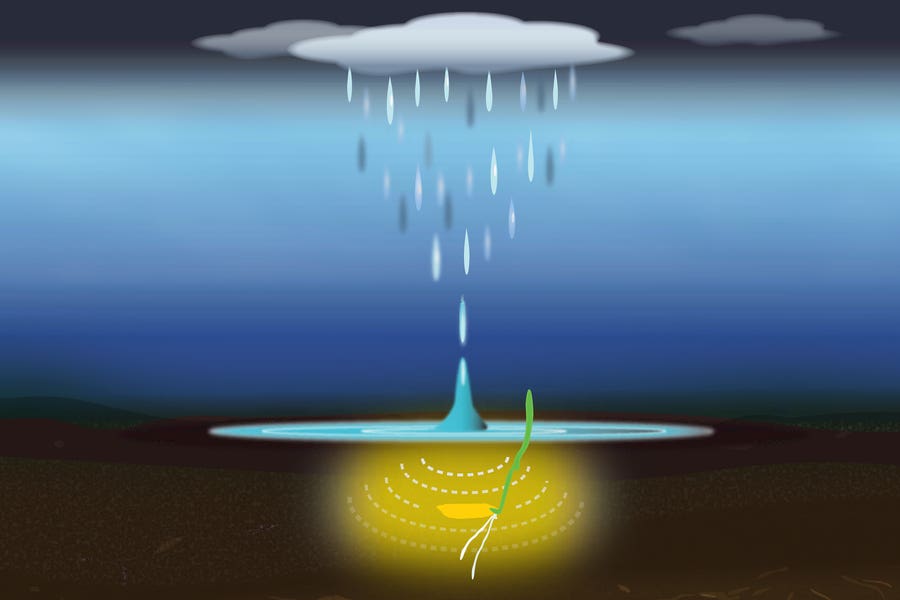
In experiments with rice seeds submerged in water, MIT researchers found that the sound of falling droplets shook the seeds out of a dormant state, stimulating them to germinate more quickly than seeds that were not exposed to the same sound vibrations. (CREDIT: Cadine Navarro)
Rain does more than soak the ground. For some seeds, it may also act like an alarm clock.
MIT engineers have found evidence that the sound of falling raindrops can speed up germination in rice seeds, apparently by physically shaking tiny gravity-sensing structures inside them. In lab experiments, seeds exposed to rain-like vibrations germinated noticeably faster than identical seeds kept in the same conditions without those sounds.
The work offers what the researchers describe as the first direct evidence that plant seeds and seedlings can detect sounds in nature and use them in ways that may help them survive.
“What this study is saying is that seeds can sense sound in ways that can help them survive,” said Nicholas Makris, a professor of mechanical engineering at MIT. “The energy of the rain sound is enough to accelerate a seed’s growth.”
The study was conducted by Makris and Cadine Navarro, a former graduate student in MIT’s Department of Urban Studies and Planning. Their findings will appear in Scientific Reports.
A noisy world below the surface
Plants are already known to be highly sensitive to their surroundings. Some fold when touched. Others react to harmful chemicals in the air. Nearly all respond to light. They also respond to gravity, which helps roots grow downward and shoots push up.
That sense of gravity depends in part on statoliths, tiny dense organelles inside certain plant cells. These particles drift through the cell and settle at the bottom, helping the plant figure out which way is down. Scientists have also found that when statoliths are disturbed or shifted, they can trigger growth.
That possibility led Makris and Navarro to a new question. Could sound in nature be strong enough to jostle statoliths and push a seed out of dormancy?
Makris said the clue came from earlier studies of rain striking water. Underwater, the sound of rain is far more intense than many people might expect.
“I went back to look at work done by colleagues in the 1980s, who measured the sound of rain underwater. If you check, you'll see it's much greater than in the air,” Makris said. “It has to do with the fact that water is denser than air, so the same drop makes larger pressure waves underwater. So if you’re a seed that’s within a few centimeters of a raindrop’s impact, the kind of sound pressures that you would experience in water or in the ground are equivalent to what you’d be subject to within a few meters of a jet engine in the air.”
That does not mean a rainy puddle sounds like an airport to a human ear. It means the pressure waves moving through water or wet ground can be surprisingly powerful for a seed sitting nearby.
Rice seeds under artificial rain
To test the idea, the researchers ran repeated germination experiments using about 8,000 rice seeds. Rice was a useful choice because it can germinate in shallow water as well as soil, making it easier to measure how sound moves through the seed’s surroundings.
The team placed seeds in shallow tubs of water and exposed some of them to dripping water above the surface. By changing droplet size and drop height, they mimicked light, moderate, and heavy rain. They also used a hydrophone to record the underwater vibrations produced by the falling droplets.
Those lab recordings were then compared with sounds measured in natural settings, including puddles, ponds, wetlands, and soils during rainstorms. The comparison showed that the lab setup was producing rain-induced acoustic vibrations similar to those found outdoors.
Across the repeated tests, the seeds exposed to the sound of droplets germinated 30 to 40 percent faster than control groups that were kept in otherwise identical conditions. Seeds positioned closer to the water surface responded more strongly than seeds that were more deeply submerged or farther from the point of impact.
The pattern mattered. It suggested that sound was not just present but biologically useful. Seeds near the surface are also more likely to be at a depth where they can get enough moisture and still emerge successfully.
How a raindrop may trigger growth
The researchers then used calculations to test whether rain-generated vibrations were physically strong enough to move statoliths inside a seed.
They factored in droplet size, terminal velocity, and the amplitude of the sound vibrations produced when the droplet hit water or soil. From there, they estimated how much a seed would shake and how that shaking would affect statoliths inside gravity-sensing cells.
Their calculations matched the germination experiments. The sound of rain, they found, could indeed dislodge and jostle statoliths. That motion may be the direct link between rainfall sound and faster germination.
In shallow puddles, the strongest sound components came at low frequencies between 10 and 100 hertz. These lower-frequency vibrations appeared to matter most for statolith displacement. Higher-frequency sounds from bubble oscillations contributed much less to that displacement.
The researchers also found a likely threshold effect. Very small estimated statolith movements produced little or no significant germination boost. But once the motion reached larger ranges, the effect became clearer and more consistent. Their analysis suggests that even light rain could trigger useful statolith movement, while moderate rain may generate especially strong responses.
The effect also appears depth-limited. The team estimated that meaningful germination acceleration from rain sound is likely confined to relatively shallow planting depths, roughly no more than 5 centimeters in the water and soil conditions they examined.
That is important because shallow depths are also where rice and similar seeds are more likely to survive. Moisture, oxygen, light, nutrients, and physical resistance all shift with depth. A seed that accelerates germination only when rain sound indicates it is close enough to the surface may gain an advantage.
A broader sense of sound
The study focused on rice, but the researchers suspect the findings may extend to other seeds with similar gravity-sensing systems.
They also point to wider possibilities. Water dripping from leaves or branches onto soil could create similar effects. Vibrations from wind may also matter. Makris and Navarro plan to investigate whether other natural sounds and vibrations can influence plant growth in related ways.
“Brilliant research has been done around the world to reveal the mechanisms behind the ability of plants to sense gravity,” Makris said. “Our study has shown that these same mechanisms seem to be providing plant seeds a means of perceiving submergence depths in the soil or water that are beneficial to their survival by sensing the sound of rain. It gives new meaning to the fourth Japanese microseason, entitled ‘Falling rain awakens the soil.’”
The work was supported in part by the MIT Bose Fellowship and the MIT Koch Chair.
The researchers were careful not to overstate the result. Their experiments were done on rice seeds in controlled water conditions, and the proposed mechanism was tested through calculations linked to those measurements. Even so, the evidence ties together sound, statolith motion, and faster germination in a way that had not been directly demonstrated before.
Practical implications of the research
The findings suggest that natural sound may play a more active role in plant life than previously recognized. For agriculture, this could eventually shape how scientists think about seed depth, water conditions, and early-stage growth in crops such as rice.
The study also raises a broader ecological point. Rain may do more than deliver moisture. It may provide seeds with a physical cue that conditions near the surface are favorable for sprouting.
That would make sound part of a seed’s environmental toolkit, alongside light, gravity, and water itself.
Research findings are available online in the journal Scientific Reports.
The original story "Seeds can sense the sound of falling raindrops, MIT study finds" is published in The Brighter Side of News.
Related Stories
- Scientists discover how primitive plants survived Earth’s worst mass extinction
- Scientists discover the invisible scent language of plants
- Spray on polymer shield helps plants fight bacteria and survive drought
Like these kind of feel good stories? Get The Brighter Side of News' newsletter.
Rebecca Shavit
Writer
Based in Los Angeles, Rebecca Shavit is a dedicated science and technology journalist who writes for The Brighter Side of News, an online publication committed to highlighting positive and transformative stories from around the world. Having published articles on MSN, AOL News, and Yahoo News, Rebecca's reporting spans a wide range of topics, from cutting-edge medical breakthroughs to historical discoveries and innovations. With a keen ability to translate complex concepts into engaging and accessible stories, she makes science and innovation relatable to a broad audience.