Stanford’s BurgerAI creates burgers that balance taste, nutrition, and sustainability
Stanford’s BurgerAI created burgers that matched fast-food taste tests while improving nutrition and lowering environmental impact.

 Edited By: Joseph Shavit

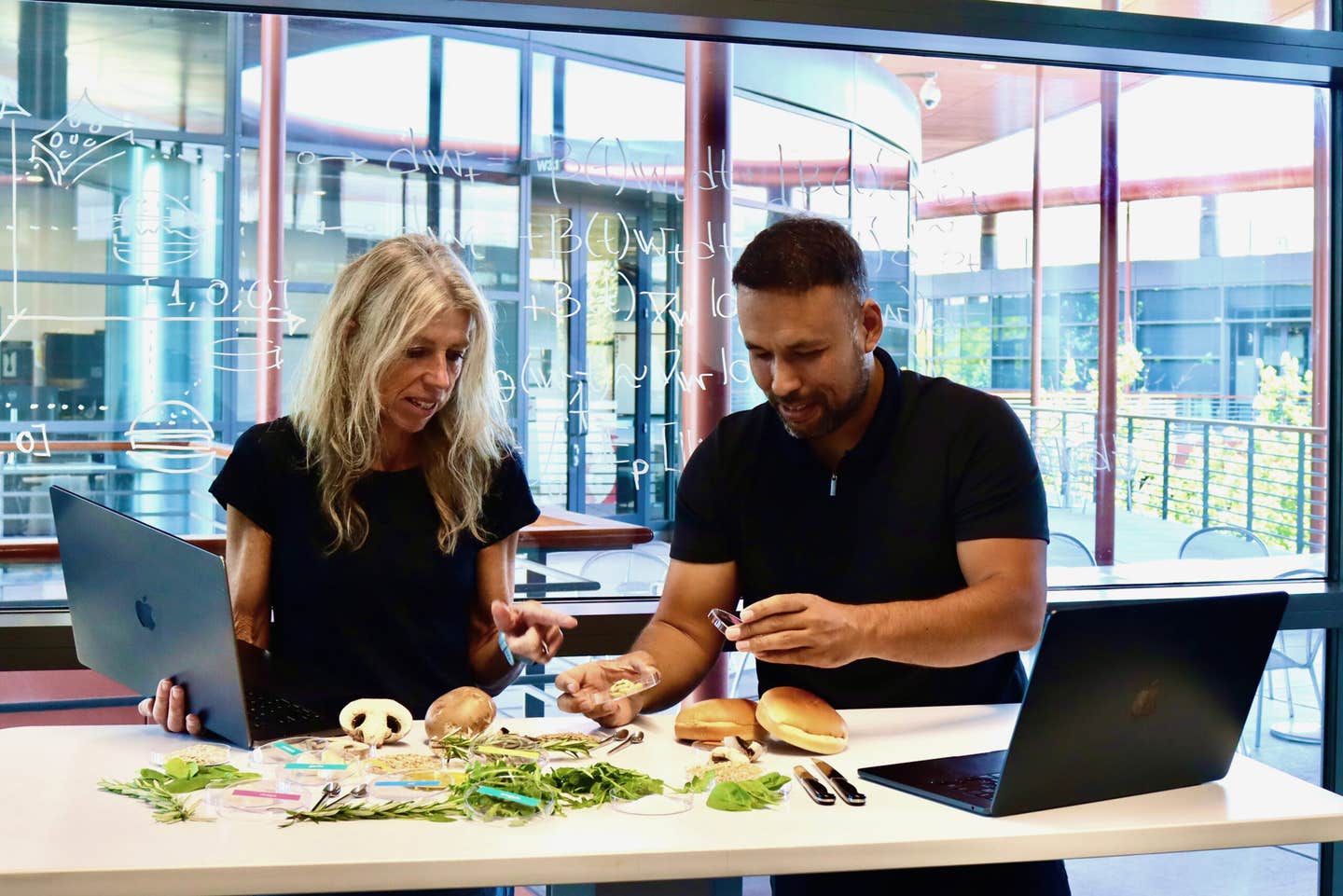
Ellen Kuhl and Vahidullah Tac inspect ingredients for the AI-designed sustainable mushroom burger and discuss the computational model behind BurgerAI. (CREDIT: Jill Sakata Melosh)
Burger menus look simple, but the design space behind them is anything but. Stanford researchers say there may be about 10^43 possible burger recipes, a number so large it helps explain why food design has mostly relied on instinct, habit, and trial and error.
Now a team at Stanford has built an artificial intelligence system that tries to navigate that maze on purpose. Called BurgerAI, the model generates burger recipes from scratch and ranks them not just for taste, but also for nutrition and environmental impact. In blind taste tests, some of its creations matched or outperformed a Big Mac® on flavor, texture, or overall liking, while other versions sharply lowered environmental costs or improved nutritional scores.
The project, led by mechanical engineering professor Ellen Kuhl and postdoctoral researcher Vahidullah Tac, uses burgers as a test case for a bigger idea. Instead of asking AI to predict what already exists, the team wanted it to design something new that satisfies several competing goals at once.
“Most AI systems are trained to predict what already exists. We wanted AI to invent what should exist next,” Kuhl said. “BurgerAI does not ask, ‘What burger is most likely?’ It asks, ‘What burger best satisfies these important and complex objectives?’”
For the Stanford group, food offered a practical place to start. Diet affects both personal health and the environment, and food choices are shaped not only by what is available, but by what people actually want to eat.
“Food choices are some of the most consequential decisions humans make every day,” Tac said. “Food was an easy motivator. With one arrow, you can hit two targets, planetary health and personal health. It’s a great and impactful research area.”
Teaching AI the structure of taste
To build BurgerAI, the researchers trained it on 2,216 burger recipes from Food.com. The system learned patterns in which ingredients tend to appear together, how much of each ingredient is typically used, and how burger recipes are structured overall.
The model combines one system for choosing ingredients and another for deciding quantities. Together, they generate complete burger recipes across a set of 146 ingredients. The researchers reported that the generated burgers closely matched the training data in several key ways, including ingredient popularity, ingredient amounts, recipe length, and correlations between ingredient pairs.
That mattered because the goal was not to spit out random combinations. The team wanted the system to capture the deeper structure of what makes a burger recognizable and appealing.
After showing that the model could reproduce the statistical patterns of human-designed recipes, the researchers generated one million burger recipes and mapped them across three measures: palatability, environmental impact, and nutrition. Burgers with higher palatability scores tended to cluster around more familiar combinations, while unusual combinations scored lower, a pattern the team said was consistent with human culinary preferences.
The work also tested whether the model could rediscover a classic burger without being explicitly taught to copy it. Using a novelty measure called the substantial difference score, where a score of zero means an exact match in ingredients and quantities, the researchers found that BurgerAI could reproduce the Big Mac® even though it was not part of the training set. Across 10 independent runs, it took an average of 7.3 million samples to rediscover it exactly.
Better burgers, not just plausible ones
The more important test came after that. Could the model create new burgers that people would actually enjoy?
To find out, the team selected several AI-designed burgers and had them professionally prepared for a blinded taste test at a San Francisco restaurant. More than 100 diners compared them side by side with a Big Mac®.
Two of the AI-generated entries, called Delicious Burger 1 and Delicious Burger 2, performed especially well. Delicious Burger 1 scored significantly higher than the Big Mac® for flavor, 5.8 ± 1.3 versus 5.4 ± 1.5. Delicious Burger 2 scored significantly higher in overall liking, 5.7 ± 1.2 versus 5.3 ± 1.5, and also higher in flavor, 5.8 ± 1.3 versus 5.4 ± 1.5. Texture ratings for both did not differ significantly from the Big Mac®.
Participants also described the burgers differently. Delicious Burger 1 was more often called meaty, moist, and fatty than the Big Mac®, while Delicious Burger 2 was more often described as meaty and smoky.
“AI did not just generate plausible burger recipes, it created burgers that real people enjoy,” Kuhl said. “That may sound simple, but it means the model learned what makes food appealing to the human palate and was able to navigate a design space with near-infinite possible burger combinations to find real-world solutions.”
Lower impact without giving up taste
The researchers also asked whether the system could create burgers with a much smaller environmental footprint. They measured environmental impact using a combined score based on land use, greenhouse gas emissions, eutrophication potential, and scarcity-weighted water use.
Looking at the training recipes, the team found large differences by protein source. Lamb- and beef-based burgers generally had higher impacts, while poultry- and mushroom-based burgers scored lower.
Among the AI-generated recipes, a mushroom-based burger stood out. Called Sustainable Burger 1, it received an environmental impact score of 0.06, compared with 0.93 for the Big Mac®, more than an order of magnitude lower. A second option, Sustainable Burger 2, used a mushroom-beef blend and scored 1.02, roughly comparable to the Big Mac®.
Taste results showed a trade-off, but not always a harsh one. Sustainable Burger 1 scored lower than the Big Mac® in overall liking, flavor, and texture. Sustainable Burger 2, however, did not differ significantly from the Big Mac® across those categories.
Tac said that result was one of the most surprising.
“We expected some trade-off between sustainability and consumer acceptance,” he said. “But we found a burger with dramatically lower environmental impact could still compete with one of the world’s most successful burgers.”
Nutrition and personalization on the menu
BurgerAI also optimized recipes for nutritional quality using the Healthy Eating Index. In the training data, bean- and mushroom-based burgers generally scored better than beef- and lamb-based recipes.
The model produced a bean-based Nutritious Burger with a Healthy Eating Index of 63.12, nearly double the Big Mac® score of 33.71. It also lowered environmental impact to 0.16, about one-sixth of the Big Mac® score. Compared with the fast-food burger, it improved several components linked to dietary guidelines, including vegetables, whole grains, and plant protein, while reducing refined grains, sodium, and saturated fat.
Still, the healthier burger paid a price in taste. It scored significantly lower than the Big Mac® in overall liking, flavor, and texture. Diners were more likely to describe it as earthy, bland, dry, soft, and grainy, and less likely to call it savory.
That gap matters because the study’s larger point is not that nutrition can be improved in theory. It is that consumer acceptance remains the central obstacle. Sustainable and nutritious foods do not help much if people do not want them.
The system also demonstrated personalization. The researchers generated separate burger recipes for a highly active 15-year-old male and a moderately active 70-year-old female, adjusting ingredients and quantities to reflect age- and activity-specific dietary needs.
Beyond burgers
For Kuhl and Tac, the burger is mainly a proof of concept. They argue that the same framework could help design products in fields that also involve huge design spaces and conflicting objectives, including pharmaceuticals, biomolecules, materials, and engineering systems.
“For centuries, food design has been a matter of intuition, experience, and trial and error,” Kuhl said. “We are beginning to show that AI can transform food design into a quantitative science with applications in other important fields.”
The study also has clear limits. The model learned from existing recipes, which means it inherits the cultural and regional biases of that dataset, most of which reflects Western-style burgers. It considered ingredients and quantities, but not cooking methods, food processing, or chemical changes during preparation that can shape flavor and texture. The environmental and nutritional scores relied on aggregated databases and global averages rather than specific supply chains or farming methods. And the taste tests covered only a limited number of burgers and participants.
Even so, the researchers say food offers a useful model for the future of AI because it ties together sensory experience, health, sustainability, and human choice in a direct way.
“The burger is just the beginning,” Kuhl said. “We see food as a model system for a much larger vision: AI as a partner in scientific and engineering discovery.”
Research findings are available online in the journal npj Science of Food.
The original story "Stanford’s BurgerAI creates burgers that balance taste, nutrition, and sustainability" is published in The Brighter Side of News.
Related Stories
- Scientists create nutritious vegan-meat alternative from sunflowers
- High-fat diets can disrupt gut bacteria and increase anxiety, study finds
- The psychology of food: What our favorite foods reveal about us
Like these kind of feel good stories? Get The Brighter Side of News' newsletter.
Shy Cohen
Writer