Strange hidden forces are shaping a rare three-body exoplanet system
TOI-201 holds a super-Earth, warm Jupiter and brown dwarf in a system shifting on human timescales.

 Edited By: Joshua Shavit

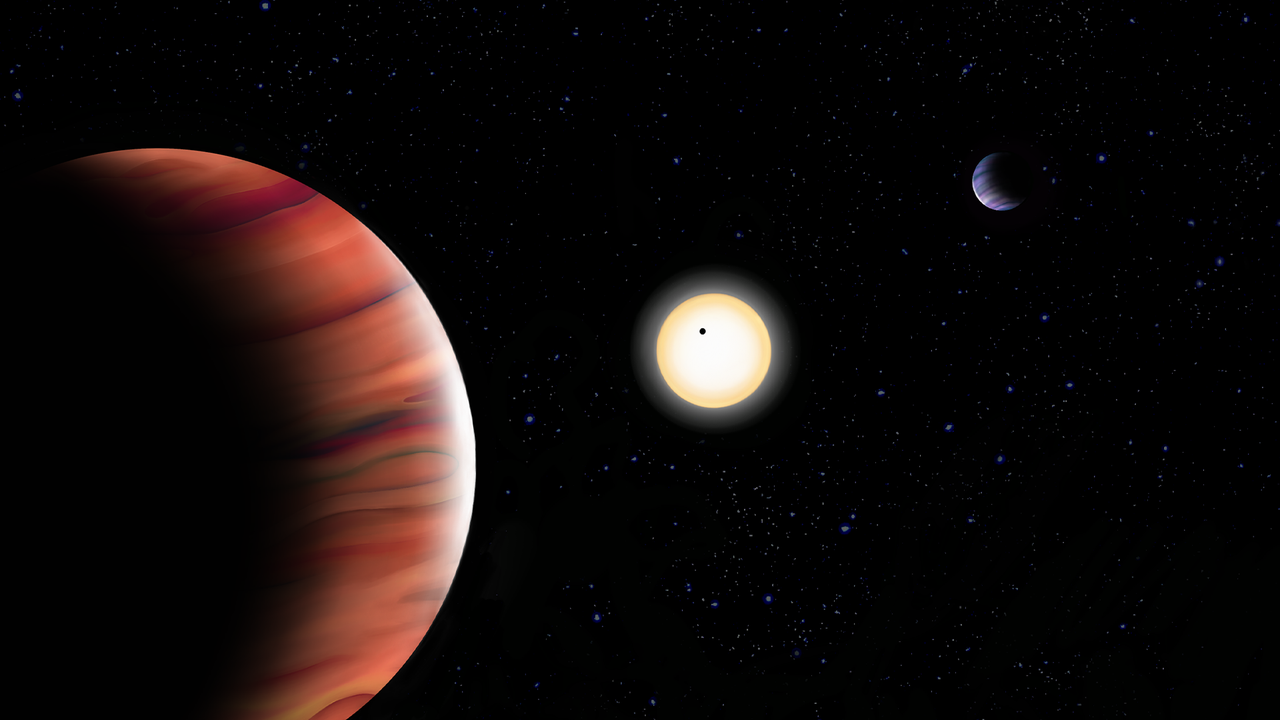
Astronomers confirmed three bodies in TOI-201, a rare exoplanet system changing in real time. An artist rendering of the system. (CREDIT: Tedi Vick)
The strangest part of the TOI-201 system is not that it holds three very different worlds. It is that astronomers can actually watch the arrangement change.
Around a bright F-type star, researchers have confirmed a compact rocky super-Earth, a warm Jupiter and a massive brown dwarf on a long, stretched-out orbit. Together, they form one of the few known planetary systems whose geometry is shifting on timescales people can grasp. This happens not just over millions of years.
“This is one of only a handful of systems where planetary orbits can be watched actively changing on human timescales,” said Ismael Mireles, a PhD candidate in the University of New Mexico Department of Physics and Astronomy. “It offers a rare real-time window into the dynamic lives of planetary systems.”
Mireles led the research with adviser Professor Diana Dragomir. Their team set out to map the TOI-201 system in full, not just to identify what circles the star. Also, they wanted to understand how those bodies tug on one another and reshape the system over time.
What they found is an odd family.
TOI-201 d is a super-Earth, about 1.39 times Earth’s radius and roughly 5.8 times its mass. It whips around its star every 5.85 days, close enough that liquid water is unlikely. TOI-201 b, the warm Jupiter, is about half Jupiter’s mass and completes an orbit every 53 days. Farther out sits TOI-201 c, a brown dwarf with a period of about 2,890 days, or roughly 7.9 years. This makes it the longest-period transiting object yet discovered by TESS.
That outer object may be the system’s chief troublemaker.
A brown dwarf with an outsized role
Brown dwarfs sit in the awkward middle ground between planets and stars. TOI-201 c has a mass of about 15.7 Jupiters, placing it just above the deuterium-burning boundary often used to separate giant planets from brown dwarfs. Yet it still lacks the mass needed to sustain hydrogen fusion like a true star.
“TOI-201 c is unique because of its extremely long orbital period (~7.9 years) and its location in a system with two interior planets,” said Mireles. “Most known transiting brown dwarfs orbit much closer to their stars.”
Its orbit is also highly eccentric. At one point it swings closer to the star than Mars does to the Sun. Then later, it travels farther out than Jupiter. That elongated path, combined with the tilt of the system’s orbital planes, creates a gravitational setup that is anything but quiet.
“The planets’ orbits are tilted relative to each other, and because of that, they’re slowly pulling each other into new orientations,” Mireles said.
That was not what astronomers expected to see.
“This was a surprise, because if planets are born in the plane of the protoplanetary disk that existed early in the life of the star, they are expected to have aligned orbits, like the planets in the Solar System,” Dragomir said. “So the next question to answer for TOI-201 is how these three objects ended up with such tilted orbits.”
The answer is still unclear. The team examined several possibilities. Some common explanations did not fit. Interactions with the disk were ruled out, and a stellar flyby appeared extremely unlikely. Simulations suggested planet-planet scattering could reproduce the present system, but only rarely. The most plausible explanation, the researchers found, involves von-Zeipel-Lidov-Kozai oscillations, driven by a still-undetected outer stellar companion.
That idea remains a hypothesis, not a confirmed fact.
How the system was pieced together
TOI-201 did not give up its structure easily.
The warm Jupiter, TOI-201 b, first emerged as a candidate in 2019 and was later confirmed. A second signal, from the super-Earth TOI-201 d, appeared in 2020 but remained unconfirmed because its radial velocity signal was too weak. Then astronomers noticed something else: a single partial transit in TESS data that did not belong to either known object.
That single event turned out to be a clue to the outer companion.
The team used four main tools to work out what was happening. One was spectroscopy, which tracks the star’s wobble and helps pin down the mass of orbiting bodies. Another was transit photometry, which records the slight dip in starlight when an object crosses in front of the star. The researchers also relied on transit timing variations, tiny shifts in when the warm Jupiter passed in front of the star. Finally, they used astrometry, using Hipparcos and Gaia data to trace slight changes in the star’s position.
“We used multiple spectrographs in Chile: CORALIE, HARPS, and PFS. We also used archival data from the FEROS spectrograph in Chile and MINERVA-Australis in Australia,” Mireles said.
Ground-based observations
Ground-based observations were just as important. The Antarctic Search for Transiting ExoPlanets telescope at Concordia station helped monitor this hard-to-catch system. Observations also came from telescopes from the Las Cumbres Observatory Global Telescope network in Chile, Australia and South Africa.
“Our contribution was enabled by having a telescope in Antarctica,” said Professor Triaud at the University of Birmingham. “Whilst the logistics involved are difficult, the telescope’s unique location and access to optimal astronomical conditions are key to studying exoplanetary systems with long orbital periods such as TOI-201.”
The outer brown dwarf’s transit was especially revealing because it happened near a sudden disruption in the warm Jupiter’s transit schedule. Right after that event, TOI-201 b began crossing the star about 30 minutes later than expected. Those shifts helped confirm that the outer object was not just present, but dynamically involved.
A system changing in plain sight
Most planetary systems are observed as frozen scenes. TOI-201 is different.
According to the team’s simulations, the system is likely stable, though there is a small chance the inner super-Earth could face instability over million-year timescales. More striking is the shorter-term behavior. The orbital tilts are causing the transit geometry to evolve over decades and centuries.
In about 200 years, the super-Earth will stop transiting from Earth’s point of view. A few hundred years after that, the warm Jupiter will also stop crossing the star. Later, the brown dwarf will do the same. Thousands of years in the future, the system will drift back into a transiting arrangement.
That means astronomers are catching TOI-201 during a temporary viewing window.
The next major moment comes sooner. The next transit of TOI-201 c is predicted for March 26, 2031, giving astronomers around the world, and even citizen scientists, a rare chance to gather more data on a body that takes nearly eight years to make a single trip around its star.
“It was truly a multi-year, large team effort to study this system,” Mireles said. “Every new transit observation from ASTEP and LCOGT and every new RV measurement gradually lifted the veil and helped uncover the three-dimensional architecture of the TOI-201 system. And this unique architecture is at the heart of the system’s previously unseen dynamical interactions.”
Practical implications of the research
TOI-201 offers a rare test case for how warm Jupiters, super-Earths and brown dwarf companions can coexist and reshape one another over time. It also gives astronomers a chance to study three-dimensional planetary architecture directly. This is different from inferring it from flat snapshots.
That could sharpen ideas about how giant planets migrate, how orbital tilts develop and how unusual systems evolve long after they form.
Just as important, the system gives observers a real schedule for future follow-up work. The 2031 brown dwarf transit stands out as a key opportunity.
Research findings are available online in the journal Science Advances.
The original story "Strange hidden forces are shaping a rare three-body exoplanet system" is published in The Brighter Side of News.
Related Stories
- JWST observations reveal massive helium clouds escaping from exoplanet WASP-107 b
- JWST spots a lemon-shaped exoplanet orbiting a pulsar — rewriting the rules of planet formation
- Exoplanet TRAPPIST-1e may hold Earth-like atmosphere, JWST finds
Like these kind of feel good stories? Get The Brighter Side of News' newsletter.
Joseph Shavit
Writer, Editor-At-Large and Publisher
Joseph Shavit, based in Los Angeles, is a seasoned science journalist, editor and co-founder of The Brighter Side of News, where he transforms complex discoveries into clear, engaging stories for general readers. With vast experience at major media companies like The Los Angeles Times, Times Mirror and Tribune Publishing, he writes with both authority and curiosity. His writing focuses on space science, planetary science, quantum mechanics, geology. Known for linking breakthroughs to real-world markets, he highlights how research transitions into products and industries that shape daily life.